Clear Sky Science · en
Responses of South Caspian coastal foraminifera to warming: spatial patterns and assemblage shifts
Why tiny sea creatures matter
The Caspian Sea, the world’s largest inland body of water, is warming as the climate changes, and its level is falling. Along its southern shores in Iran, millions of people depend on coastal waters for food, jobs, and tourism. This study focuses on microscopic shell-building organisms called foraminifera that live in the sea-floor mud. Although invisible to the naked eye, they are powerful indicators of environmental change and can help reveal how warming waters may reshape coastal life today and in the future.
A shrinking, warming inland sea
The southern Caspian Sea is heating up faster than many other regions, with surface temperatures that can now reach about 30 °C in summer. At the same time, reduced rainfall and other climate shifts are causing the sea level to drop, altering shorelines and stressing marine habitats. The authors note that this unique ecosystem already faces pollution, erosion, and human disturbance. Against this backdrop, they ask how bottom-dwelling foraminifera along Iran’s coast respond when the water gets warmer, and whether some species are more resilient than others. 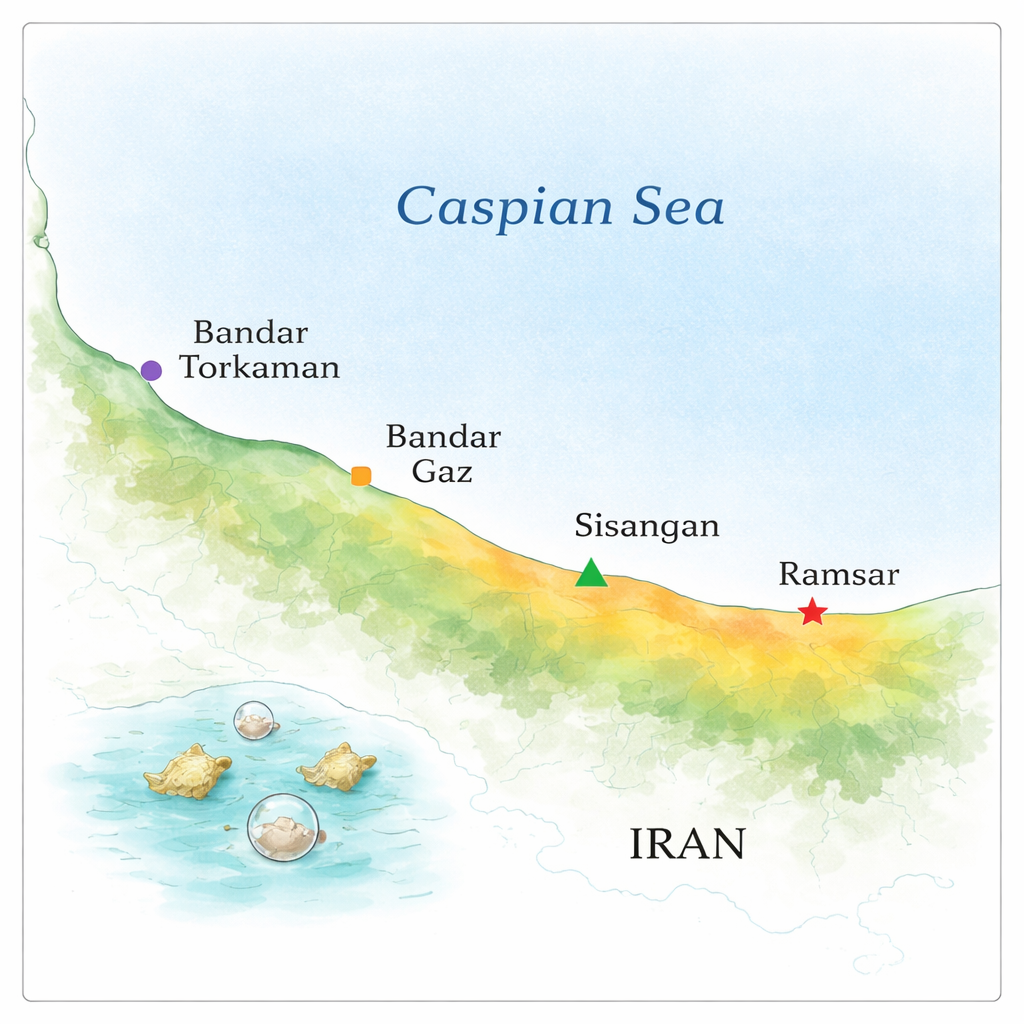
Taking the pulse of the sea floor
In March 2023, researchers sampled shallow sediments at four coastal stations: Bandar Torkaman, Bandar Gaz, Sisangan, and Ramsar. They gently pushed hand-held corers into the nearshore sea floor, preserved the mud, and counted the living foraminifera under microscopes. Seven species were identified, but one—Ammonia beccarii caspica—dominated everywhere. Bandar Gaz stood out with the highest numbers of individuals and the greatest variety of species, while Sisangan had very few. By comparing local conditions such as temperature, oxygen, depth, and grain size, the team showed that environmental differences among sites help explain where these tiny organisms thrive.
A warming experiment in miniature seas
To isolate the effect of temperature, the scientists brought sediment cores from Bandar Gaz into the laboratory and placed them in three large tanks maintained at 24, 27, and 30 °C for 60 days—miniature versions of the coastal seabed. All tanks received filtered Caspian water and constant aeration, and levels of oxygen, acidity (pH), and key nutrients were carefully monitored. These conditions stayed broadly similar across tanks, so temperature was the main factor that changed. After two months, the researchers re-counted the foraminifera and compared their numbers, diversity, and community make-up across the three temperature treatments. 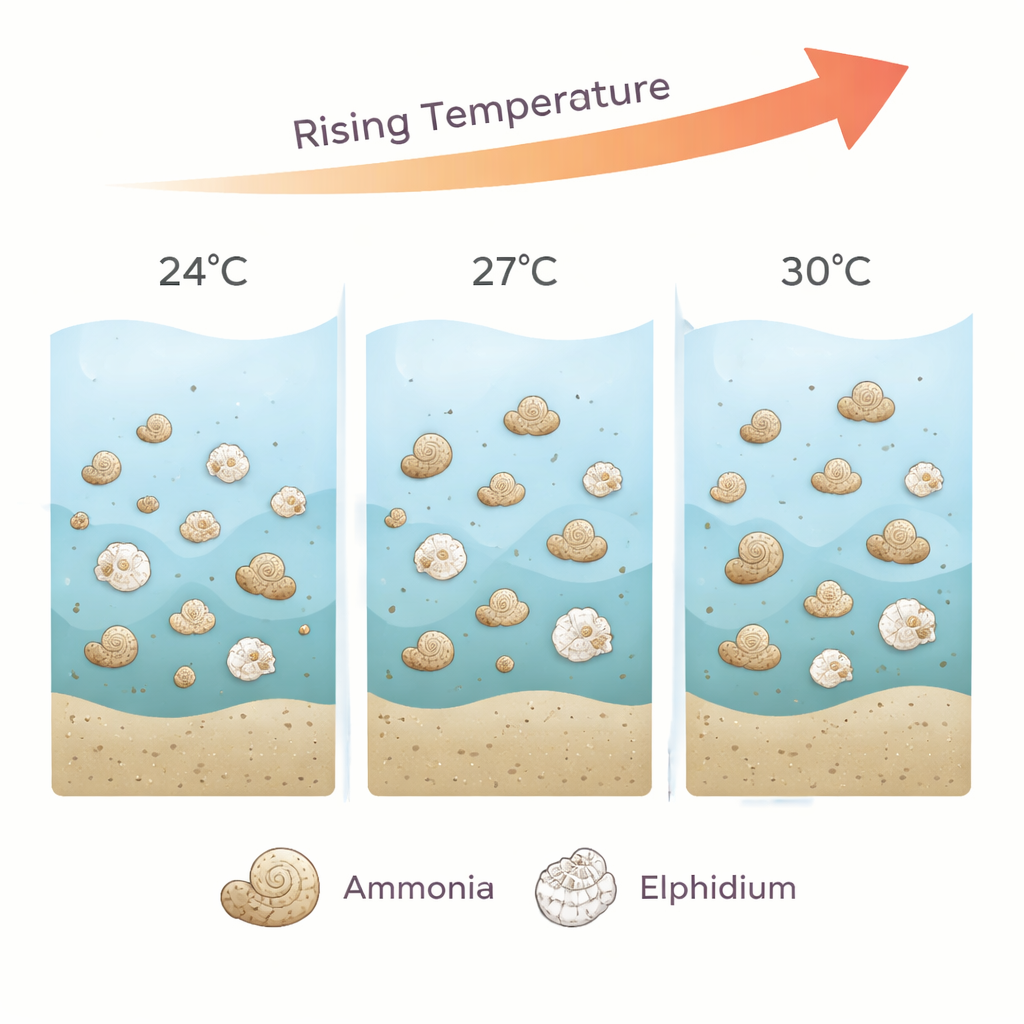
Winners and losers in hotter water
The total number of species barely changed with warming, but who was most common did. The tough Ammonia species proved to be clear winners in hotter water. Ammonia beccarii and Ammonia tepida became more abundant as temperature rose, reaching their highest densities at 30 °C. In contrast, several Elphidium species, which had been important members of the community at cooler temperatures, declined sharply at 30 °C. Measures of how evenly species shared the habitat dropped as warming pushed the system toward just a few dominant, heat-tolerant forms. In other words, the community did not simply “grow” or “shrink” with temperature—it was rearranged.
What this means for a changing Caspian Sea
By combining field surveys with a tightly controlled warming experiment, the study shows that temperature alone can systematically shift foraminiferal communities along the South Caspian coast. If the sea continues to warm, the researchers expect natural assemblages to become more uniform and dominated by resilient Ammonia species, while more sensitive Elphidium species retreat. Such changes could ripple through the coastal food web and alter the way the seabed processes nutrients and organic matter. At the same time, the clear temperature preferences of these species make them valuable natural thermometers, helping scientists reconstruct past climate and monitor the Caspian Sea’s response to ongoing global warming.
Citation: Bagheri, H., Taheri, M. Responses of South Caspian coastal foraminifera to warming: spatial patterns and assemblage shifts. Sci Rep 16, 6863 (2026). https://doi.org/10.1038/s41598-026-38207-1
Keywords: Caspian Sea, climate warming, foraminifera, benthic communities, coastal ecosystems