Clear Sky Science · en
Development and validation of a simple nomogram for predicting knee osteoarthritis using movement evoked pain in a community setting
Why everyday knee pain matters
Knee osteoarthritis is one of the most common reasons older adults struggle to walk, climb stairs, or keep up with housework. Yet by the time joint damage is clearly visible on an X‑ray, much of the harm is already done. This study from community clinics in Hangzhou, China, asks a simple question with big implications: can brief tests of pain during everyday movements, done without any imaging, flag who is likely to have knee osteoarthritis early enough to act?
Looking for clues in daily movements
Instead of starting in big hospitals, the researchers went into 12 ordinary neighborhoods and invited residents aged 40 and older to take part. More than 3,300 people—over 6,700 knees—were assessed. Participants answered questions about their age, exercise habits, and past knee treatments, then completed a set of short movement tests. These tests mimicked common activities: starting to walk after resting, slowly squatting and holding the position, going up and down a flight of stairs, and doing light housework like mopping. After each task, specially trained nurses asked people to rate how much their knee hurt on a simple 0–10 pain scale. 
Turning pain scores into a practical risk tool
The team then compared these movement-evoked pain scores, along with basic background information and treatment history, to knee X‑rays taken the same day. An imaging scale known as the Kellgren–Lawrence grade was used to decide which knees had clear signs of osteoarthritis. About four out of five knees in this older group met that definition. Using statistical methods designed to sift through many possible clues, the researchers picked out nine factors that, together, best predicted which knees showed damage on X‑ray. These included age, whether a person reported regular exercise, pain during squatting, stair climbing and housework, the single highest pain rating across all tests, and whether the person had ever received physical therapy, taken anti‑inflammatory pills, or had medicine injected directly into the joint.
A simple visual chart for front-line clinics
With these nine elements, the researchers built a “nomogram”—a kind of visual scoring chart that lets a clinician draw straight lines to convert each person’s answers and pain scores into a total risk number. When they tested how well this chart distinguished between damaged and relatively healthy knees, it performed strongly in both the main group of knees used to build it and in a separate group reserved for checking its accuracy. In both groups, the model correctly separated higher‑risk from lower‑risk knees nearly nine times out of ten. Additional checks suggested that its predicted risks matched real outcomes closely enough to be useful, and decision analyses indicated that using the chart in everyday practice could help doctors focus follow‑up tests and treatments on people most likely to benefit.
What the findings reveal about pain and lifestyle
The study highlights that pain brought on by movement—especially during squatting, stair climbing, and housework—may be a more telling warning sign than pain felt only at rest. These tasks place load on the joint, and pain during them may reflect early changes in how the knee and nervous system handle mechanical stress, long before severe damage is obvious on imaging. Age understandably raised risk, and certain exercise patterns also seemed linked to osteoarthritis, echoing debates about whether some types or amounts of activity might overstrain the knee. Past use of pain pills and physical therapy appeared more common in people with worse disease, likely because those with more severe symptoms are the ones who seek and receive such care. Interestingly, joint injections showed a modest association with lower apparent risk, consistent with their role in calming inflammation rather than harming the joint. 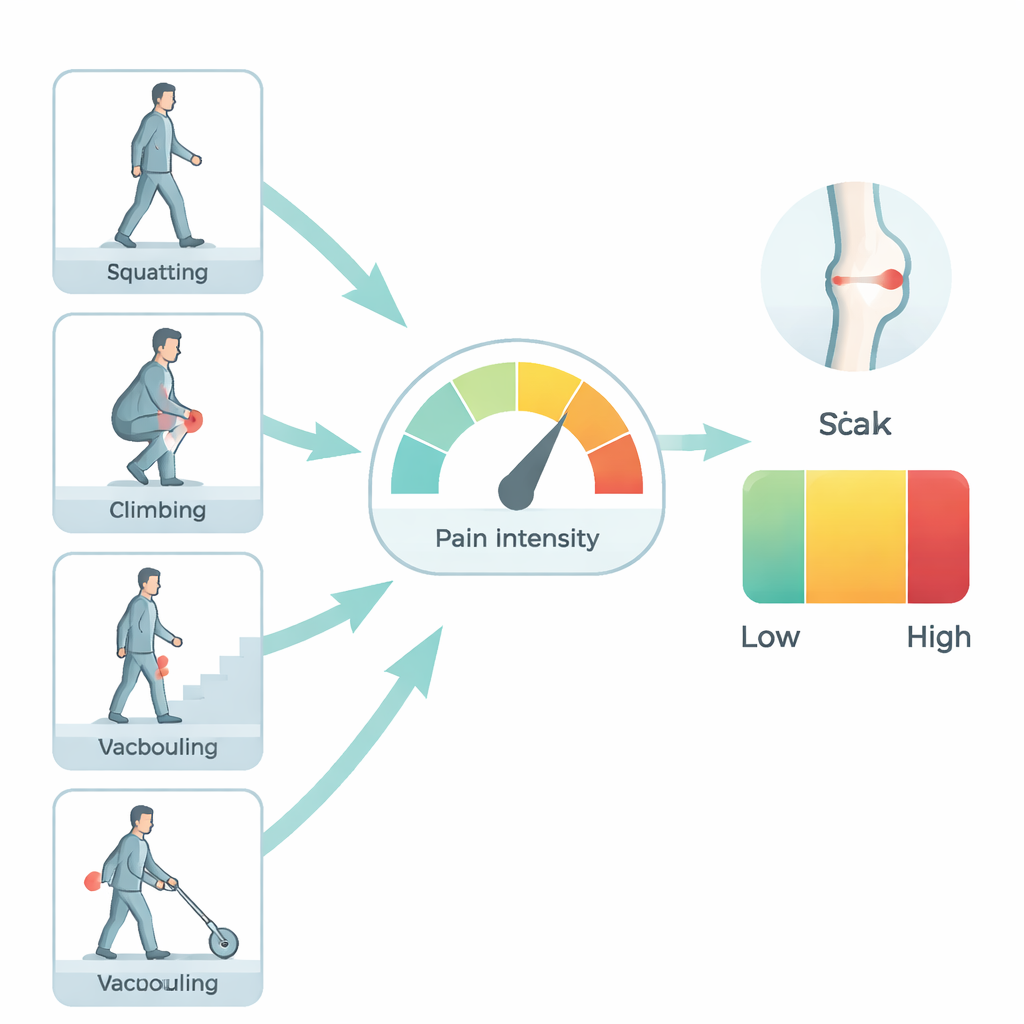
What this means for patients and communities
For people worried about stiff, aching knees—especially when climbing stairs or doing chores—this work suggests that simple, guided movement tests can offer an early window into joint health, even where X‑ray or MRI machines are scarce. The nomogram created here does not replace a doctor’s judgment or detailed imaging, but it offers a quick, visual way for community clinicians to estimate knee osteoarthritis risk and decide who might need closer monitoring, lifestyle advice, or earlier treatment. In plain terms, paying careful attention to how much your knees hurt when you move, and sharing that information with your health provider, could help catch joint problems sooner and keep you active and independent for longer.
Citation: Tang, Y., Zhang, Z., Zhang, W. et al. Development and validation of a simple nomogram for predicting knee osteoarthritis using movement evoked pain in a community setting. Sci Rep 16, 7256 (2026). https://doi.org/10.1038/s41598-026-38204-4
Keywords: knee osteoarthritis, movement-evoked pain, community screening, early diagnosis, risk prediction