Clear Sky Science · en
Experimental and molecular docking analyses of antibacterial activity in moroccan Rosmarinus officinalis essential oil
Kitchen Herb Meets a Global Health Threat
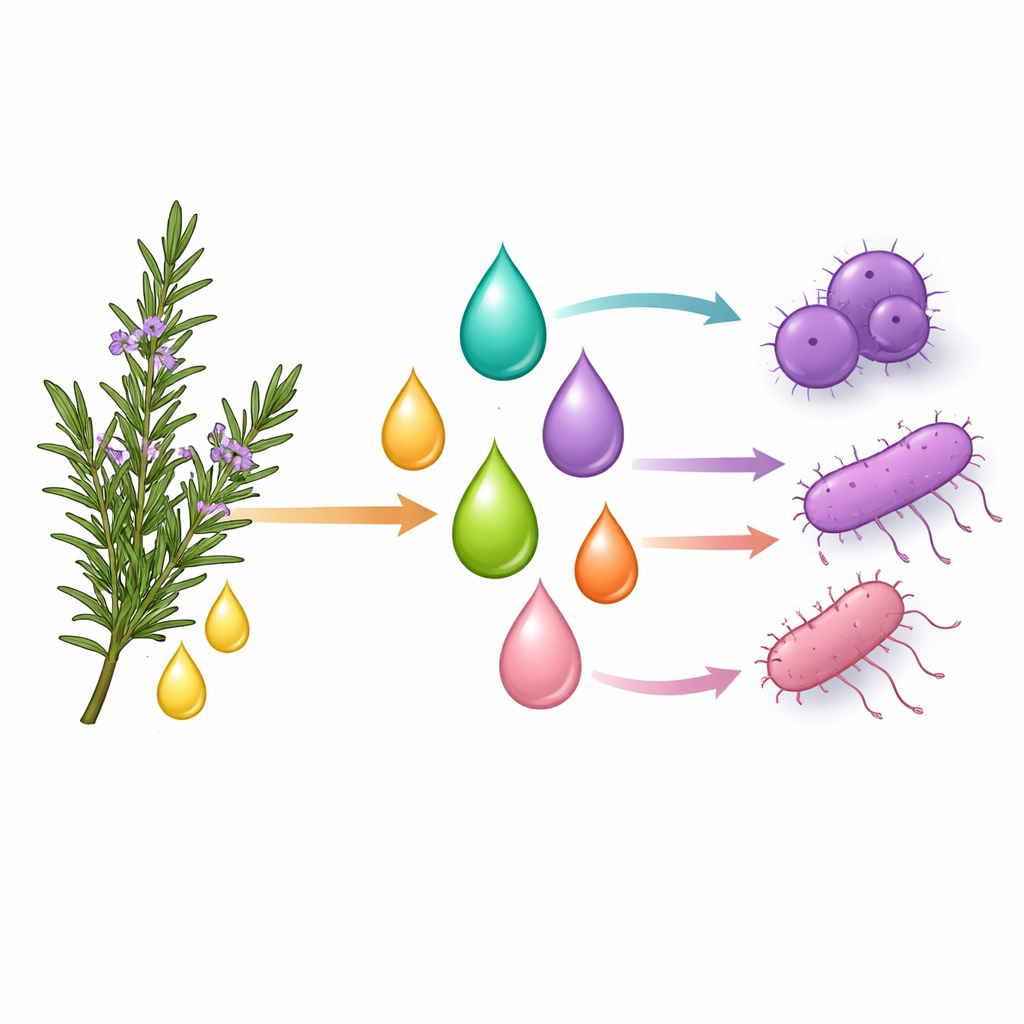
Drug‑resistant infections are rising worldwide, and doctors are running out of safe, effective antibiotics. This study asks a deceptively simple question with big implications: can the familiar kitchen herb rosemary yield compounds that help fight dangerous bacteria in new ways? Focusing on essential oil distilled from Moroccan rosemary, the researchers trace its journey from aromatic plant to laboratory tests, computer‑guided molecular models, and early safety checks, building a case that some of its natural ingredients could become multi‑target antibacterial leads.
Why New Germ Fighters Are Urgently Needed
Antimicrobial resistance now kills more people each year than HIV or malaria, and routine infections caused by bacteria such as Escherichia coli, Citrobacter freundii, Staphylococcus aureus, and Enterococcus faecalis are becoming harder to treat. As older drugs fail, physicians are forced to rely on “last‑line” antibiotics that can be more toxic and are also losing their punch. Because many modern antibiotics hit just one molecular target, bacteria can often evolve a single clever workaround. In contrast, complex natural mixtures, like plant essential oils, tend to attack microbes on several fronts at once, making it more difficult for resistance to arise quickly.
Testing Rosemary Oil Against Tough Bacteria
The team distilled essential oil from rosemary collected in coastal Morocco and tested it against four important bacterial strains using standard lab methods. When paper disks soaked in the oil were placed on bacteria‑covered plates, clear halos formed around them, showing that the oil could halt growth. All four species were affected, with the strongest response seen in Enterococcus faecalis. A second, more quantitative assay showed that the oil could stop growth of every strain and actually kill E. faecalis at roughly twice the growth‑inhibiting concentration, while acting more as a growth‑stopper than a killer for the others. These results confirmed that rosemary oil is not just mildly antiseptic; under laboratory conditions, it can significantly curb some problem microbes.
Homing In on the Most Active Ingredients
Rosemary oil is a crowded chemical “soup,” so the researchers set out to find which portion carried most of the antibacterial punch. They separated the oil into eight fractions using chromatography, then tested each against E. faecalis. Only the most polar, or water‑loving, fraction—called F8—retained clear activity. Chemical analysis by gas chromatography–mass spectrometry revealed that this fraction is dominated by a family of small, oxygen‑bearing molecules known as oxygenated monoterpenes. Six of them—myrtenol, verbenone, p‑cymen‑8‑ol, γ‑terpinen‑7‑al, carvone, and β‑thujone—made up nearly the entire fraction, suggesting that these closely related compounds are central to the observed antibacterial effects, perhaps working together.
Peeking Inside Bacteria With Virtual Models
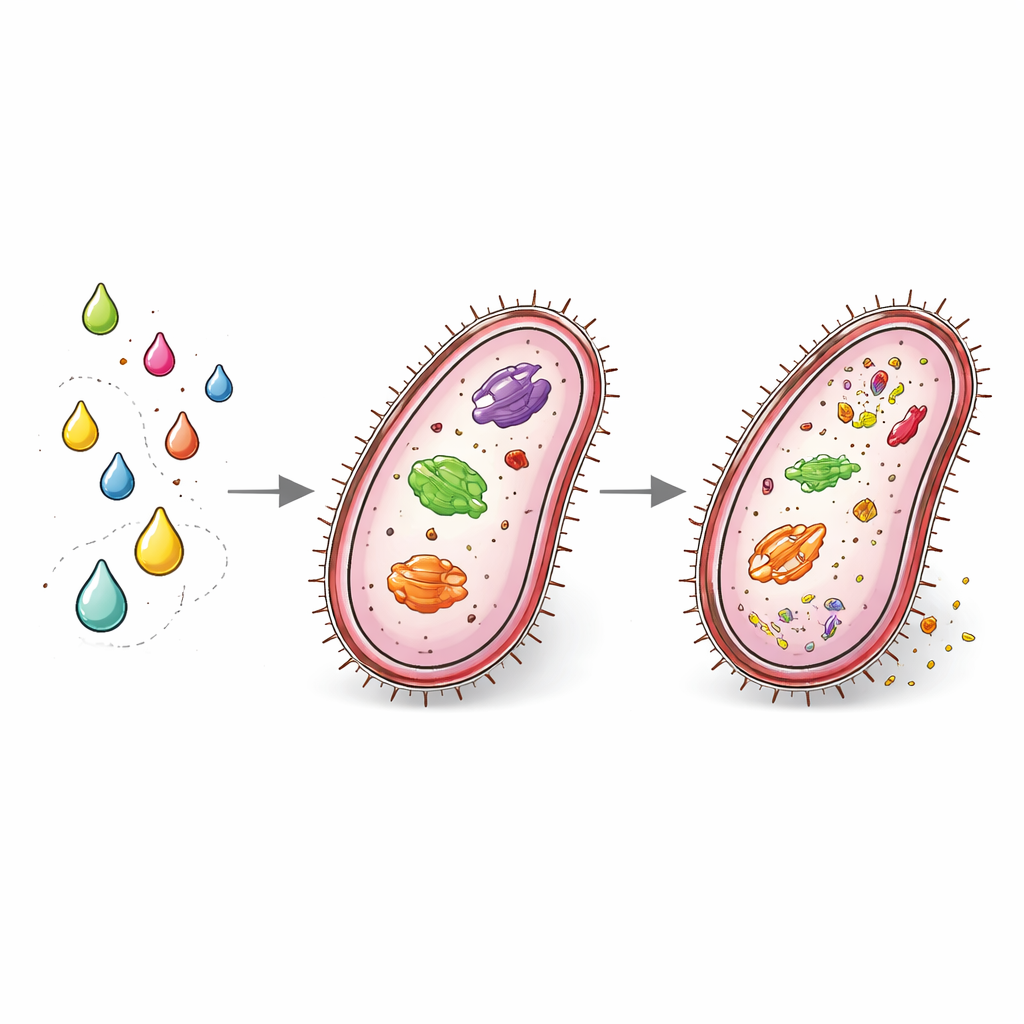
Stopping growth on a plate is one thing; understanding “how” is another. To explore possible mechanisms, the team used computer docking tools to see how the main rosemary molecules might fit into the three‑dimensional structures of crucial bacterial enzymes. They focused on proteins that help build new proteins and copy or repair DNA—processes no bacterium can live without. The simulations predicted that several rosemary components, especially p‑cymen‑8‑ol, carvone, and γ‑terpinen‑7‑al, can nestle into the active pockets of enzymes such as tyrosyl‑tRNA synthetase, DNA gyrase B, L‑methionine γ‑lyase, and NAD⁺‑dependent DNA ligase. While these virtual “matches” are weaker than those of standard antibiotics like ampicillin, they suggest that rosemary’s compounds may subtly jam multiple bits of the bacterial machinery at once.
Early Clues on Safety and Future Uses
Because any future medicine must be both effective and safe, the researchers also ran in‑silico screens of absorption, distribution, metabolism, excretion, and toxicity. The six main monoterpenes are small, fairly fat‑soluble molecules predicted to be well absorbed in the gut, capable of crossing membranes, and free of obvious red flags such as strong DNA damage or heart‑rhythm disruption. At the same time, the models hint at class‑typical cautions: easy entry into the brain and a tendency to irritate or sensitize skin, both well‑known features of many essential oils. These findings support the idea that rosemary‑derived compounds could be turned into pills or perhaps carefully formulated topical treatments, provided later animal and human studies confirm safety.
What This Means for Everyday Life
For non‑scientists, the key message is that a common culinary herb harbors a tightly focused set of molecules that can hinder troublesome bacteria through several weak but coordinated blows, rather than one heavy hit. The study does not mean that kitchen rosemary or bottled essential oil can replace prescribed antibiotics; the experiments were done under controlled lab conditions and the doses were far higher than in cooking or casual aromatherapy. Instead, the work offers a roadmap for turning nature’s chemical diversity into modern, precisely tested antibacterial agents. By isolating an oxygen‑rich fraction of rosemary oil, mapping its main ingredients, and proposing how they might disarm microbes from the inside, the researchers lay groundwork for future enzyme tests, synergy studies with existing drugs, and eventually in‑vivo trials aimed at safer, more resilient treatments for resistant infections.
Citation: Lahlou, Y., Elorchi, S., Dakir, M. et al. Experimental and molecular docking analyses of antibacterial activity in moroccan Rosmarinus officinalis essential oil. Sci Rep 16, 7850 (2026). https://doi.org/10.1038/s41598-026-38203-5
Keywords: rosemary essential oil, antibacterial resistance, natural antibiotics, molecular docking, plant-based medicine