Clear Sky Science · en
Stability of surrounding rock in roadways with fractured rock mass: mechanisms and effects of layout optimization
Why Cracked Rock Matters Deep Underground
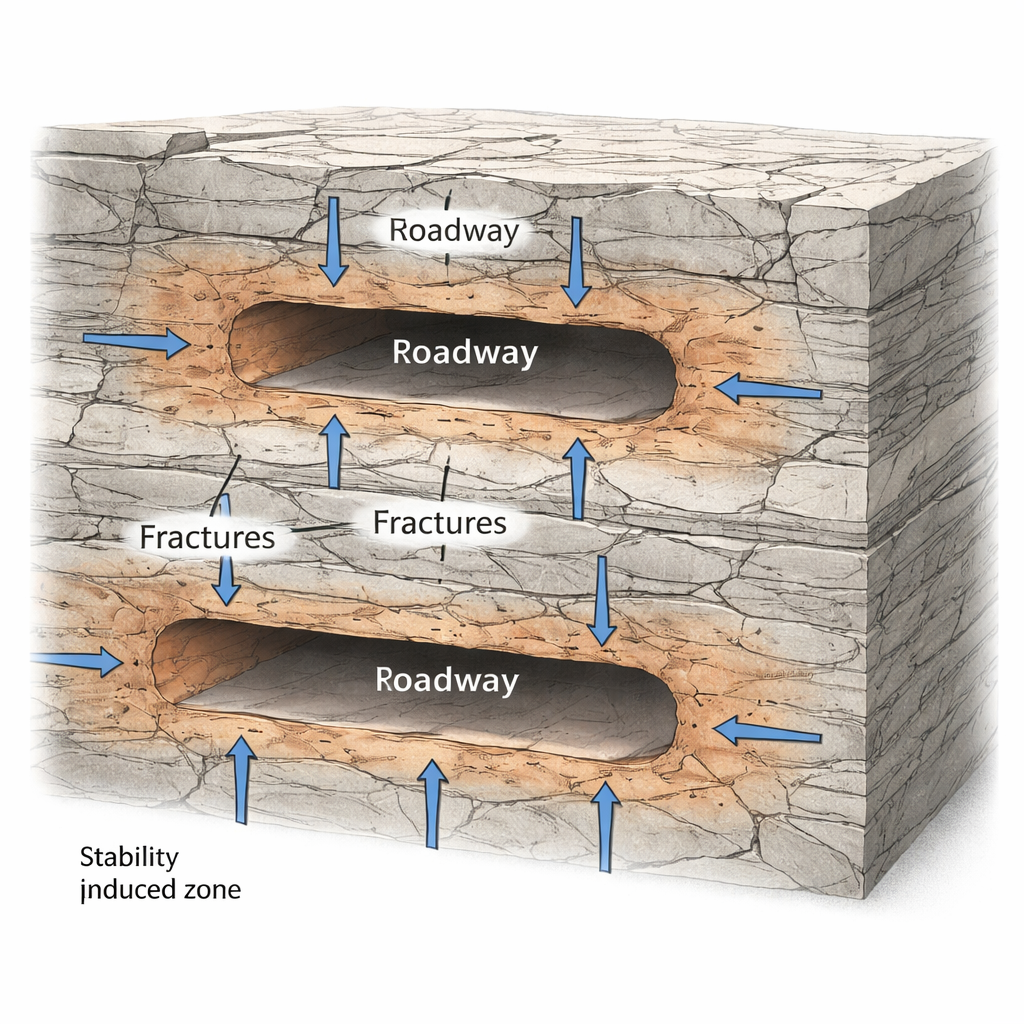
Far below the Earth’s surface, coal mines depend on long tunnels, or roadways, carved through solid rock. These passages must stay stable for workers to travel safely and for equipment to operate. But the rock is rarely perfect: it is cut by natural cracks and joints that can grow and link together under stress, sometimes leading to collapses. This study asks a practical question with life-or-death consequences: how do these hidden fractures behave as mines go deeper, and how can the layout of roadways be optimized to keep the surrounding rock from failing?
How Scientists Recreated Broken Rock
To study this problem in a controlled way, the researchers first created rock-like samples in the laboratory. Instead of using natural rock, which is hard to fracture in a precise way, they cast concrete blocks with a single man‑made crack at different angles, from horizontal to vertical. They checked the quality of each sample using ultrasonic waves, confirming that only the central region contained a clear fracture while the rest of the material stayed uniform. These samples were then squeezed in a testing machine to see how and where new cracks started, how they grew, and how the sample finally broke.
From Tabletop Specimens to Computer Rock
Laboratory tests alone cannot capture the full complexity of real mines, so the team built detailed computer models of the fractured samples using a method called the discrete element approach. In this virtual rock, the material is split into many small polygonal blocks that can slide, separate, or crush against one another—much like real grains of rock. By carefully tuning the model so that its strength and failure patterns matched the physical tests, the researchers could trust it to explore many more scenarios than would be practical in the lab, including how different amounts of surrounding pressure, like that found at greater depths, affect crack growth.
What Happens to Cracks Under Pressure
The simulations and experiments together revealed that the angle of the original fracture strongly controls how damage spreads, especially when the crack is tilted between about 30 and 60 degrees. In this range, new cracks tend to start close to the existing fracture and grow in directions that gradually align with it. As outside pressure increases—similar to going deeper underground—cracking becomes more confined to the immediate neighborhood of the fracture instead of spreading throughout the rock. The overall strength of the samples shows a distinct V‑shaped trend with fracture angle: the rock is relatively strong when the crack is nearly horizontal or vertical, but noticeably weaker at intermediate angles where fractures most easily connect.
Designing Safer Roadway Layouts
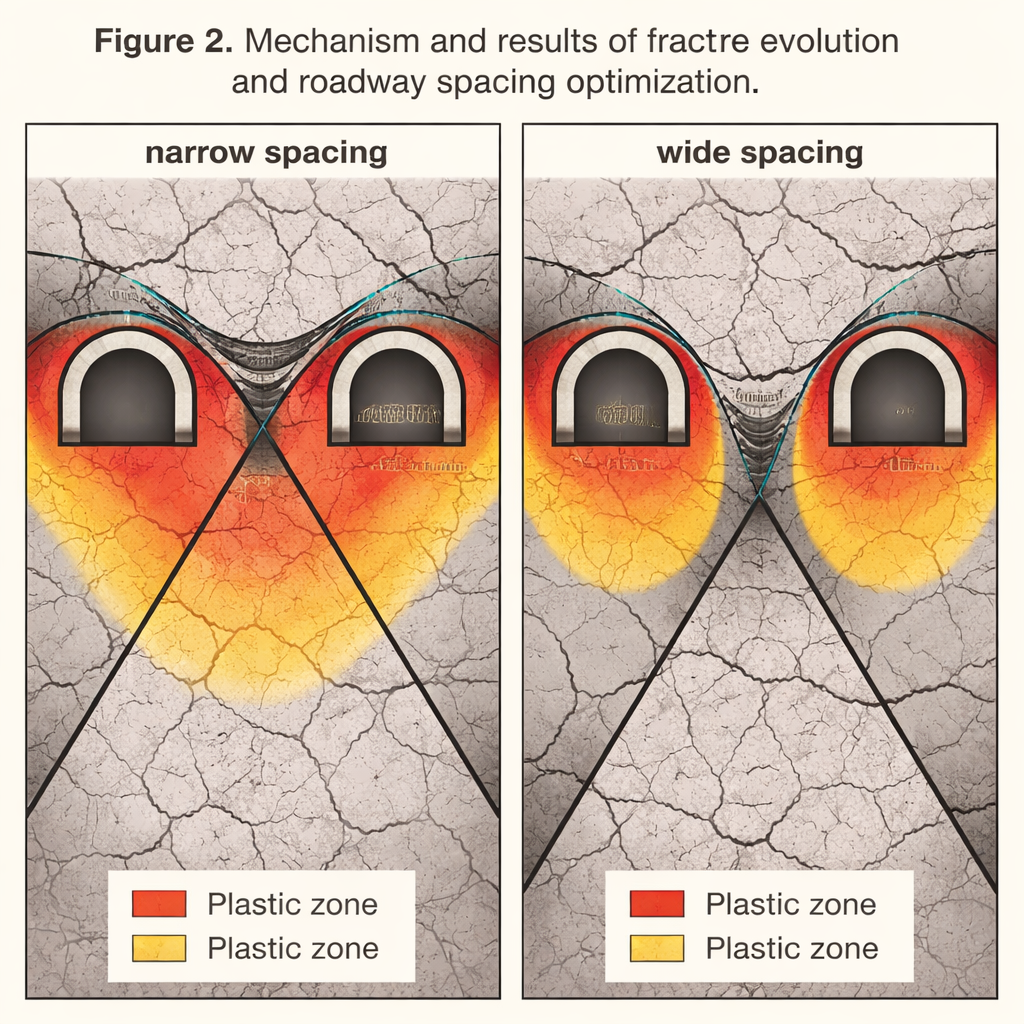
Armed with this understanding at the small scale, the team turned to real mine layouts with multiple nearby roadways. Using their validated models, they simulated how stresses from the weight of overlying rock and from coal extraction cause plastic zones—regions where the rock has yielded and cracked—to form around each roadway. They found that as the overall stress level rises, deformations grow rapidly and plastic zones deepen. When two roadways are placed too close together, these damaged zones can merge, creating a large weakened region that threatens both tunnels. Field borehole imaging from an operating coal mine confirmed the model’s picture: the shallow roof rock above closely spaced roadways was heavily fractured, while deeper rock remained comparatively intact.
What This Means for Coal Mine Safety
The study concludes that there is a practical rule‑of‑thumb for safer design: keeping the spacing between major roadways greater than about five times the roadway radius (or roughly more than 15 meters in the case they studied) helps prevent overlapping fracture zones and improves long‑term stability. It also highlights that high natural ground stresses, combined with the additional stresses created by mining, are the main drivers of fracture growth and deepening damage. In everyday terms, this work shows how careful planning of tunnel positions—guided by both experiments and realistic simulations—can significantly reduce the risk of rock failure, protect workers, and cut maintenance costs in deep coal mines and similar underground projects.
Citation: Hao, H., Tian, B., Li, G. et al. Stability of surrounding rock in roadways with fractured rock mass: mechanisms and effects of layout optimization. Sci Rep 16, 6999 (2026). https://doi.org/10.1038/s41598-026-38202-6
Keywords: coal mine roadways, fractured rock, underground stability, roadway spacing, discrete element modeling