Clear Sky Science · en
Phenotypic classification of opium poppy genotypes (Papaver somniferum L.) based on morpho-phenological traits
Why poppy colors matter
Opium poppy is best known for its role in pain‑relief medicines, but it is also an important food and oil crop. Its flowers and seeds come in many colors, and these colors are tied to traits that farmers and breeders care about, such as seed quality, yield, and the content of valuable alkaloids like morphine and noscapine. Being able to sort plants quickly and reliably by their visible features could speed up breeding programs, reduce waste, and help match each variety to its best use in food or medicine.
From colorful fields to useful data
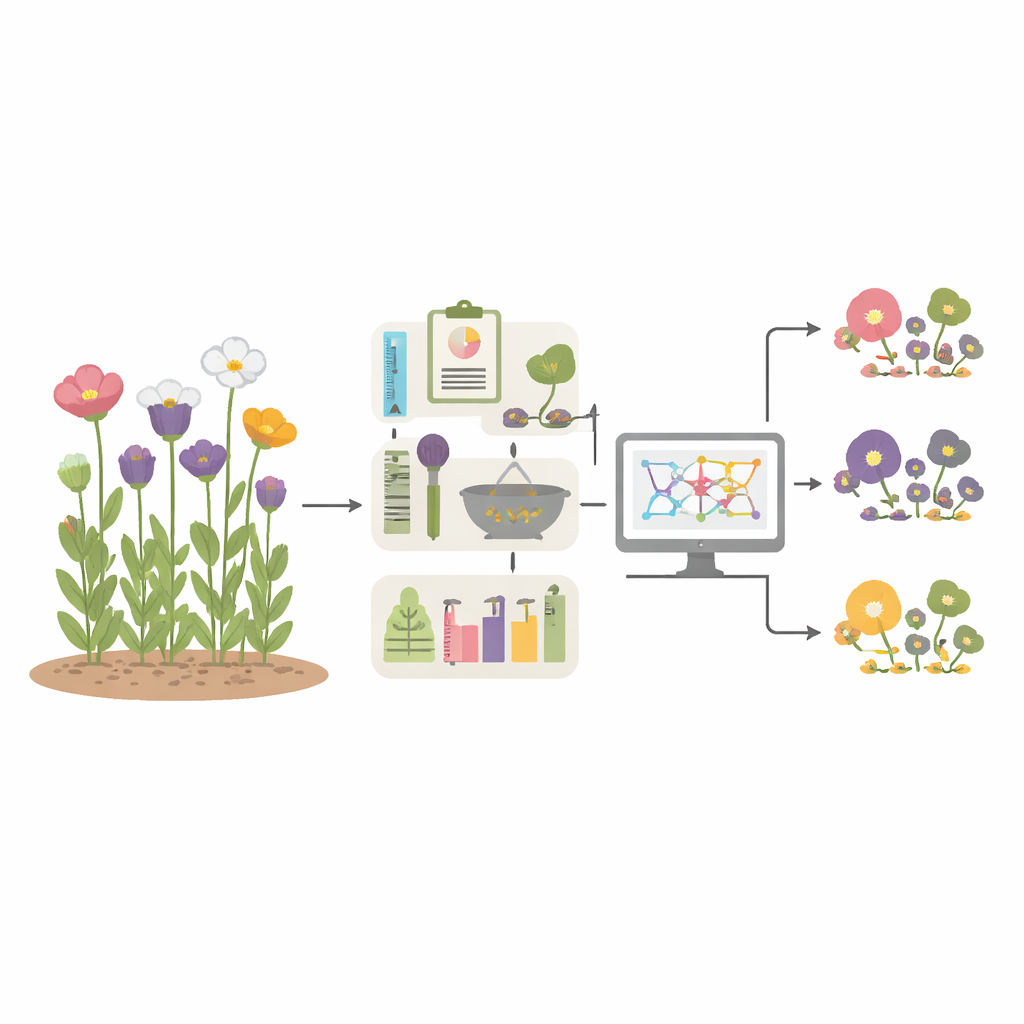
The researchers worked with 23 advanced breeding lines and two standard opium poppy varieties grown over two seasons in Türkiye. In the field they recorded basic growth and yield traits: when plants sprouted, flowered, and matured; how tall they grew; how many seed capsules they formed; capsule size; seed yield; and the proportion of seed in each capsule. They also measured key chemical traits such as morphine and noscapine content and calculated how much of each alkaloid was produced per unit area. Together, these measurements created a detailed picture of each plant’s appearance and performance.
Linking flower and seed colors
Opium poppy flowers can be white, purple, pink, or other shades, and their seed color—blue, white, pink, green, or brown—is genetically linked to the petal color. Because of this connection, the team reasoned that they might be able to predict seed color, which affects market value and end use, simply from plant traits observed earlier in the season. Traditionally, specialists sort seeds and flowers by eye, a slow and subjective process. The study set out to replace this manual inspection with objective models that use measured traits to predict whether a plant belongs to a given flower‑ or seed‑color group.
Teaching machines to recognize plant types
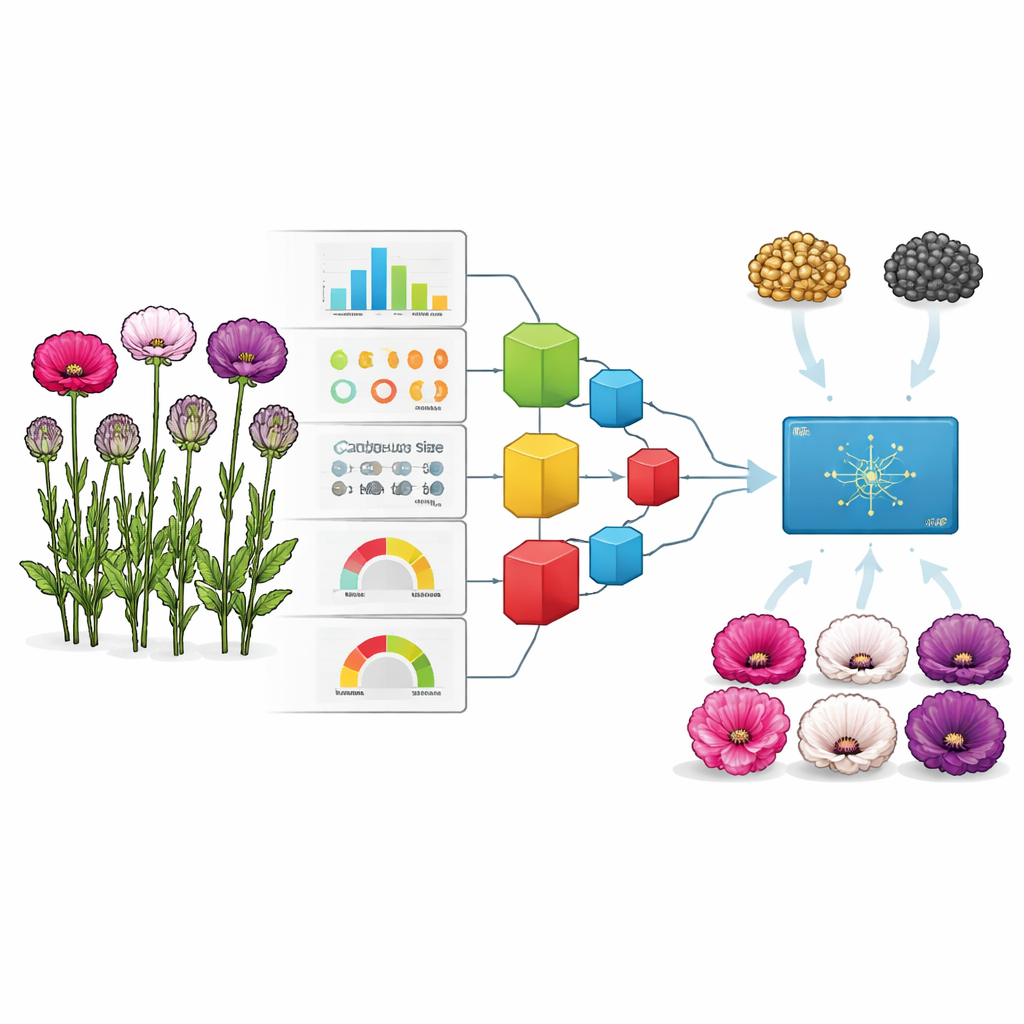
The scientists assembled a dataset of 200 plant records and split it into two parts: 70% for training machine‑learning models and 30% for testing how well those models worked on new cases. Each record included the measured traits plus the known flower and seed colors. They then trained six different classification algorithms, including Naïve Bayes, support vector machines, k‑nearest neighbors, learning vector quantization, and two decision‑tree approaches (bagging CART and Random Forest). The goal was to see which method could best use the trait data to assign each plant to its correct color category.
Which traits and methods worked best
For flower color, the simplest probabilistic model, Naïve Bayes, performed best, correctly classifying 95% of test plants. Support vector machines were almost as accurate at 91.7%. For seed color, which had more categories and was less evenly represented in the data, support vector machines were the top performer, again reaching 91.7% accuracy, while Naïve Bayes achieved about 78%. Decision‑tree methods, often strong in other agricultural problems, struggled here, especially for the rarer green and brown seed types. By examining how traits varied together, a statistical technique called principal component analysis showed that yield and alkaloid production clearly separated purple and white flowers, making them easier for the models to distinguish. In contrast, the less common seed colors overlapped more in their trait patterns, explaining why they were harder to classify.
What this means for breeding and farming
The study shows that a combination of fairly simple plant measurements and well‑chosen machine‑learning tools can reliably sort opium poppy plants by flower and seed color. For breeders, this means faster, earlier decisions about which lines to keep, whether the goal is high‑value dark blue seeds for food markets or particular alkaloid profiles for medicine. For farmers and regulators, it offers a more objective way to characterize and track varieties grown under strict legal controls. The authors argue that expanding these datasets to include more genotypes, environments, and even genetic information could turn color‑based classification into a powerful, routine aid for designing better opium poppy varieties.
Citation: Özgen, Y., Bayraktar, N. & Ozkan, U. Phenotypic classification of opium poppy genotypes (Papaver somniferum L.) based on morpho-phenological traits. Sci Rep 16, 7977 (2026). https://doi.org/10.1038/s41598-026-38198-z
Keywords: opium poppy, machine learning, flower color, seed color, plant breeding