Clear Sky Science · en
A settingless fault detection approach for MVDC network
Why keeping the lights on is getting harder
As our homes, cars, and factories fill with electronics and renewable power sources, the way electricity is delivered is quietly changing. Medium‑voltage direct current (MVDC) networks promise quieter, more efficient grids that connect solar farms, wind turbines, data centers, and neighborhoods. But there is a catch: when something goes wrong on a DC line, currents can rise so quickly that equipment is damaged in a blink. This paper presents a new way to spot and isolate these faults in MVDC networks in less than a thousandth of a second, without relying on delicate preset thresholds that may fail in real‑world conditions.
New roads for direct current power
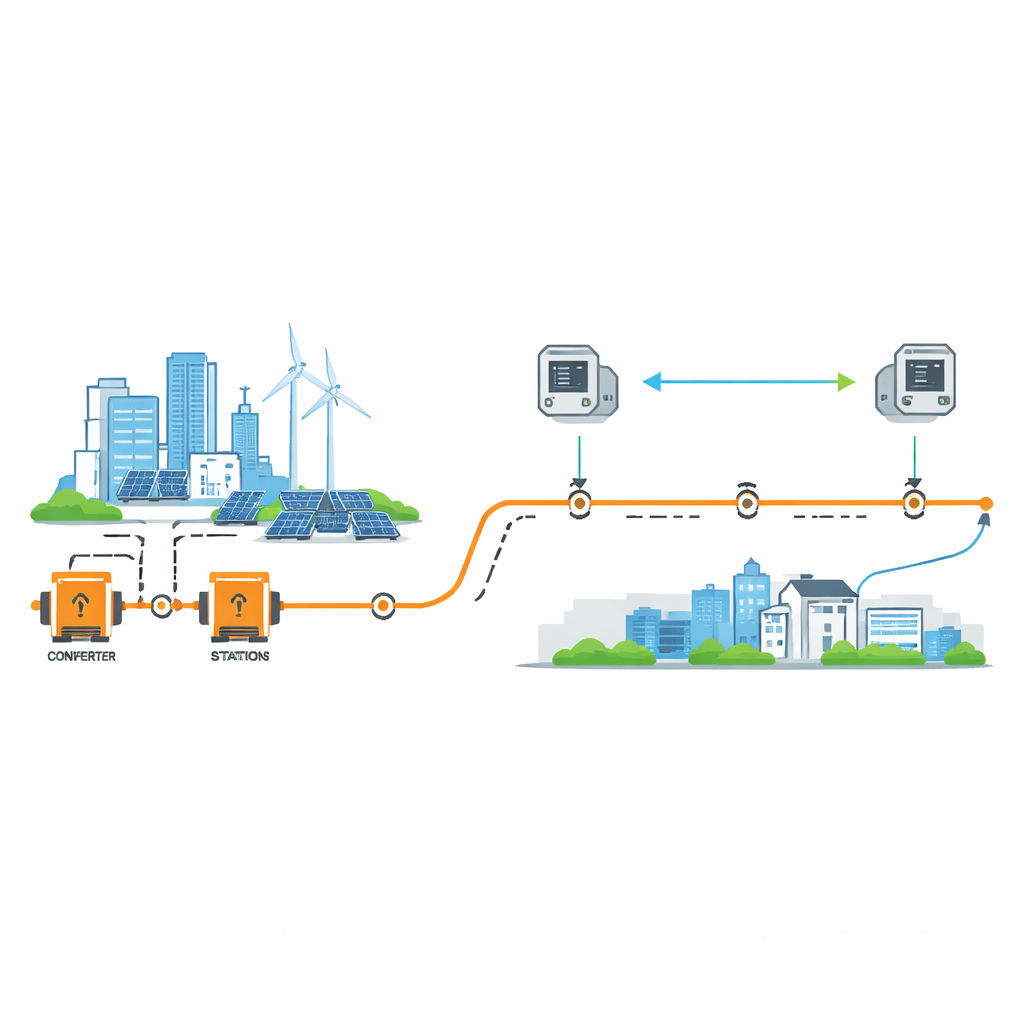
Traditional power grids move electricity using alternating current, where voltage and current constantly change direction. MVDC networks instead use a steady flow of electricity at medium voltage, acting as a bridge between low‑voltage DC inside devices and very high‑voltage DC used for long‑distance transmission. MVDC is attractive because it can reduce losses, simplify connecting renewable energy, and better match the growing share of DC‑based loads such as LED lighting, electronics, and electric vehicle chargers. In the study, the authors model a realistic MVDC system operating at 33 kV that links AC grids, DC and AC loads, and a wind farm through power electronic converters. Keeping such a system safe demands protection schemes that react in milliseconds, even when the behavior of faults is complex and rapidly changing.
Why current tools can misread danger
Many existing protection methods watch local voltages and currents and compare them to preset thresholds. Others compare measurements at both ends of a line through communication links. In practice, these techniques face several hurdles. They can be confused by brief bursts of current from line capacitances, by communication delays, or by high‑resistance faults where the current is too small to obviously stand out. Methods that depend on carefully tuned settings may work well in one network but fail when line lengths, loads, or fault conditions change. Some rely on added hardware such as large inductors or on high‑frequency "traveling waves" along a line, which are difficult to capture in the relatively short cables used in MVDC distribution systems. As a result, protection systems may trip when they should not, or worse, miss dangerous internal faults entirely.
A self‑adjusting way to sense trouble
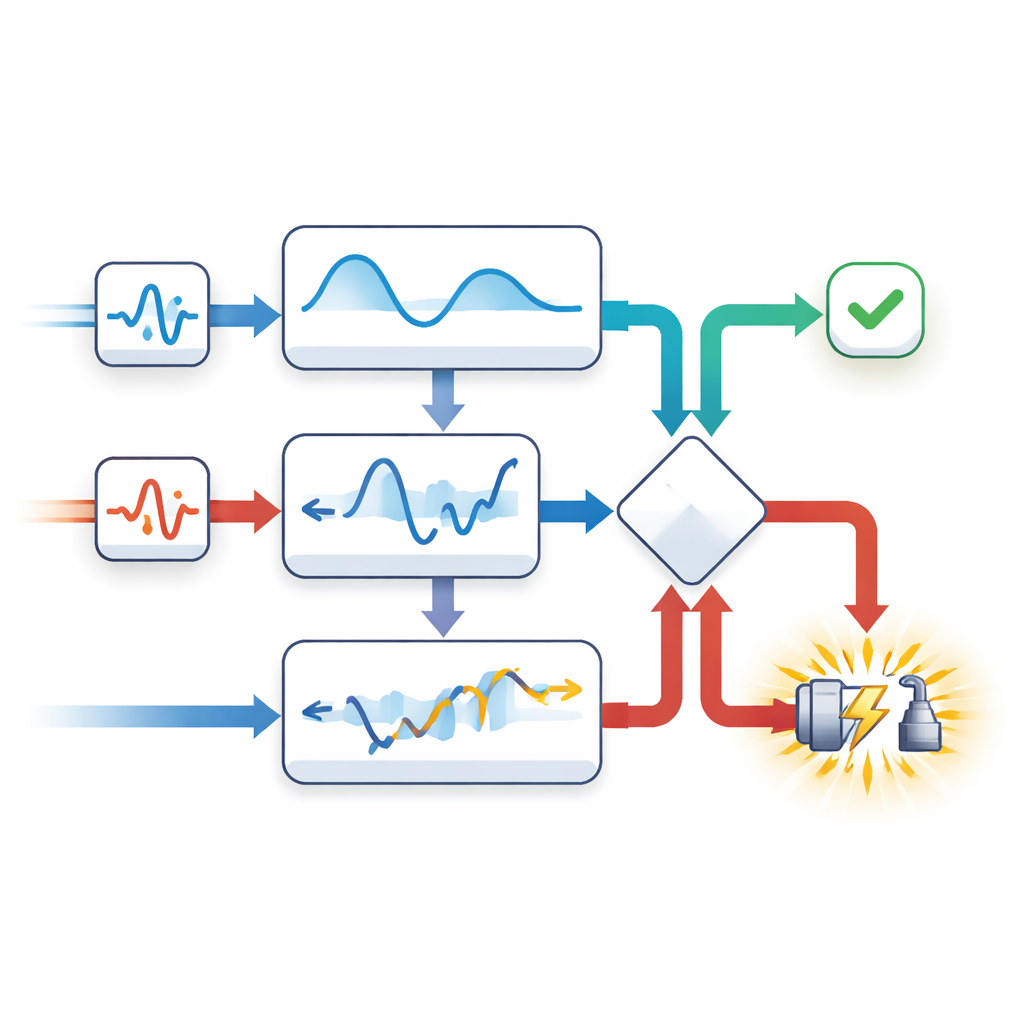
The authors propose a “setting‑less” protection scheme designed to sidestep these weaknesses. Instead of checking raw current magnitudes against fixed limits, it looks at how the difference between currents measured at both ends of a line changes over time. Intelligent electronic devices at each terminal measure the currents, compress them using wavelet‑based signal processing to focus on the low‑frequency part that carries the real fault information, and exchange this compact data via high‑speed digital links (IEC 61850). From these synchronized measurements, each device calculates a simple index based on the rate of change of the current difference in both directions. During healthy operation or external disturbances, this index tends to a positive value, indicating that currents at the two ends behave alike. When a fault occurs within the protected zone, the directions and rates of change of the currents diverge, and the index turns negative, signaling that the associated breakers must open.
One logic for both lines and buses
A strength of the approach is that the same basic index and decision logic can guard both individual lines and entire buses (the junction points where many lines meet). For a line, the scheme compares the changing difference between the two terminal currents. For a bus, it compares the changing balance between all currents flowing into and out of the bus. In both cases, the sign of the index, rather than its absolute size, determines the action. This means there is no need to choose or tune sensitive thresholds for every new network configuration. The method also greatly reduces the amount of data that must be communicated, because devices exchange only processed, low‑frequency components of the currents instead of raw high‑speed waveforms, making it practical for real‑time use.
Putting the method to the test
To see how the scheme performs, the researchers simulate a two‑terminal MVDC network under a wide range of conditions using industry‑standard software tools. They test severe short circuits between poles, faults from a single pole to ground with resistances up to 200 ohms, faults located at different positions along lines and buses, sudden load changes, and disturbances on the connecting AC grids. They also introduce communication delays and strong measurement noise. In each scenario, the devices track the index and determine whether they should trip or stay restrained. The proposed method detects internal line and bus faults in as little as 0.25 to 0.5 milliseconds, correctly ignores AC‑side faults and load changes, and still identifies difficult high‑impedance faults where power flow barely changes. It remains robust even when signals are corrupted by 50 dB of Gaussian noise and when power flows outward from a faulted line segment (outfeed conditions) that often confuse other schemes.
What this means for future power grids
In simple terms, the study shows that it is possible to build a "self‑tuning" protection system for DC distribution that decides based on how currents behave, not on fragile preset numbers. By focusing on the direction and rate of change of current differences rather than their exact size, the proposed scheme quickly distinguishes between harmless disturbances and dangerous internal faults, even under noisy, changing conditions. This could make MVDC networks more reliable and easier to deploy, supporting the broader shift toward cleaner, electronics‑rich power systems where fast, dependable protection is essential.
Citation: Kassem, A., Sabra, H., Ali, A.A. et al. A settingless fault detection approach for MVDC network. Sci Rep 16, 8267 (2026). https://doi.org/10.1038/s41598-026-38187-2
Keywords: medium voltage DC, fault detection, power grid protection, smart grids, renewable integration