Clear Sky Science · en
Effect of cutting process parameters on fatigue properties of quenched and tempered 42CrMo steel
Why the Smoothness of Metal Matters
From wind turbines to high-speed trains, many critical machines rely on steel shafts, bolts, and gears that spin or flex millions of times during their lives. These parts often fail not in one dramatic overload, but slowly, through tiny cracks that grow with each cycle of stress. This study looks at a popular high-strength steel, known as 42CrMo, and asks a practical question with big safety and cost implications: how does the way we cut and finish the metal during machining change how long these parts last before they crack and break?
How Everyday Machining Shapes Hidden Weaknesses
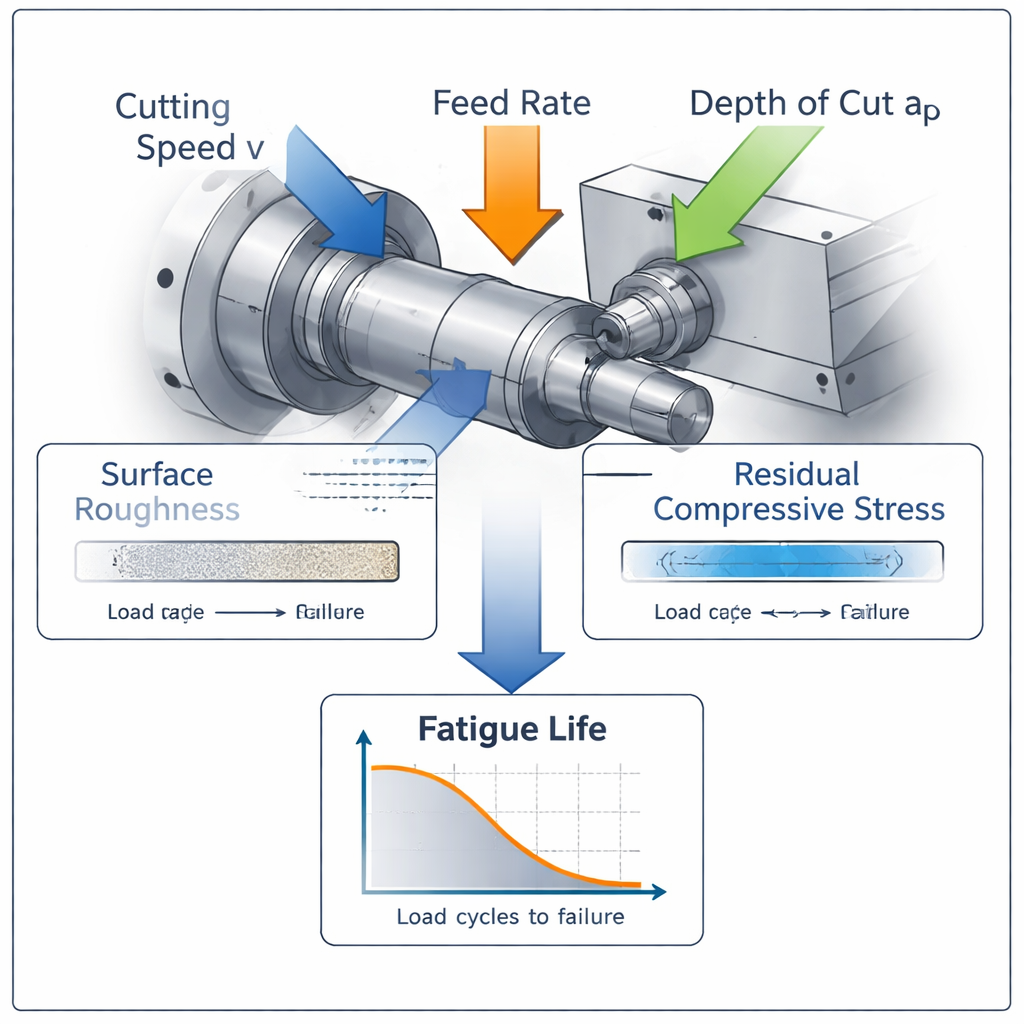
Before a steel shaft ever goes into service, it is turned on a lathe to its final shape. In that step, manufacturers choose three key settings: how fast the tool moves along the part (feed rate), how fast the workpiece rotates (cutting speed), and how deep the tool cuts into the metal (depth of cut). These decisions don’t just affect how quickly the job gets done. They also control the surface finish and the internal stresses locked into the skin of the part—features collectively called “surface integrity.” Rougher surfaces act like tiny notches where cracks can start, while compressive stresses near the surface act like invisible clamps that hold those cracks back.
Testing Steels Under Realistic Bending
The researchers used quenched and tempered 42CrMo steel, a common choice for demanding components, and machined test pieces on a computer-controlled lathe under controlled “wet” (lubricated) cutting conditions. They varied cutting speed, feed rate, and depth of cut one at a time, then measured two crucial outcomes: surface roughness and the residual compressive stress in the outer layer, using a roughness tester and X-ray methods. Next, they chose four representative sets of cutting conditions and made special hourglass-shaped samples, which were then bent back and forth at high stress until they failed, allowing the team to link machining conditions directly to fatigue life: how many cycles each piece could survive.
What Makes a Part Last Longer
The experiments showed that feed rate has a strong effect on how rough the surface becomes: higher feed produces more pronounced tool marks and a rougher finish. Cutting speed, on the other hand, turned out to be especially important for both roughness and the pattern of residual stress. Within a moderate range, higher cutting speeds, combined with coolant, reduced vibration and prevented built-up material on the cutting edge, leading to a smoother surface and stronger compressive stresses in a deeper layer beneath it. Depth of cut had a smaller, more subtle influence. When the team compared the four selected cutting setups, the combination of a relatively high cutting speed and low feed produced parts with a very favorable profile: low roughness, very high surface compressive stress, and a deep protective layer. These parts lasted up to about 95,000 bending cycles—significantly more than parts with rougher surfaces or weaker compressive stress.
Weighing the Two Big Players: Roughness and Stress
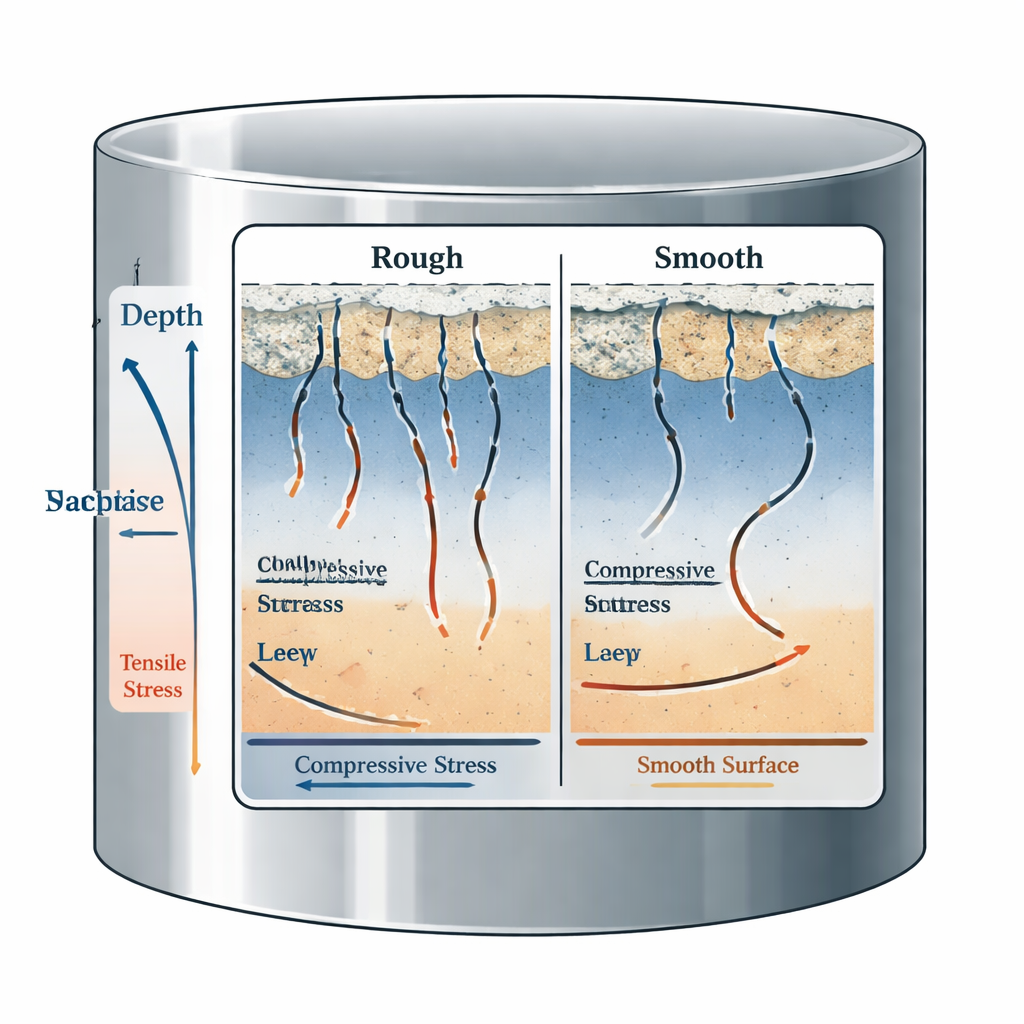
To turn these observations into a practical design tool, the authors built a combined score that mixes surface roughness and residual compressive stress into a single “weighted standard value.” They scaled both measurements to a common 0–1 range, then gave surface roughness a 35% influence and residual compressive stress 65%, mirroring their suspected importance for fatigue life. This score tracked very closely with how long the specimens actually survived in fatigue tests: samples with the highest weighted value consistently showed the longest lives, and those with the lowest value failed the fastest. Microscopic fracture images backed this up, showing that strong compressive stresses and a deep stress gradient slowed crack growth even when the surface was not perfectly smooth, while good roughness alone could not compensate for weak compressive stress.
What This Means for Real Machines
For non-specialists, the message is straightforward: how you cut steel can be just as important as what steel you choose. By choosing machining settings that create a reasonably smooth surface plus a strong, deep compressive stress layer, manufacturers can greatly delay the tiny cracks that eventually lead to failure. The study’s weighted scoring method offers engineers a simple way to balance these two effects when tuning cutting speed, feed rate, and depth of cut. In practice, this means safer, longer-lasting bolts, shafts, and gears—without changing the material at all, just by machining it more intelligently.
Citation: Tang, K., Zhu, J., Yin, B. et al. Effect of cutting process parameters on fatigue properties of quenched and tempered 42CrMo steel. Sci Rep 16, 6962 (2026). https://doi.org/10.1038/s41598-026-38185-4
Keywords: metal fatigue, machining, surface roughness, residual stress, high-strength steel