Clear Sky Science · en
Mechanical properties and durability of concrete with zeolite and waste ceramic powder through experimental investigation and machine learning analysis
Turning Trash Tiles into Tougher Concrete
Concrete is everywhere: in our homes, bridges, and city streets. But making cement, the glue that holds concrete together, is energy‑hungry and a major source of carbon dioxide. At the same time, mountains of broken ceramic tiles from construction and demolition end up in landfills. This study explores a way to tackle both problems at once—by replacing part of the cement with natural volcanic minerals and finely ground waste ceramics, then using machine learning to predict how well this greener concrete will perform.
Why Rethink the Ingredients of Concrete?
Cement is the most expensive and environmentally damaging part of concrete. Producing it burns large amounts of fuel and releases CO2. Meanwhile, the ceramic tile industry generates millions of tons of waste each year that is hard to recycle by conventional means. The researchers looked at two promising substitutes that can partially stand in for cement: natural zeolite, a reactive volcanic mineral, and waste ceramic powder made from discarded tiles. Both are rich in silica and alumina, which can react with by‑products of cement hydration to form extra binding gel, potentially making concrete stronger and less permeable to water and salts. 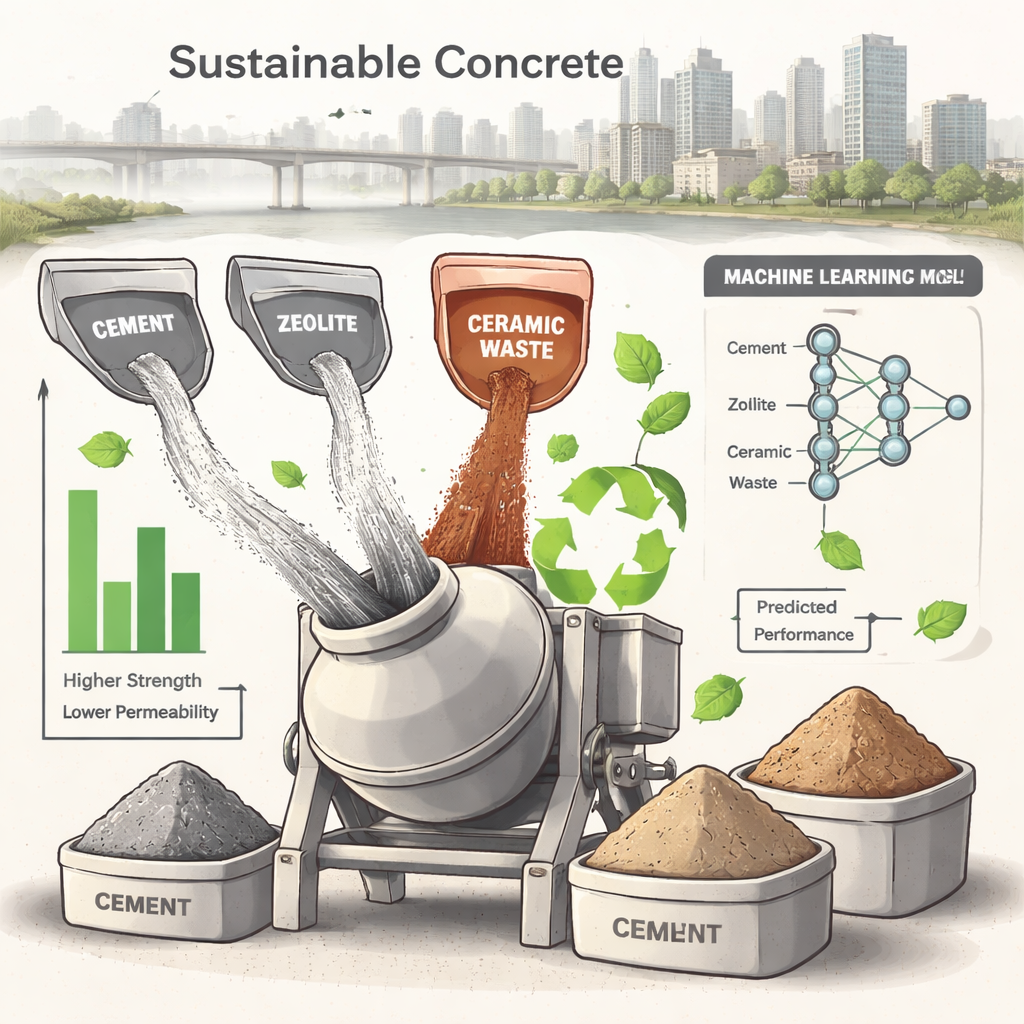
Designing and Testing the New Mixes
The team prepared thirteen different concrete recipes. They kept the water content and sand and gravel the same, but systematically replaced part of the cement with zeolite (5%, 10%, or 15%) and ceramic powder (0%, 10%, 20%, or 30%). For each mix, they cast standard specimens and cured them in water for up to 91 days. They then measured key properties that matter for real structures: compressive strength (how much load the concrete can bear in crushing), tensile and flexural strength (how well it resists cracking and bending), how much water it absorbs, and how easily chloride ions—like those from road salt or seawater—can penetrate. The chloride resistance was evaluated with a standard rapid test that measures the electrical charge passing through a concrete slice over six hours.
Stronger, Less Leaky, and More Durable Concrete
The experiments showed that blends of zeolite and ceramic powder can outperform ordinary concrete when the proportions are chosen carefully. A mix with 15% zeolite and 10% ceramic powder delivered the best overall mechanical behavior, boosting compressive, tensile, and flexural strength at all test ages compared with the conventional mix. At the same time, this hybrid concrete absorbed far less water—up to about three‑quarters less after 91 days—meaning its internal pore network became much tighter. For protection against corrosive salts, an even more aggressive replacement (15% zeolite and 30% ceramic powder) gave the most impressive result: the measured electrical charge related to chloride penetration dropped from about 3200 coulombs in the control concrete to roughly 425 coulombs, shifting the material into the "very low" permeability category used by engineers.
What Happens Inside the Concrete
Microscopic chemistry explains these gains. Both zeolite and ceramic powder contain finely divided, amorphous silica and alumina. Inside the moist concrete, they react with calcium hydroxide, a relatively weak and soluble by‑product of cement hydration. This reaction forms additional calcium‑silicate‑hydrate and related gels—the same glue that gives concrete its strength. These gels fill and refine the pore system, thicken the contact zone between the paste and the gravel, and reduce the number of pathways through which water and chloride ions can travel. In effect, the waste ceramic particles act as both micro‑fillers and reactive ingredients, while the zeolite provides highly active surfaces that drive the chemical reactions forward. 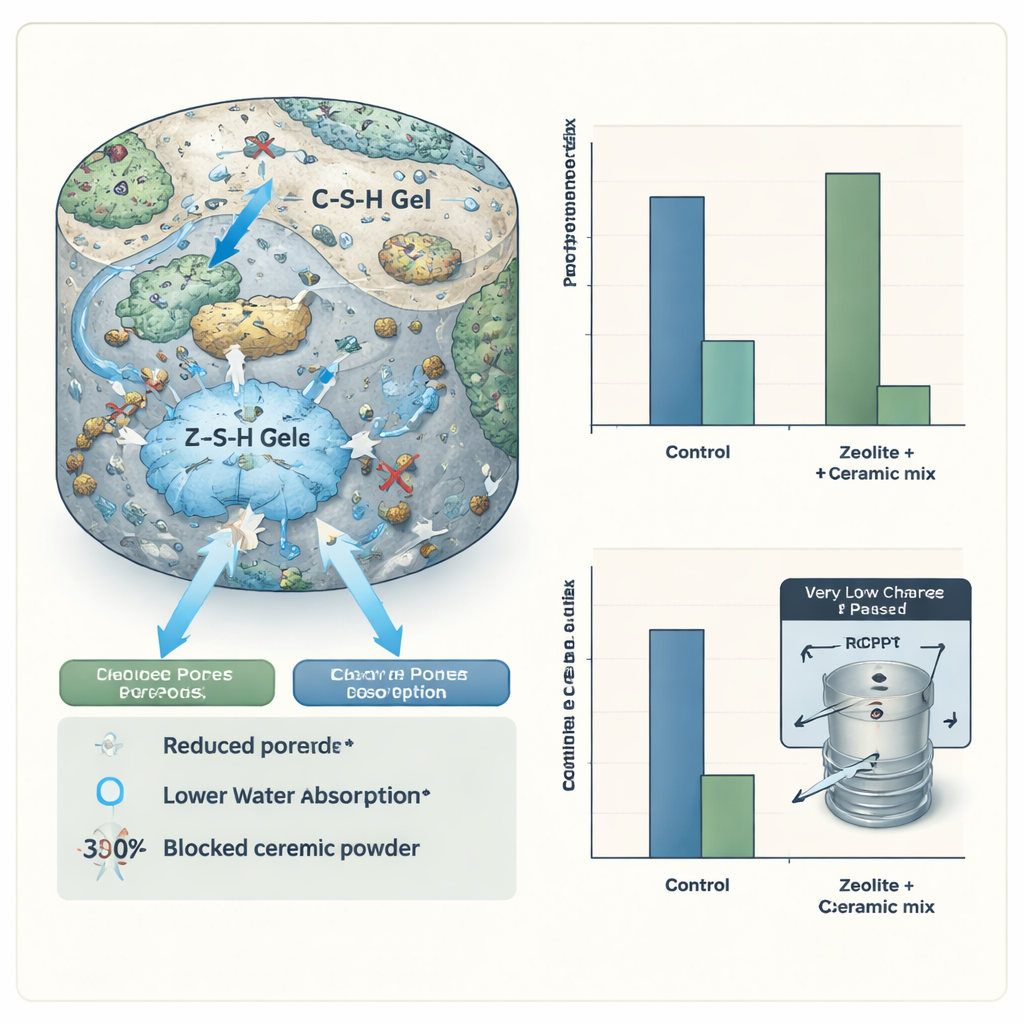
Letting Computers Predict Concrete Performance
To move beyond trial‑and‑error in the lab, the researchers trained several machine‑learning models on their test data. The models took as inputs the curing time and the percentages of zeolite and ceramic powder, and learned to predict compressive strength. Among the approaches tested, an algorithm called XGBoost—a type of boosted decision‑tree method—gave the most accurate forecasts, with a high degree of agreement between predicted and measured strengths. This suggests that, once trained on a modest experimental dataset, such models can help engineers quickly explore many possible combinations of natural and waste‑based additives, narrowing down the most promising mixes before casting any concrete.
What This Means for Everyday Structures
For a non‑specialist, the bottom line is that this study points to a practical recipe for greener, longer‑lasting concrete. By swapping a significant share of cement for natural zeolite and finely ground waste tiles, it is possible to cut cement use, recycle an industrial by‑product, and at the same time make concrete that cracks less easily, absorbs far less water, and is much more resistant to salt attack. Coupled with machine‑learning tools that can guide future mix designs, this approach offers a pathway toward roads, bridges, and coastal structures that are both more sustainable and more durable over their service life.
Citation: Nasr, D., Babagoli, R. & Bidabadi, P.S. Mechanical properties and durability of concrete with zeolite and waste ceramic powder through experimental investigation and machine learning analysis. Sci Rep 16, 7413 (2026). https://doi.org/10.1038/s41598-026-38184-5
Keywords: sustainable concrete, waste ceramic, zeolite, durability, machine learning