Clear Sky Science · en
Earliest direct evidence of trophic interactions between terrestrial apex predators and large herbivores
When Giant Plant-Eaters First Faced Big Hunters
Long before dinosaurs ruled the Earth, the first large plant‑eating animals appeared on land—and so did the predators that fed on them. This study looks at rare, direct evidence of those early clashes: bite and chew marks preserved on 280‑million‑year‑old bones. By reading these marks like forensic clues, scientists can reconstruct who was eating whom, and how the first complex land‑based food webs began to take shape.
The Earliest Big Plant Eaters
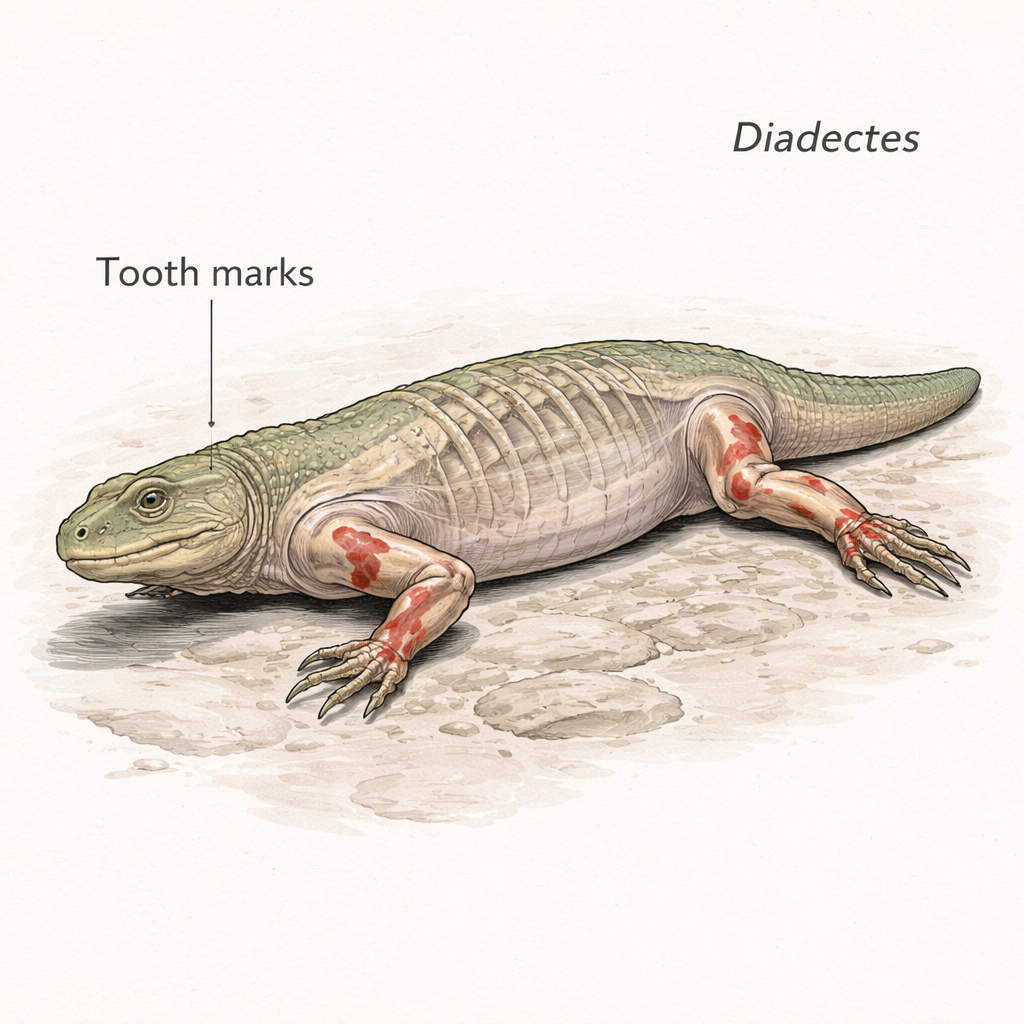
The focus of the research is Diadectes, a stout, low‑slung herbivore that lived in what is now Texas during the early Permian period, long before true dinosaurs appeared. Diadectes was among the first land vertebrates able to chew and digest tough, fibrous plants, opening up a new way of life as a large‑bodied plant‑eater. That new lifestyle made it an attractive food source for the era’s top hunters, including sail‑backed meat‑eaters like Dimetrodon and sleek reptile‑like predators such as Varanops, as well as large amphibians. Until now, scientists had fossils of these animals, but almost no physical proof of how they actually interacted.
A Flooded Graveyard Full of Clues
The key evidence comes from a site called Mud Hill, part of the Vale Formation in Texas. In 1997, construction of a dam exposed a jumble of fossil bones that appear to have been washed together in a sudden flood, then left exposed before final burial. Among them were limb bones and hip bones from at least three young Diadectes individuals. Although the skeletons were somewhat damaged by both ancient processes and modern excavation, many limb elements were well preserved. Careful preparation and close inspection revealed that these bones were covered with a surprising variety of marks left by teeth and by tiny borers, turning the site into a time capsule of feeding and decay.
Bite Marks That Tell a Feeding Story
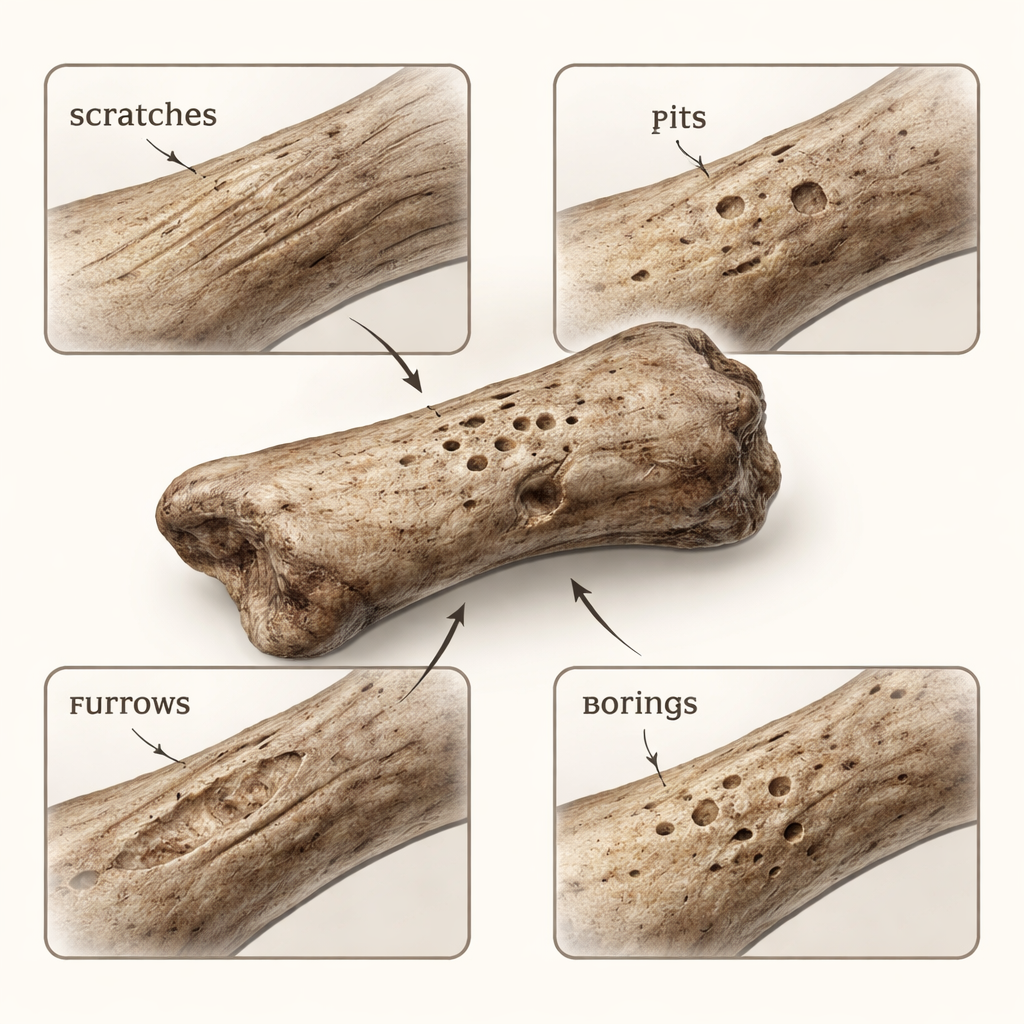
Under magnification, the researchers grouped the marks into several types. There were narrow scratches that run along the length of the bones, deeper pits, broad gouges or furrows, and sharp punctures that sometimes align in rows like a jaw outline. Many marks cluster around the ends of limb bones and in joint regions that were rich in cartilage, rather than in the meaty midsections usually targeted first by predators. This pattern, along with shallow, smooth‑walled marks, suggests repeated tugging, ripping, and gnawing on leftover soft tissues rather than a rapid, flesh‑tearing kill. The team also found tiny round holes—borings—likely produced by insect larvae tunneling into the last remaining tissues during decomposition.
Reconstructing the Hunters
By comparing the shape and depth of the marks with teeth from known animals in the same rock layers, the authors infer that more than one kind of predator or scavenger fed on these carcasses. The strongest candidates include Dimetrodon and Varanops, whose robust, conical teeth could puncture and chip bone, as well as large amphibians with peg‑like teeth capable of similar damage. The smooth interiors of the bite marks indicate that the main culprits lacked sharp serrations along their tooth edges, matching these groups. Body‑mass estimates based on the thickness of the Diadectes limb bones suggest that even as juveniles they weighed over 250 kilograms—making them hefty, slow‑moving packages of calories that would have attracted multiple meat‑eaters and scavengers.
Building the First Land Food Webs
Because the Diadectes bones come from young individuals that were later swept into a temporary pond by flooding, the scientists cannot say for sure whether they were actively hunted or simply scavenged after death. However, the heavy damage to cartilage‑rich, low‑value areas and the evidence of long exposure before burial point to prolonged postmortem scavenging. Taken together, these fossils provide the oldest direct proof that large land predators were feeding on large plant‑eaters, and that carcasses were reused by a whole community—from big carnivores down to insect larvae. For non‑specialists, the key message is that by reading tiny marks in ancient bone, we can watch the very first “modern‑style” food chains take shape on land, as plant‑eating giants and the predators that depended on them began to structure life on Earth in ways that still echo today.
Citation: Young, J.M., Maho, T. & Reisz, R.R. Earliest direct evidence of trophic interactions between terrestrial apex predators and large herbivores. Sci Rep 16, 6977 (2026). https://doi.org/10.1038/s41598-026-38183-6
Keywords: Permian predators, fossil bite marks, early herbivores, trophic interactions, paleoecology