Clear Sky Science · en
Leatherback sea turtles (Dermochelys coriacea) react to impulsive sounds
Why loud oceans matter for gentle giants
As offshore wind farms, shipping lanes, and energy exploration expand, the ocean is getting much noisier. For leatherback sea turtles—huge, soft-shelled reptiles that roam thousands of kilometers to feast on jellyfish—this rising underwater clamor may quietly erode their chances of survival. This study asks a deceptively simple question with big conservation stakes: when loud, sudden sounds like those used in seismic surveys cut through the water, do leatherback turtles change how they swim and feed—and could that put an already endangered species at greater risk?
Listening in on turtles at work
To find out, researchers followed leatherback turtles in a rich feeding ground off coastal Massachusetts, an area that overlaps with current and planned marine development. Instead of capturing the turtles, scientists carefully approached them by boat when they surfaced to breathe and attached small suction-cup tags. These high-tech tags recorded video, sound, depth, and sometimes GPS location, allowing the team to see exactly what the turtles were doing and hearing while they searched for jellyfish below the waves. The goal was to watch natural behavior with as little disturbance as possible.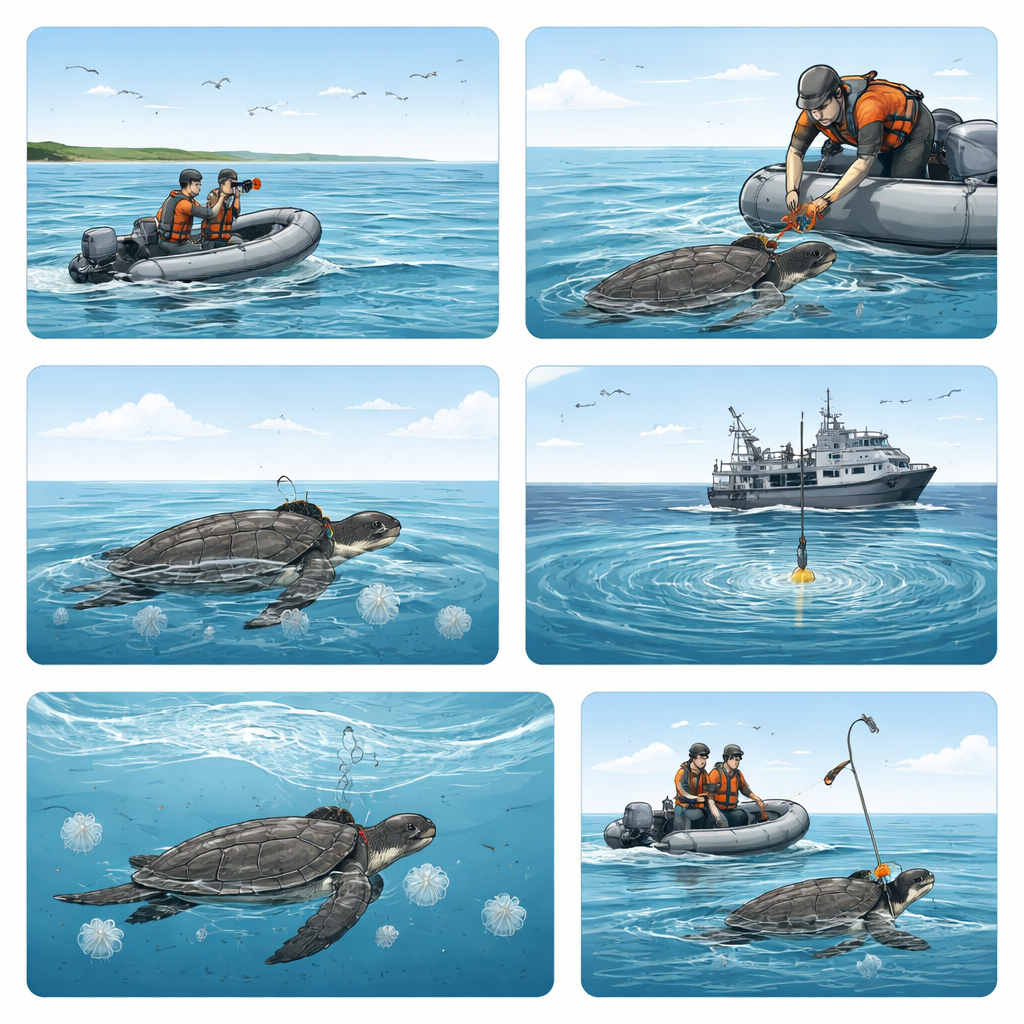
Bringing in the big noise
Once turtles were tagged and had resumed normal feeding, a second vessel towed a device called a seismic sparker. This tool releases extremely short, intense sound bursts—similar in character to those used in seafloor surveys for offshore construction. The sparker fired once every second, producing loud, low-pitched pulses in the frequency range that leatherbacks can hear. Over four days in 2023, 13 turtles were exposed to these sounds for about 50 minutes each, and the tags captured more than 1,400 minutes of combined footage and depth records. This setup let researchers link the exact loudness of each pulse at the turtle’s depth to how the animal moved and whether it was feeding.
How behavior shifted underwater
The data showed that the turtles did react—but in subtle, behavior-changing ways rather than dramatic panic. As sound levels increased, dives tended to become shorter once the noise passed a certain threshold, around 141 decibels. Turtles also changed how directly they swam: near the noisy sparker, their paths became more winding, as if they were trying to orient themselves relative to a moving sound source, while farther away their paths straightened out. Interestingly, swimming speed was most strongly linked to how close turtles were to the vessel itself, suggesting that boat presence, not just the sound pulses, influenced how fast they moved.
Feeding less in a noisy neighborhood
The most worrying shift was in feeding. Using the tag videos, the team counted how often turtles snapped up jellyfish during each second of their dives. In quieter conditions, leatherbacks fed at a high rate—more than 300 jellyfish-sized foraging events per hour. During louder periods, feeding dropped by roughly two-thirds, to about 130 events per hour. Statistical models showed this wasn’t just because turtles were diving at different depths: both sound level and depth independently influenced the chance of a turtle grabbing a jellyfish. In fact, the animals appeared to choose parts of the water column where sound was lower, even if those depths were not the most food-rich, suggesting they were trading feeding efficiency for a quieter, less disruptive acoustic environment.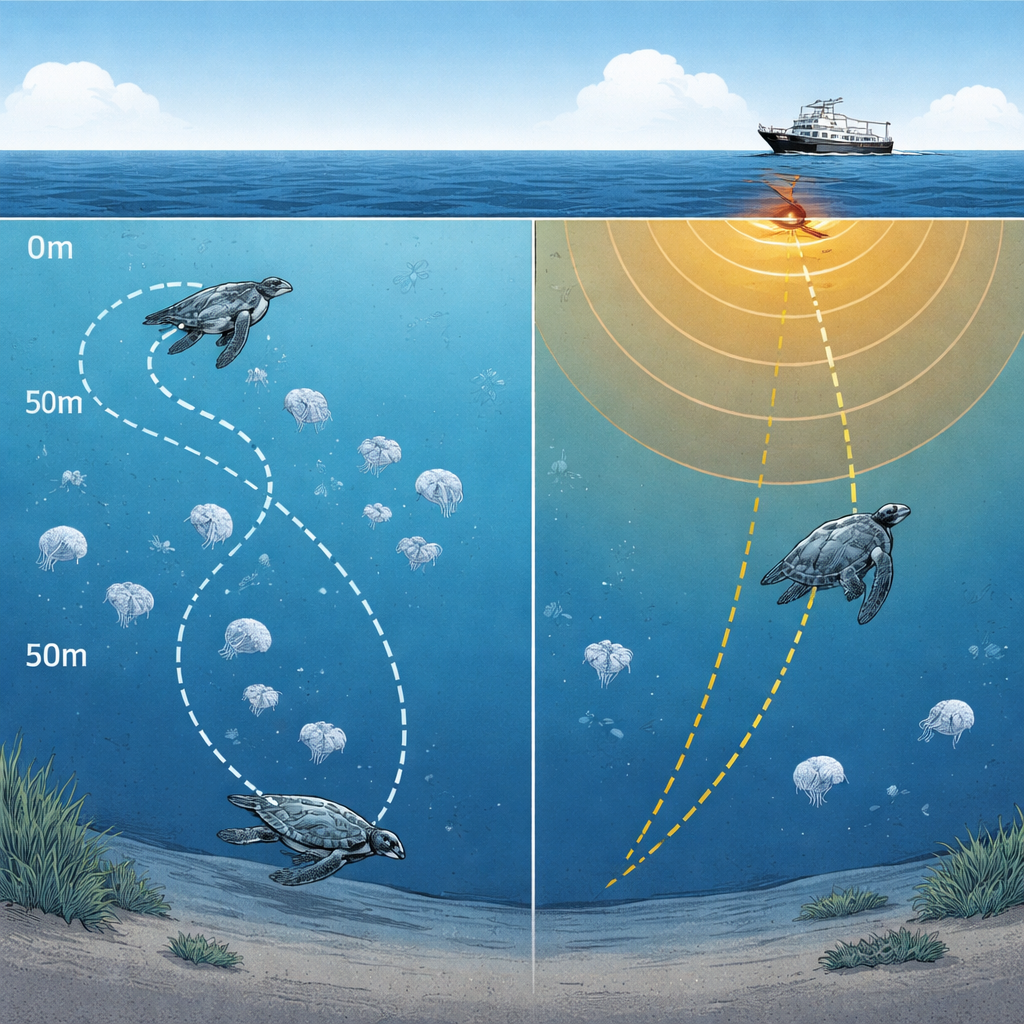
What this means for leatherbacks and ocean planning
For a giant reptile that lives on watery “cotton candy” like jellyfish, every successful meal matters. Leatherbacks must eat hundreds of jellyfish per hour in some areas to fuel long migrations and reproduction. A sustained reduction in feeding—even without visible injury—could leave them with too few energy reserves to complete their journeys or lay as many eggs. This short-term study shows that intense, impulsive sounds can measurably reduce foraging and alter movement in free-swimming leatherbacks, underscoring that noise is more than a nuisance: it is a real ecological pressure. As offshore wind farms and other marine projects expand in the Northwest Atlantic, factoring in these hidden behavioral costs will be essential to designing noise limits, seasonal restrictions, and other safeguards that let leatherback turtles keep feeding, migrating, and recovering in an increasingly industrial ocean.
Citation: Patel, S.H., Munnelly, R., Choate, K. et al. Leatherback sea turtles (Dermochelys coriacea) react to impulsive sounds. Sci Rep 16, 7372 (2026). https://doi.org/10.1038/s41598-026-38178-3
Keywords: underwater noise, leatherback turtles, seismic surveys, marine conservation, offshore wind