Clear Sky Science · en
Large ungulates will be present in most of Japan by 2050 owing to natural expansion and human population shrinkage
Why roaming deer and boar matter to everyday life
Across Japan, wild sika deer and wild boar are no longer creatures seen only in remote mountains. They bring valued game meat and a sense of wilderness, but also crop damage, traffic collisions and disease risks. This study asks a pressing question for residents, farmers and planners alike: how far and how fast will these large animals spread across the country as the climate warms and human populations shrink?
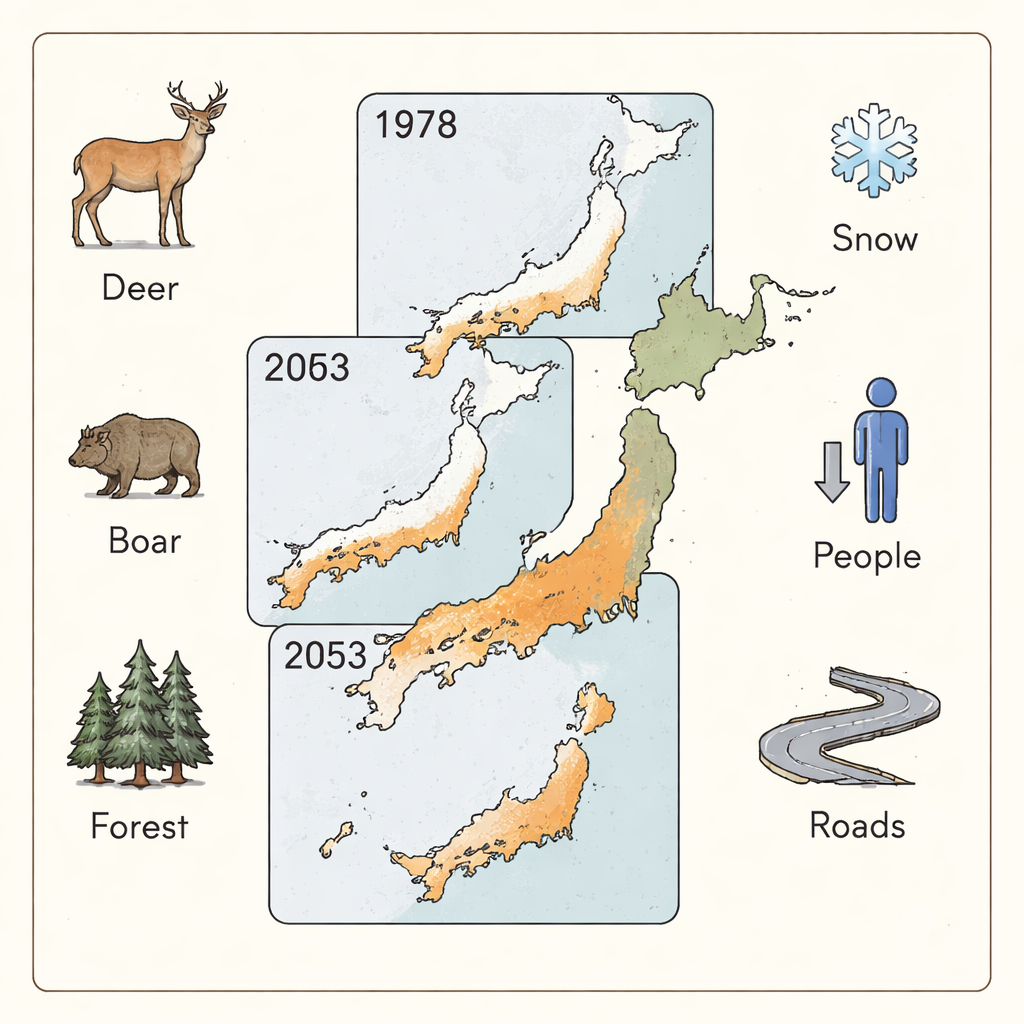
Animals on the move across the Japanese islands
The researchers examined how the ranges of sika deer and wild boar have changed since the late 1970s and used those patterns to forecast where the animals are likely to live in coming decades. They combined nationwide wildlife survey records from 1978, 2003 and 2014 with information on snow, forests, roads, elevation, and human population, all laid out on a grid of 5-by-5 kilometer squares covering Japan. By building a statistical model that tracks where animals were present, absent, or newly arrived through time, they could estimate what makes new areas attractive or difficult for deer and boar to colonize.
Closer herds spread faster
The single strongest driver of expansion for both species was distance from existing populations. In plain terms, new areas were most likely to be colonized when they were near places where the animals already lived. This highlights the natural mobility of large mammals: once a population is established, young animals tend to disperse outward step by step. Environmental conditions still mattered, but the ability of deer and boar to walk into neighboring regions often outweighed subtle differences in climate or land use.
Forests, snow, and shrinking towns
Among environmental factors, forest cover consistently encouraged spread for both species. Forests provide food, cover from people, and safe travel routes across the landscape. Snow played a more complex role. For sika deer, more days with snow were actually linked to greater expansion, likely because deer use snow-tolerant conifer forests as winter refuges, even in areas that historically seemed too snowy. For wild boar, snow could either help or hinder, depending on how severe future climate change becomes. Under milder warming, boar also pushed into snowier areas, but under more intense warming scenarios, the influence of snow weakened and factors like forest cover and distance from current populations became more important. Human population tended to hold both species back: they were less likely to colonize densely settled areas, though wild boar showed more willingness than deer to enter urban and suburban landscapes.
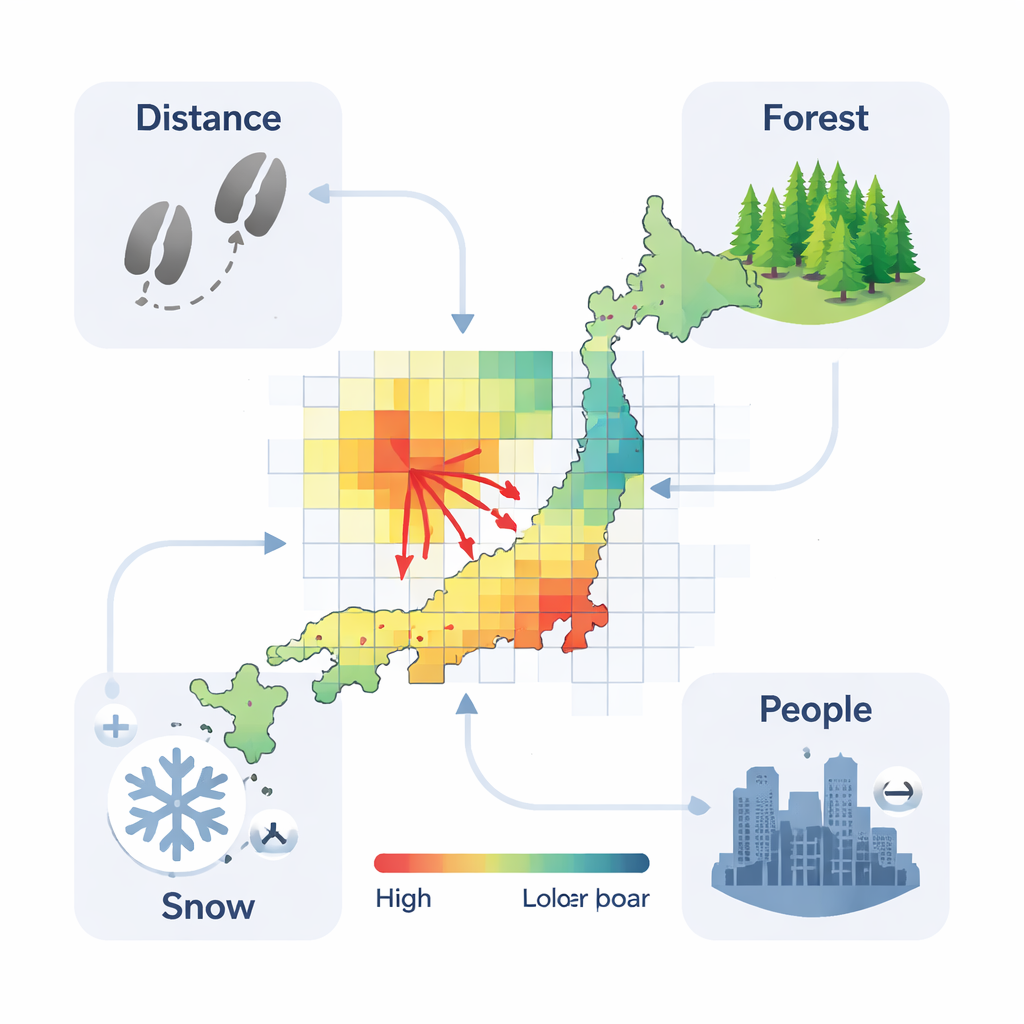
Japan’s wildlife map in 2050 and beyond
Using their model, the authors projected the distributions of sika deer and wild boar for 2025, 2050 and 2100 under both mild and strong climate-warming scenarios. Their forecasts suggest that by around 2050, large parts of Japan will host one or both species. Sika deer are expected to occupy almost all suitable areas except some heavily populated low-lying coastal and metropolitan regions such as the Kanto area. Wild boar are projected to expand widely through Honshu, Shikoku and Kyushu, including many urban fringes. Interestingly, the broad patterns look similar regardless of whether climate change is kept in check or allowed to run hotter, though stronger warming slightly speeds up boar expansion into former snowbelt regions.
Living with more deer and boar
For residents and policymakers, the take-home message is that without strong management, deer and boar will be common across most of Japan within a few decades. Because their spread is driven more by natural movement and forests than by climate alone, simply hoping that harsh winters will hold them back is not realistic. Instead, the authors argue that carefully planned hunting, fencing, and damage-prevention measures should be focused in the places their model identifies as most likely to be colonized next. By anticipating where these large animals will appear, communities can better protect crops, forests, and road safety while still benefiting from the ecological and cultural values that wild deer and boar provide.
Citation: Morosawa, T., Iijima, H., Kawamoto, T. et al. Large ungulates will be present in most of Japan by 2050 owing to natural expansion and human population shrinkage. Sci Rep 16, 7550 (2026). https://doi.org/10.1038/s41598-026-38177-4
Keywords: sika deer, wild boar, species range expansion, Japan wildlife, human population decline