Clear Sky Science · en
Biocompatible 3D hierarchical flower-like iron-doped silver nanostructures as a platform for in vitro and in vivo drug delivery
Why tiny metal flowers matter for cancer treatment
Chemotherapy drugs can be powerful allies against cancer, but they often behave like carpet bombers, spreading through the whole body and harming healthy tissues as well as tumors. This study explores a very different approach: building tiny, flower-shaped particles made of silver and iron that can carry an established cancer drug, methotrexate, and release it more precisely where it is needed. By tuning their shape, surface chemistry, and response to acidity, the researchers aim to make treatment both more effective and kinder to the rest of the body.
Tiny flowers built from metals
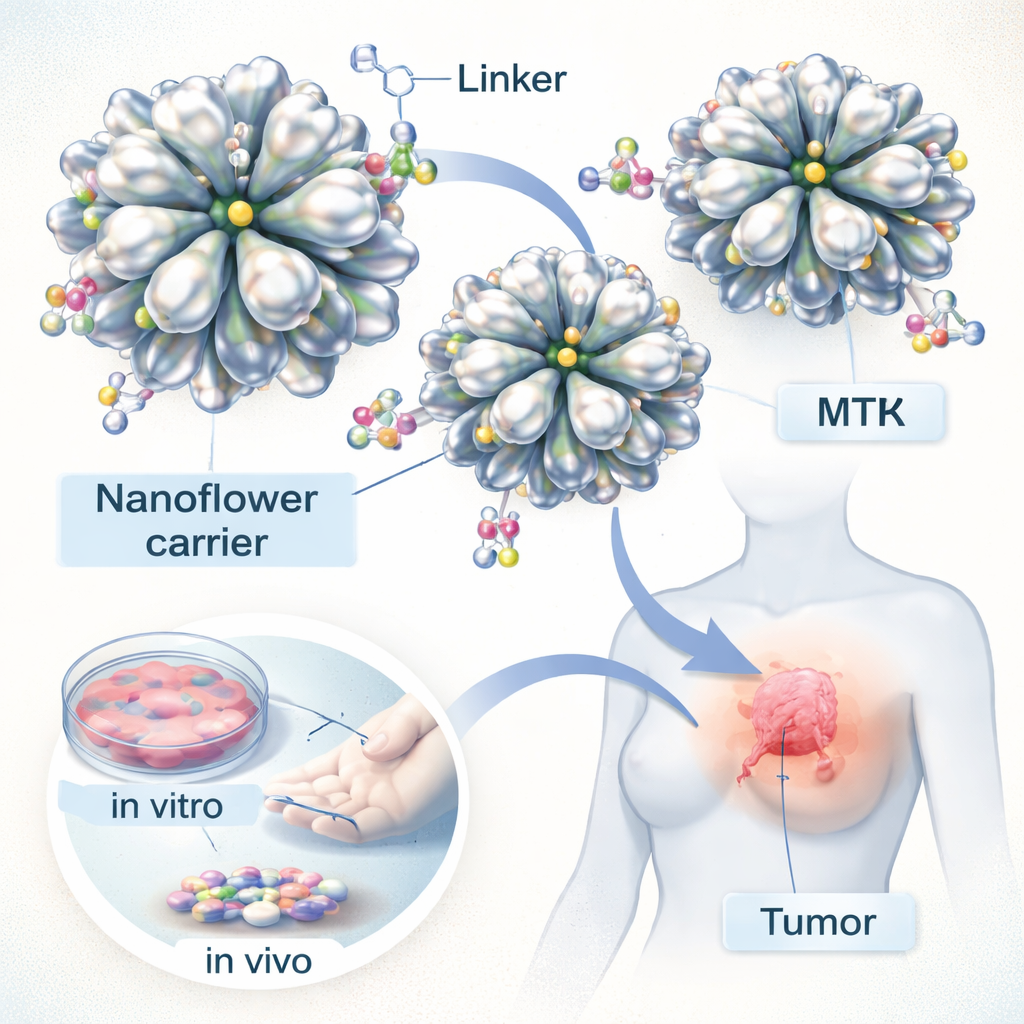
The team designed three-dimensional “nanoflowers” made from silver that is lightly mixed with iron. Under the microscope, these particles really do resemble flowers, with many thin, overlapping petals. This intricate shape gives them a very large surface area, which is ideal for holding drug molecules. The researchers created the nanoflowers using a simple water-based chemical reaction, adjusting ingredients such as malonic acid and iron salts so that the metal atoms grow into branched, petal-like structures instead of solid balls. Tests using imaging and structural tools confirmed that the particles had the desired rough, layered surfaces and that iron was evenly spread throughout the silver.
Turning metal flowers into drug carriers
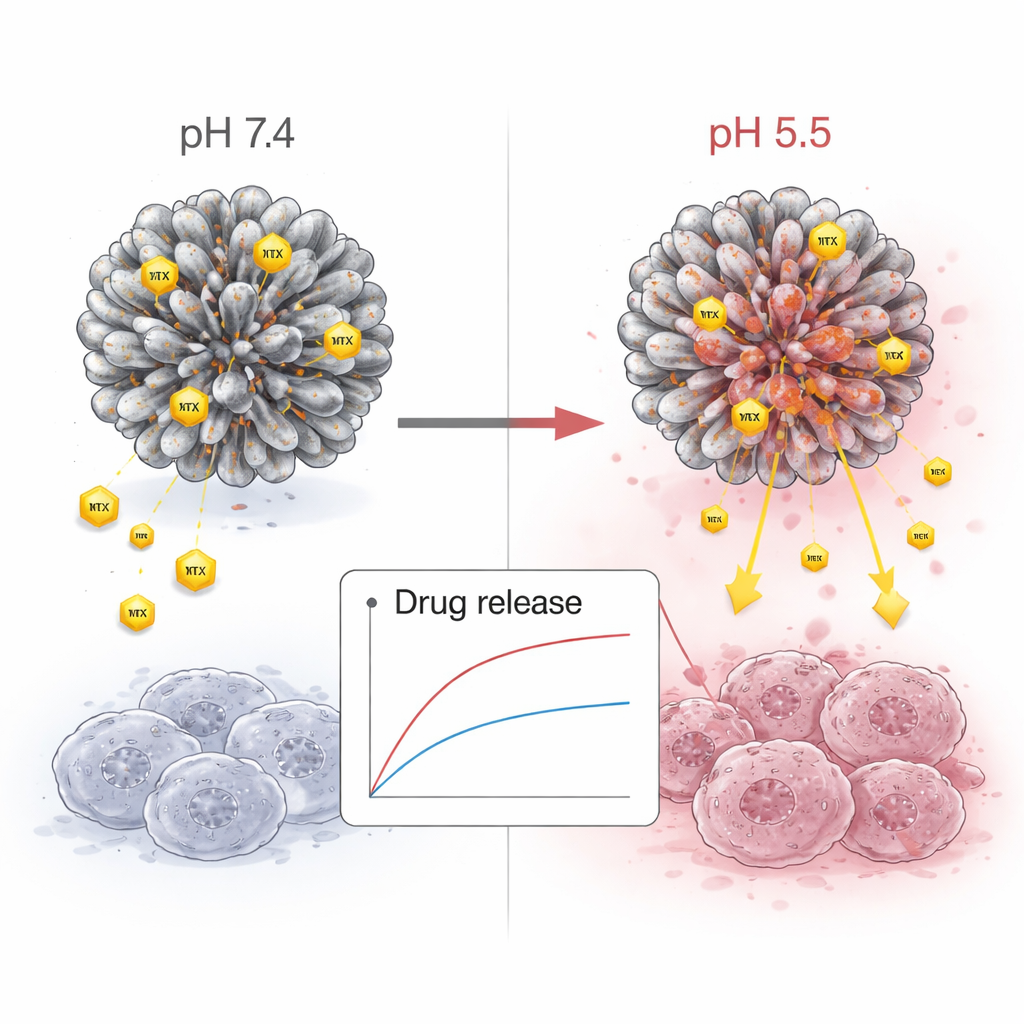
To turn these metal flowers into drug shuttles, the scientists first coated their surface with a small organic molecule that acts like a two-headed hook. One end naturally grips silver, while the other end can latch onto methotrexate. Using a standard coupling chemistry, they created stable links between the drug and the nanoflower surface. This strategy achieved a high loading capacity—most of the methotrexate supplied could be attached to the carrier. Crucially, the bond between drug and carrier is sensitive to acidity. At the slightly acidic conditions commonly found inside tumors and cancer-cell compartments, this bond loosens more quickly, while it stays more intact at the near-neutral pH of healthy blood.
Smart release in acidic tumors
The team then tested how much drug was released over time at different acidity levels. At normal blood pH, the nanoflowers let go of methotrexate only slowly, which could help limit damage to healthy tissues. In more acidic conditions similar to the inside of breast cancer cells, the release sped up significantly, with far more drug being freed over a couple of days. This means the same particle can act “quiet” in circulation but become “active” once it reaches the tumor’s harsher chemical environment. Such pH-responsive behavior is one of the key goals of modern “smart” drug-delivery systems.
Effects on cells, blood, and tumors
When tested in dishes, the methotrexate-loaded nanoflowers proved gentle to normal fibroblast cells while being more harmful to breast cancer cells, suggesting some degree of selectivity. Cancer cells exposed to the nanoflowers showed signs of programmed cell death and were halted mainly in the DNA-copying phase of their growth cycle, which matches methotrexate’s known mode of action. Fluorescence imaging showed that the particles could enter cells and approach their genetic material. The nanoflowers also performed well in blood tests: they caused little damage to red blood cells at most concentrations, and the drug-loaded versions were particularly safe. In mouse models of breast cancer, X-ray micro-CT scans and tissue studies revealed that the particles tended to collect in tumors, where they helped shrink tumor volume over a two-week period while showing limited buildup in other organs.
What this could mean for future treatments
Overall, the study suggests that these iron-doped silver nanoflowers can serve as a promising platform for delivering methotrexate more precisely and gently. By combining high drug loading, acidity-triggered release, and reasonable safety in blood and tissues, they address several long-standing problems with chemotherapy: lack of selectivity, strong side effects, and rapid drug washout. While more work is needed to fully understand their long-term behavior in the body and to adapt them for use in people, these tiny metal flowers hint at a future where cancer drugs are carried directly to tumors and released in a more controlled, targeted way, potentially making established medicines both safer and more effective.
Citation: Almosawy, W., Landarani-Isfahani, A., Moghadam, M. et al. Biocompatible 3D hierarchical flower-like iron-doped silver nanostructures as a platform for in vitro and in vivo drug delivery. Sci Rep 16, 7044 (2026). https://doi.org/10.1038/s41598-026-38175-6
Keywords: nanomedicine, drug delivery, methotrexate, breast cancer, silver nanoparticles