Clear Sky Science · en
Rupture access to hydrous minerals controls aftershocks in subduction zones
Why some big quakes have busy aftershocks
When a major earthquake strikes, we often brace for days or months of aftershocks. Yet some equally large quakes are followed by surprisingly few. This paper asks a deceptively simple question with big implications for hazard forecasts: what controls how many aftershocks an earthquake produces? The authors argue that the answer lies not just in how rocks break, but in how much water is trapped inside them deep below our feet.
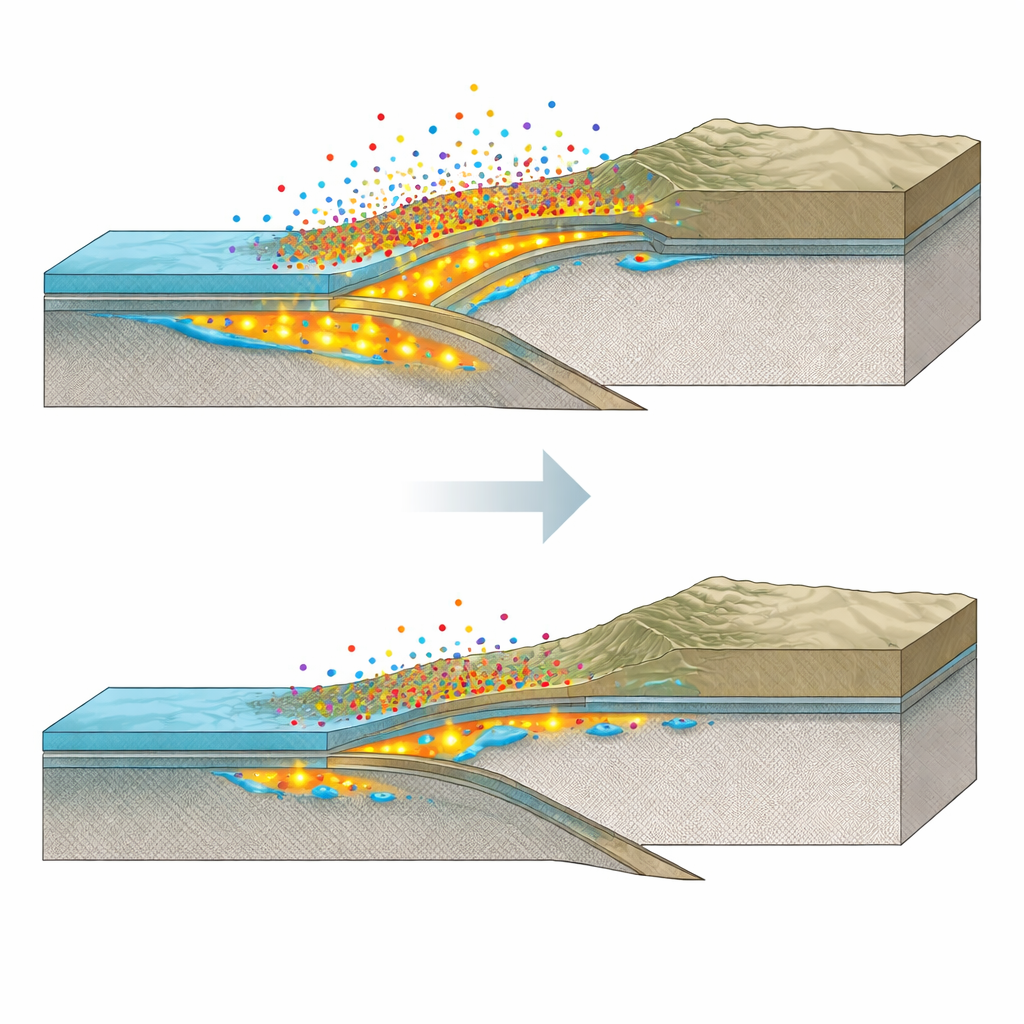
Hidden water deep in sinking plates
Under the world’s oceans, tectonic plates slowly dive beneath neighboring plates in regions called subduction zones. Before they sink, these plates crack and allow seawater to seep in, forming water-rich minerals in the crust and upper mantle. As the plate descends, those hydrous minerals ride down with it, concentrating along the contact where the sinking and overriding plates slide past each other. In many places this contact forms a continuous, weak, and very wet zone made of altered oceanic crust and a rock called serpentinite. This hidden band of hydrated rock turns out to be a key player in generating long-lasting aftershock sequences.
Steep slabs versus flat slabs
Not all subduction zones look the same. In “steep” systems, the oceanic plate dives down at a sharp angle, staying relatively cool and preserving a thick, continuous belt of water-bearing minerals along the plate interface. In “flat-slab” regions, the plate bends less and travels almost horizontally for hundreds of kilometers beneath the continent. These flat segments are warmer and less thoroughly hydrated, and the hydrated zones are patchier and thinner. By comparing global earthquake catalogs, the authors show that steep slabs routinely host large quakes that spawn hundreds to thousands of aftershocks, whereas nearby events of similar size in flat-slab regions often produce only a handful—or none at all.
How rupture paths tap or miss the water
The team analyzed 21 large to great earthquakes (magnitude roughly 6.8 to 8) in South America, Central America, the Middle East, Indonesia, and other subduction margins. For each case, they mapped aftershock density over three months and examined the geometry of the main rupture relative to the slab and the hydrated interface beneath it. Earthquakes that produced rich aftershock sequences tended to rupture along the plate boundary itself, staying within the hydrated shear zone. In contrast, aftershock-poor events often occurred within the sinking plate on faults that cut across the interface at steep angles. These “intraslab” ruptures intersect only small pockets of hydrous minerals instead of the main wet band, sharply limiting the volume of water-rich rock they can affect.
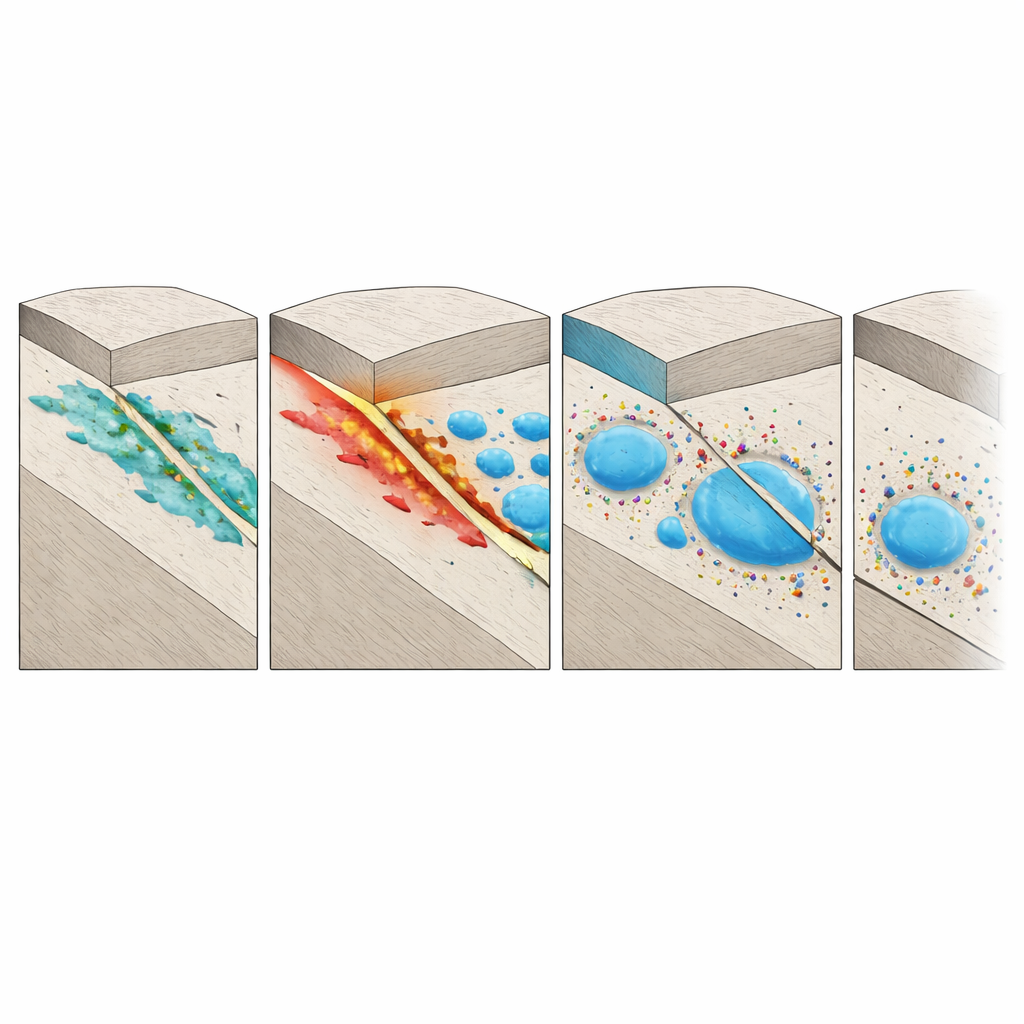
Fluids as the fuel for long-lived aftershocks
Why does this access to hydrous minerals matter? During a major quake, rapid sliding along the fault generates intense frictional heating. Where the fault cuts through water-bearing minerals, that heating can trigger dehydration reactions and break down the minerals, releasing high-pressure fluids into surrounding cracks. These fluids reduce the clamping force on nearby faults and migrate outward over weeks to months, encouraging further slipping events—our observed aftershocks. Where the rupture passes mostly through dry or poorly hydrated rock, much less fluid is produced, and aftershocks die out quickly after the initial stress changes. The authors quantify this pattern by normalizing aftershock counts for earthquake size and show a clear trend: steeper, better-hydrated slabs yield far higher aftershock productivity than flatter, drier ones.
Exceptions that prove the rule
There are intriguing exceptions. One magnitude 7.3 earthquake in Iran, far from an oceanic plate, generated an intense aftershock sequence while rupturing a thick carbonate platform. Laboratory and modeling work suggest that in such settings, rapid heating can break down carbonate minerals and release carbon dioxide–rich fluids, playing a similar role to water released in subduction zones. Other continental quakes in Morocco and Afghanistan show that where rocks lack such fluid-producing minerals, even sizable events may have very modest aftershock activity. Across all case studies, aftershock-poor earthquakes tend to occur deeper and in geometries where access to fluid-producing rocks is limited.
What this means for earthquake risk
To a non-specialist, the core message is straightforward: aftershocks are not random leftovers from a big quake—they are largely powered by fluids released from specific minerals at depth. The shape of the sinking plate and the direction of the rupture together determine how much of that “fuel” the earthquake can tap. Steeply dipping, well-hydrated plate boundaries act like long, wet fuses that can keep aftershocks going, while flat slabs and drier rocks give those sequences little to feed on. This fluid-based view offers a testable framework for improving aftershock forecasts in different tectonic settings and suggests that mapping deep water- and carbon-bearing rocks may one day help us anticipate where the earth is most likely to keep shaking after a major quake.
Citation: Gunatilake, T., Gerya, T., Connolly, J.A.D. et al. Rupture access to hydrous minerals controls aftershocks in subduction zones. Sci Rep 16, 8109 (2026). https://doi.org/10.1038/s41598-026-38159-6
Keywords: aftershocks, subduction zones, hydrous minerals, fluid-driven seismicity, slab geometry