Clear Sky Science · en
Experimental study on the influence of synchronous grouting in shield tunneling on an upper existing tunnel in sandy soil stratum
Why what happens under our cities matters
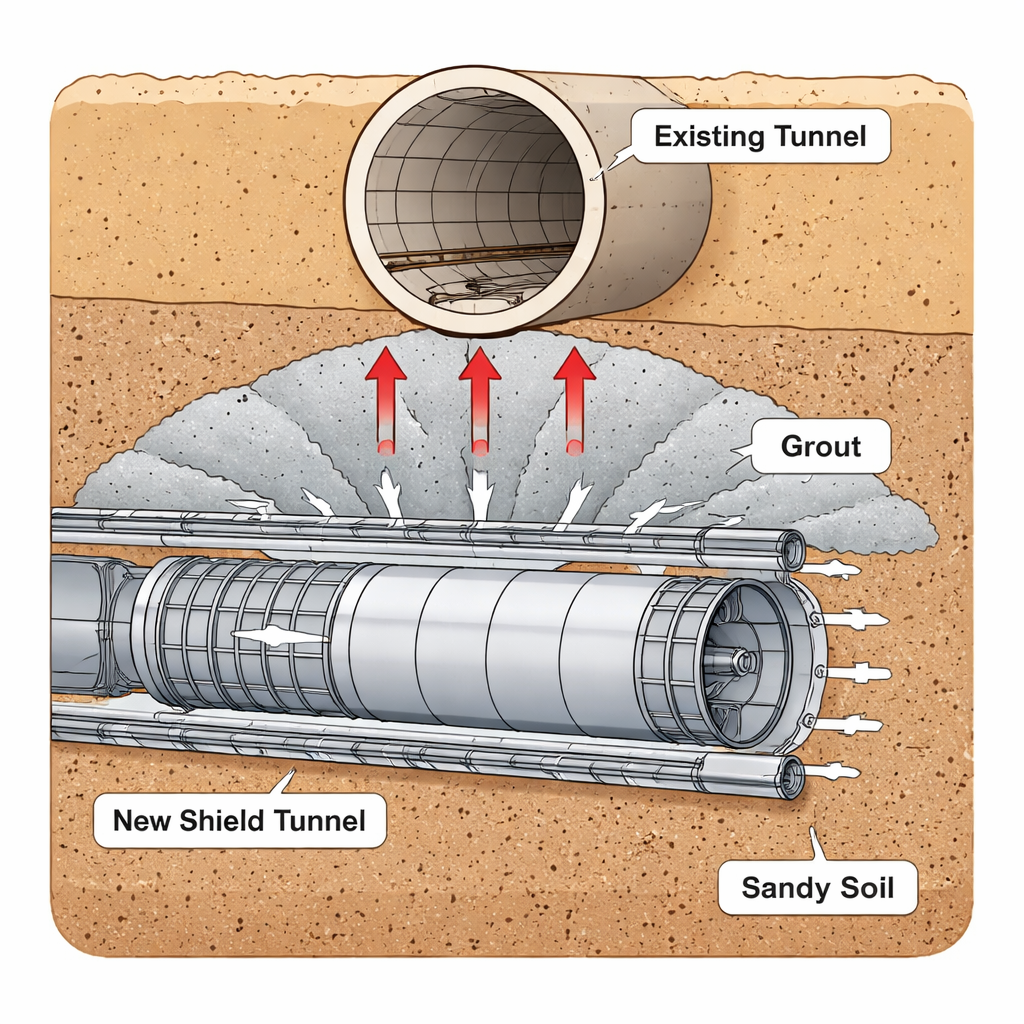
Modern cities increasingly rely on stacked layers of underground tunnels for subways, utilities and roadways. When engineers need to build a new tunnel beneath an older one, they inject liquid grout around the new structure to keep the ground from sinking. But in loose, sandy soil, that same grout can unintentionally push on the tunnel above, bending and squeezing it in ways that could threaten long‑term safety. This study uses a carefully scaled laboratory model to show how and why that happens, and how much grout is too much.
Building a miniature city underground
To probe these hidden processes, the researchers constructed a large soil box filled with sand whose grain sizes and density mimic real subway conditions. Inside, they installed a steel model of an "existing" circular tunnel and, below it, a second tunnel representing the one being newly excavated by a shield machine. The entire setup was built at one‑tenth real size, allowing precise control while still capturing realistic behavior. Rather than simulate every step of tunneling at once, they separated the stages: excavation had been modeled in earlier work, and this study focused solely on the grouting that occurs behind the shield as new tunnel segments are installed.
How grout is injected and measured
In real projects, grout is pumped into the narrow gap behind the shield tail to fill the space between the lining and the ground. The team recreated this with a custom shield tail, sealing brushes and grouting pipes connected to a pump. They varied two key parameters: the water content of the grout slurry and how much grout was injected relative to the volume that strictly needed filling, known as the grout fill ratio. Small sensors embedded in the sand measured how the pressure in the soil changed around the upper tunnel. Inside that tunnel, overlapping steel rulers, lasers and cameras tracked tiny changes in diameter and bending, allowing the researchers to see exactly how the structure flexed as grouting progressed.
Hidden pushes and bends in the upper tunnel
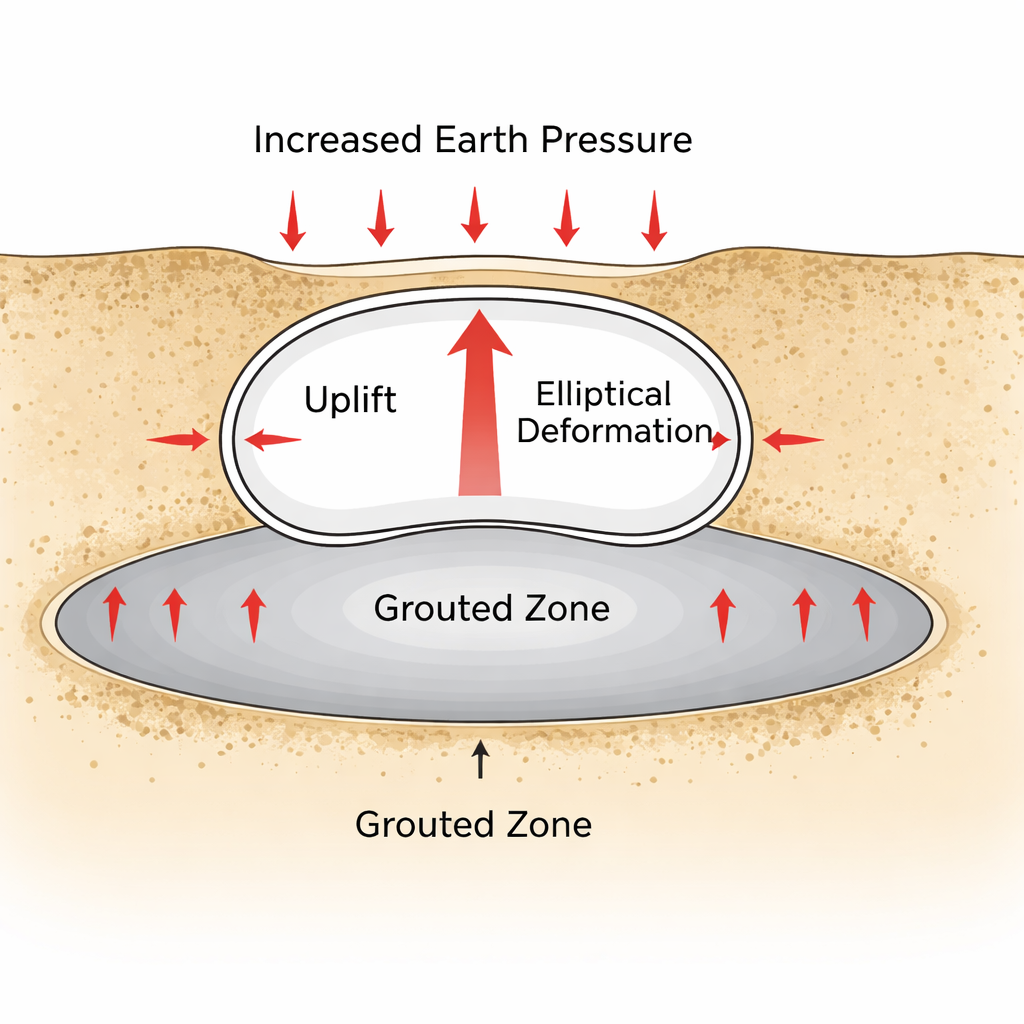
The measurements revealed that grouting does not act uniformly. As the grouted zone moved beneath the existing tunnel, pressure in the sand rose sharply, especially directly under the tunnel’s middle. The bottom of the upper tunnel saw the largest increase, while the sides changed little and the top only modestly. When the grout fill ratio was high, the upward push at the tunnel bottom was roughly one and a half times greater than when a more modest amount was used. This uneven loading made the upper tunnel arch upward over the grouting path, with the bottom lifting more than the top. At the same time, the cross‑section of the tunnel changed shape: its vertical diameter shrank while its horizontal diameter grew, turning the circle into a gentle sideways oval.
When more grout becomes a problem
These deformations matter because tunnels are designed to share forces evenly around their circular rings. When the bottom bulges and the cross‑section becomes elliptical, some parts of the lining carry far more stress than others. The study shows that in sandy ground, using a large grout fill ratio (around 1.6 times the strict void volume) can cause significant upward movement and ovalisation of an overlying tunnel. Once the grout beneath the tunnel hardened and shrank slightly, some of the uplift partially rebounded, but the episode of extra bending would still have stressed the structure. Over time, such changes can encourage cracks, joint openings, bolt damage and leaks.
Practical lessons for safer tunnels
To a non‑specialist, the message is straightforward: when digging a new tunnel under an old one in sandy soil, too much supporting grout can be nearly as problematic as too little. The experiments suggest that keeping the grout fill ratio below about 1.6, and adjusting it based on real‑time monitoring, helps avoid excessive lifting and distortion of the existing tunnel. By better understanding these invisible underground forces, engineers can refine their designs and construction controls, protecting the tunnels that already carry millions of passengers while adding the new ones our growing cities demand.
Citation: Huang, D., Lu, W., Luo, W. et al. Experimental study on the influence of synchronous grouting in shield tunneling on an upper existing tunnel in sandy soil stratum. Sci Rep 16, 7203 (2026). https://doi.org/10.1038/s41598-026-38155-w
Keywords: shield tunneling, synchronous grouting, subway tunnels, sandy soil, tunnel deformation