Clear Sky Science · en
Evaluation of real-time source apportionment approaches in six Chinese cities using the AXA (ACSM, Xact, Aethalometer) instrumental set-up
Why fast pollution tracking matters
Air pollution is often talked about as a single number on a weather app, but what really matters is who and what is creating those dirty particles in the air, minute by minute. In many Chinese cities, thick winter haze can build up fast, forcing officials to decide in hours whether to curb traffic, close factories, or cut other activities. Until now, those decisions have largely been made without real-time information about which sources are actually to blame. This study presents and tests a new system that can disentangle the main contributors to harmful fine particles almost in real time across six major Chinese cities.
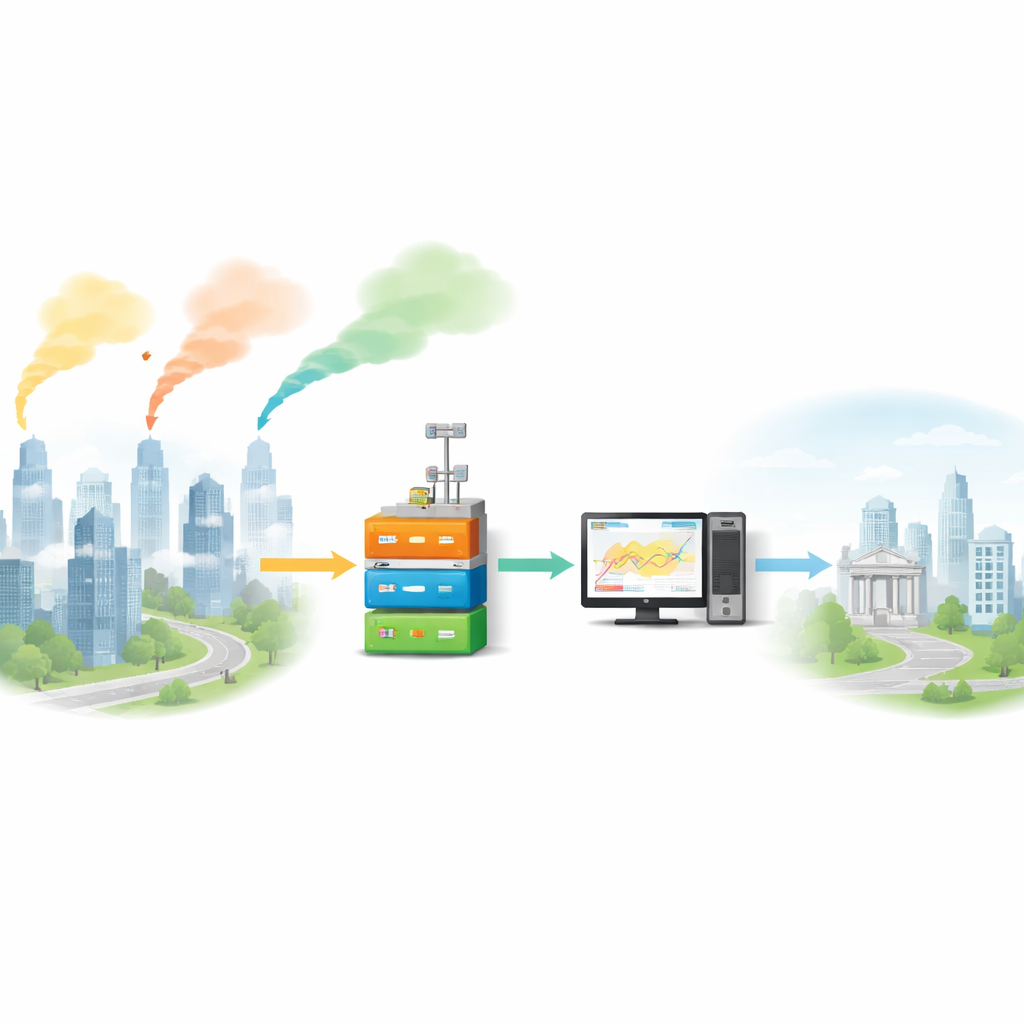
A new way to “fingerprint” dirty air
The researchers built a near real-time source apportionment system, essentially a smart analyzer that not only measures how much particulate matter (PM2.5) is in the air but also determines where it comes from within minutes. The system couples three continuous instruments, together called the AXA setup: one tracks organic particles and major ions, another measures trace elements such as metals, and a third focuses on light-absorbing black carbon. Each type of source—traffic, coal, biomass, dust, or industrial emissions—leaves its own chemical fingerprint in these measurements. Specialized software then uses these fingerprints to separate the mixed pollution into contributions from each source automatically, without needing an expert to watch over it.
Putting the system to the test in six cities
To see if this approach works outside the lab, the team ran multi‑month monitoring campaigns between 2020 and 2022 in Beijing, Langfang, Shijiazhuang, Xi’an, Wuhan, and Chongqing. First, they carried out careful, slower “offline” analyses on the full datasets to identify the main sources and their chemical profiles in each city. These offline results served as a reference. Then they configured the real‑time model with these source profiles and let it process the data as if it were running live, adding new measurements one time step at a time. In the last two cities, Shijiazhuang and Wuhan, the model was also operated in genuine near real time, delivering updated source breakdowns within minutes of each measurement.
What they learned about the haze itself
Across all six cities, the study confirms that secondary pollutants—particles formed in the air from gases like nitrogen oxides, sulfur dioxide, volatile organics, and ammonia—are the major drivers of PM2.5, often making up half or more of the fine particle mass. Nitrate, sulfate, and oxygen‑rich organic material were especially important. Primary emissions, such as smoke from coal and biomass burning, vehicle wear and exhaust, and industrial activities, still contributed substantially, typically around 10–30% of the mass, and in some cases more during specific events. Langfang, for example, experienced dust storms during the campaign, causing windblown mineral dust to dominate particle levels for extended periods. Seasonal patterns were also clear: wintertime heating boosted solid‑fuel smoke, while sunny periods favored the build‑up of secondary particles formed in the atmosphere.
How reliable is real-time source splitting?
The key question was whether the rapid, automated system could match the more careful offline work. The authors compared the two sets of results in several ways. When the real‑time model used optimized source fingerprints derived from the slow analysis, its estimates of each major source tracked the reference very closely, with statistical agreement (R²) above 0.82 for all major sources. They then challenged the system by training it on only two‑thirds of the data and testing it on the remaining third, mimicking deployment in a new period it had never “seen.” Even under these conditions, the model reproduced most sources well, though highly variable ones like cooking and biomass burning were somewhat less precise. A more demanding test, using generic “multi‑city” average fingerprints instead of local ones, produced mixed results, underscoring that local configuration and instrument details still matter for best performance.
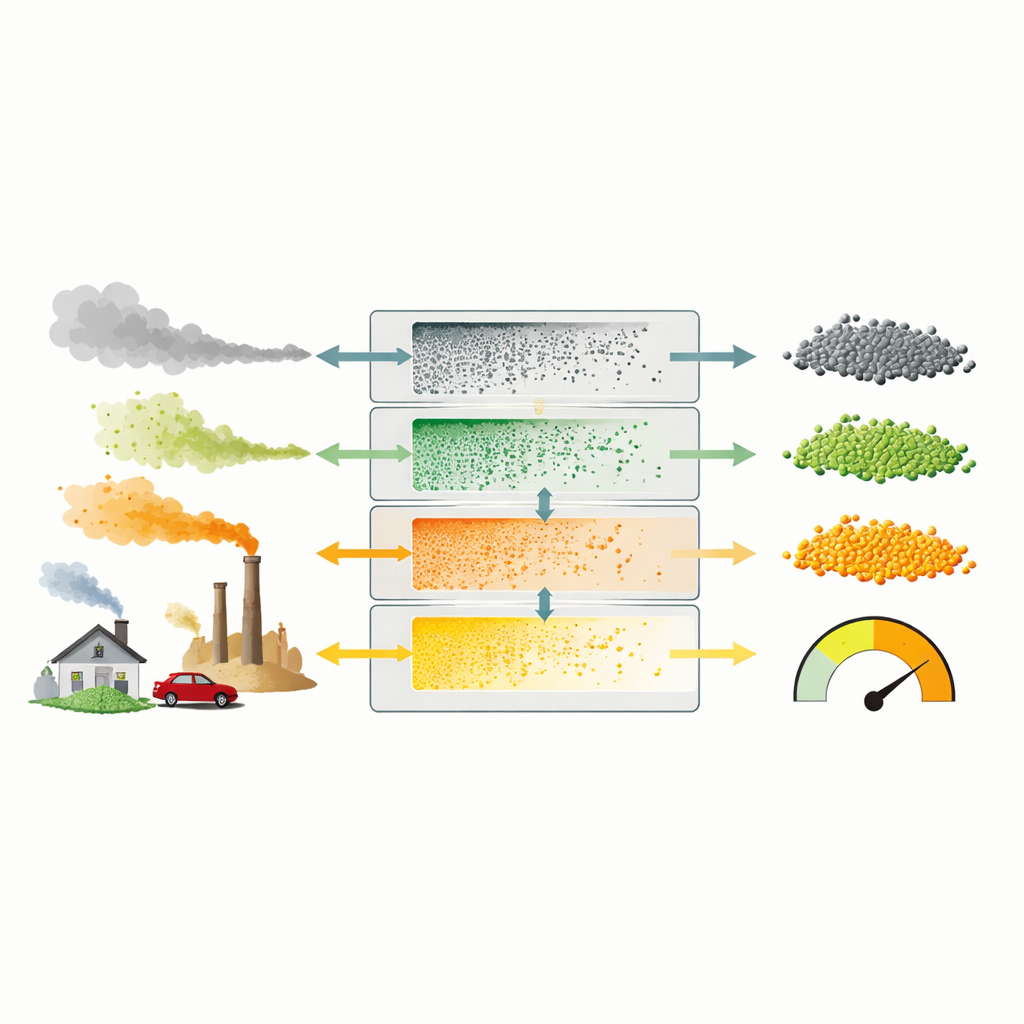
Limits, challenges, and the bigger picture
The study also highlights several challenges. Pollution sources and atmospheric conditions change with season, so a model tuned on winter heating emissions may not describe summer chemistry accurately. Instruments at different sites did not always measure the same set of pollutants, which can affect how well individual sources can be separated. And because the system is designed to run without human intervention, it trades some flexibility—for instance, frequent manual retuning of source profiles—for robustness and ease of use by non‑experts in routine monitoring networks.
What this means for cleaner city air
For a lay reader, the bottom line is that this work shows it is now possible to get a near real-time breakdown of who is polluting the air in major cities—not just how bad the air is. The new AXA‑based model can, within minutes, estimate how much of the fine particles in a given hour come from traffic, solid fuels like coal and biomass, dust, or secondary formation in the atmosphere, and it does so with accuracy close to that of much slower, expert‑driven methods. While further testing over full year‑long cycles is needed, such tools could help authorities respond more precisely during haze episodes—targeting the right sector at the right time—ultimately supporting better health outcomes and more efficient air‑quality management.
Citation: Manousakas, M.I., Cui, T., Wang, Q. et al. Evaluation of real-time source apportionment approaches in six Chinese cities using the AXA (ACSM, Xact, Aethalometer) instrumental set-up. Sci Rep 16, 9890 (2026). https://doi.org/10.1038/s41598-026-38154-x
Keywords: air pollution, particulate matter, real-time monitoring, source apportionment, Chinese cities