Clear Sky Science · en
An explanatory composite metric for air cargo network robustness: incorporating pairwise synergistic effects
Why should we care about fragile flight networks?
Every night, while most of us sleep, fleets of cargo planes race across the sky carrying medicine, electronics, fresh food, and online orders. Although this freight is less than 1% of world trade by weight, it represents about a third of its value. If a handful of key airports were knocked out by storms, outages, or strikes, disruptions could ripple quickly through supply chains. This study asks a subtle but critical question: not just which single airports matter most, but which pairs of airports are especially dangerous to lose at the same time.
Looking at the air cargo web as a living system
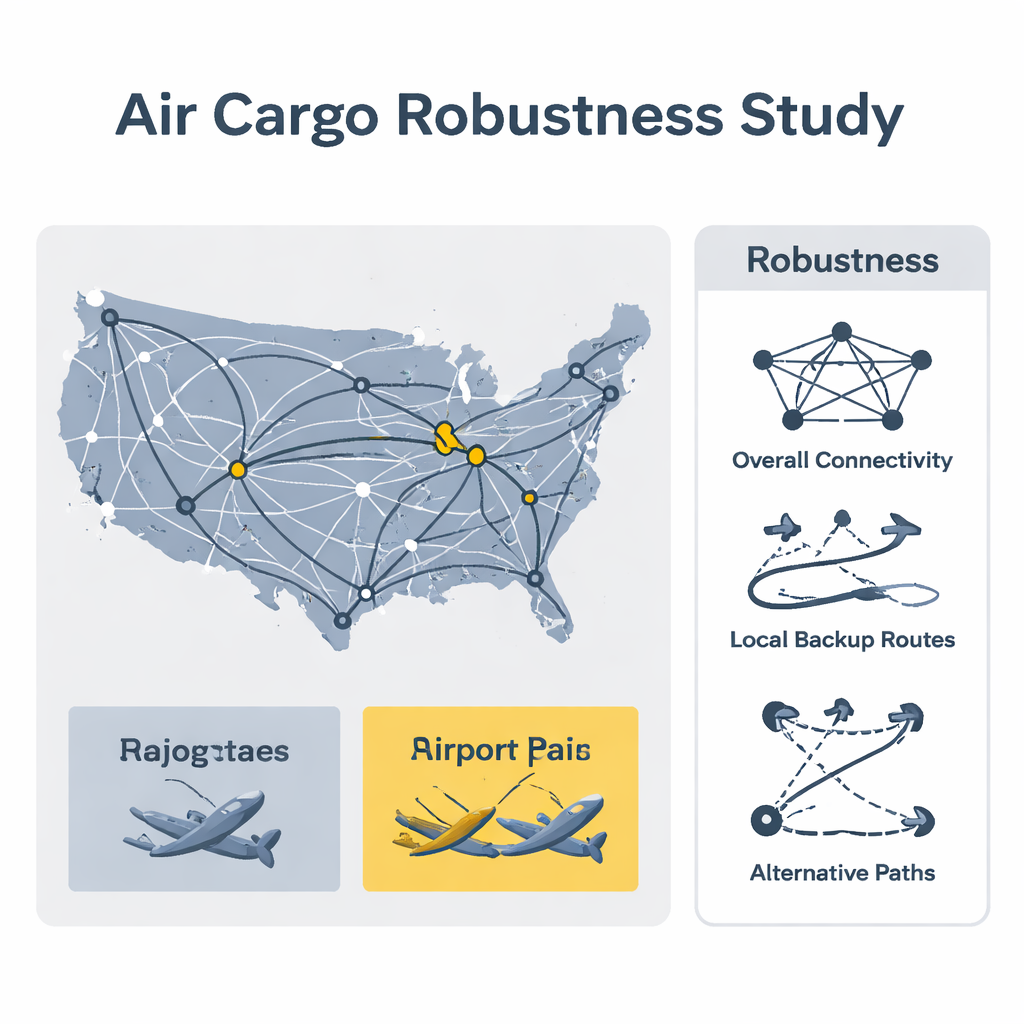
The authors treat the U.S. air cargo system as a web of 100 major airports linked by freight routes. Rather than focusing on passenger convenience, they look at how easily goods can still move when something goes wrong. They draw on three ideas from network science to capture different kinds of damage: how well airports can reach each other overall, how well nearby detours work if a local hub fails, and how many alternative routes exist in the background. Together, these measures describe whether the network still works smoothly or starts to fray when airports or routes disappear.
When one plus one is worse than two
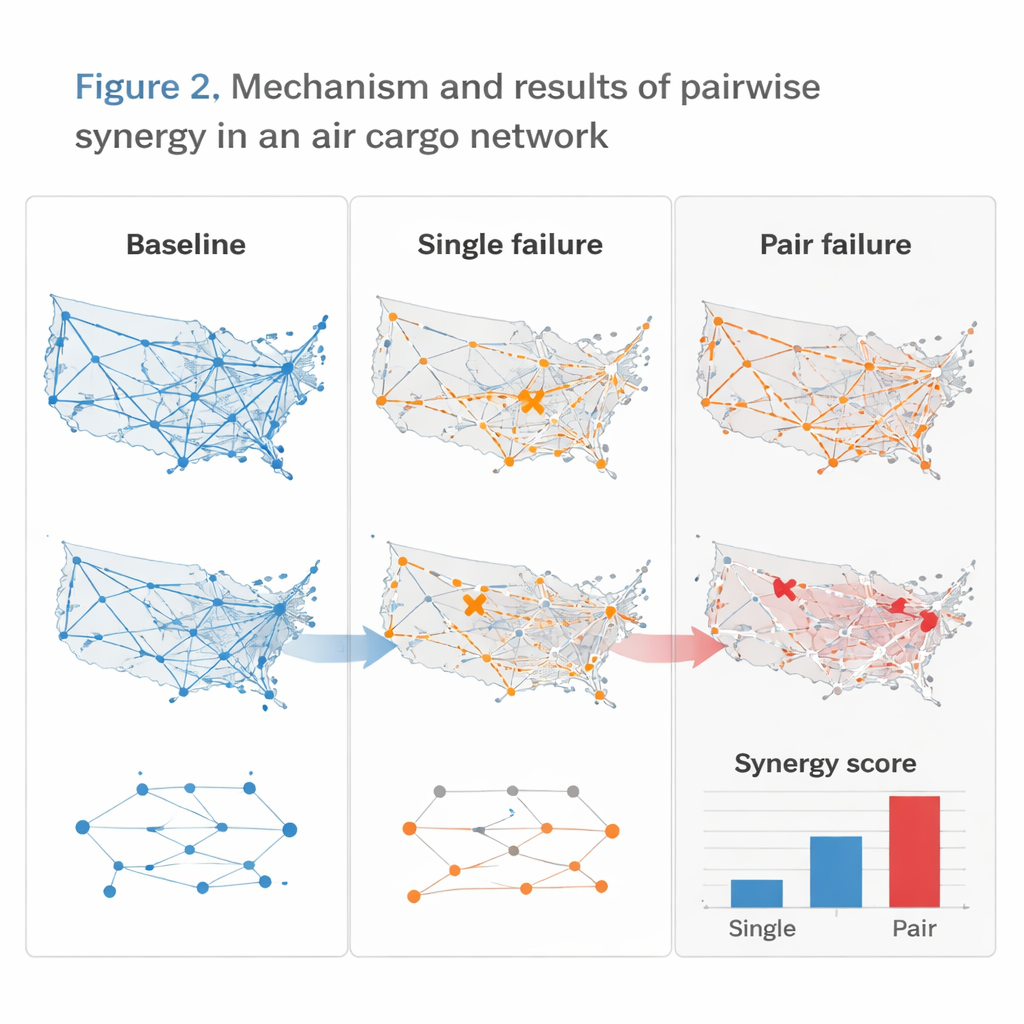
Most past studies test robustness by removing airports one by one or at random and watching performance decline. This misses an important reality: sometimes losing two specific airports together is much worse than simply adding up their individual impacts. To capture this synergistic effect, the researchers introduced a concept they call robustness vitality, which measures how much a single airport or airport pair harms the network when removed. They then compute a synergy score: the extra damage caused when two airports fail together beyond what would be expected from knocking them out separately. Positive synergy means a particularly dangerous pair.
Blending multiple views into one clear signal
Each underlying robustness measure highlights a different weakness: some are sensitive to longer routes, some to local detours, others to the depth of hidden backup paths. No single number tells the full story. The authors therefore build a composite score that merges all three. They rescale the individual synergy scores and weight them using an information-theory method that gives more weight to measures that vary meaningfully across airport pairs and less to measures that add little. This composite score keeps what the three measures agree on, smooths out their quirks, and makes it easier to rank airport pairs by how dangerous their joint failure would be.
Hidden weak spots: pairs that quietly hold the network together
Applying this method to U.S. 2022 freight data, the study uncovers several striking patterns. Many of the most risky airport pairs do not have direct cargo flights between them. Instead, they serve as distant anchors that jointly support multi-stop routes bridging regions. When both fail, entire corridors of indirect connections vanish. Well-known freight hubs like Louisville, Memphis, Cincinnati, Rockford, and Fort Worth Alliance show up again and again in the top pairs, even when partnered with less prominent airports. Statistical models confirm that both the structure of the network (how central, distant, or bridging the airports are) and the existence of direct cargo links help explain these high-synergy relationships.
What this means for keeping goods moving
For non-specialists, the main takeaway is that air cargo resilience cannot be judged by looking only at single, obvious hubs or at direct high-volume routes. The real fragility often lies in pairs of airports whose combined outage would quietly cut off long chains of alternatives. By providing a single, data-driven metric that flags these risky pairs, this work offers cargo airlines, logistics firms, and regulators a new kind of early-warning tool. It can guide where to add backup capacity, diversify routings, or harden infrastructure so that when disruptions strike, packages still find a way to their destinations.
Citation: Zhou, H., Razavi, S. An explanatory composite metric for air cargo network robustness: incorporating pairwise synergistic effects. Sci Rep 16, 7071 (2026). https://doi.org/10.1038/s41598-026-38153-y
Keywords: air cargo networks, transportation robustness, critical airport pairs, network resilience, supply chain disruptions