Clear Sky Science · en
Digital decision support integrated with diagnostics and precision fungicide application for Southern Corn Leaf Blight in maize
Why this matters for your dinner table
Maize, or corn, feeds people, livestock, and even powers cars. Yet a single disease called Southern Corn Leaf Blight can slash harvests and threaten food security, as it did in a historic U.S. epidemic that caused billions of dollars in losses. This study shows how a combination of artificial intelligence, smart spraying of fungicides, and a simple web tool can help farmers spot the disease early, treat it precisely, and protect both yields and the environment.
Seeing sickness on leaves with smart cameras
Instead of relying on slow and subjective field scouting, the researchers built a large collection of high-quality photos of maize leaves, both healthy and infected, from farms and research plots in different parts of India. Plant disease experts carefully checked each plant, confirmed infection in the lab, and labeled the images as healthy or diseased. These photos, resized and lightly edited to standardize brightness and contrast, became the training material for computer programs that learn to recognize the subtle brown, elongated lesions that mark Southern Corn Leaf Blight.
Putting many computer brains to the test
The team then compared thirteen different computer approaches, from classic machine-learning models to modern deep-learning networks. While traditional methods such as decision trees and support vector machines did a reasonable job, they struggled with the complex patterns found in real-world field images. In contrast, a deep-learning model called VGG16, which has already been trained on millions of general images, excelled when fine-tuned on maize leaves. It correctly identified disease in about 97 out of 100 cases and almost never confused healthy plants with sick ones. Additional checks showed that its probability estimates were stable and only rarely far from the truth, suggesting that the model is both accurate and reliable.
Looking into the black box
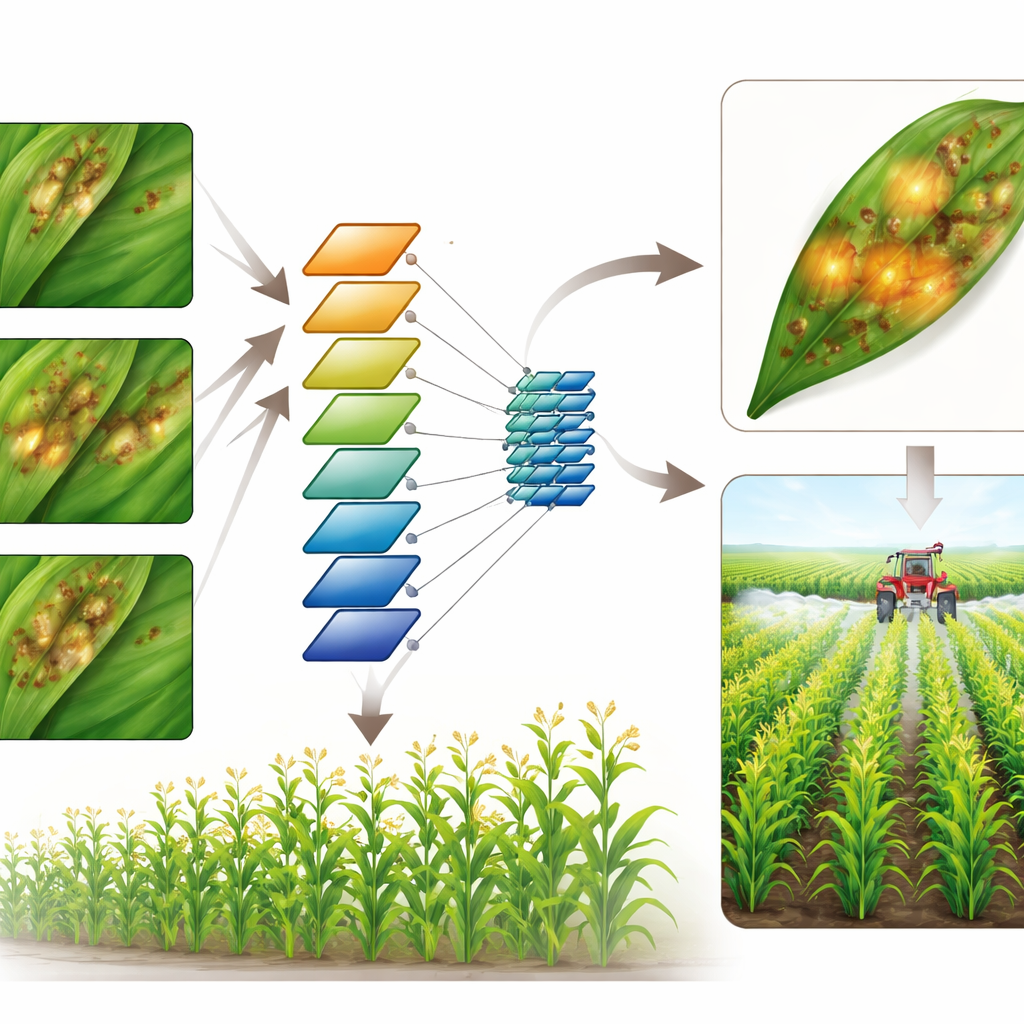
To make sure the computer’s decisions made biological sense, the researchers used visualization tools that act like thermal cameras for attention. One method, called Grad-CAM, paints heatmaps on leaf photos to show where the network is “looking” when it calls a plant diseased. These maps lit up precisely over the necrotic, yellow-rimmed lesions that plant pathologists use for diagnosis, rather than on soil, shadows, or background clutter. Another technique squeezed the model’s internal features into a two-dimensional plot, revealing two mostly separate clouds of points for healthy and sick leaves. Together, these visual checks boosted confidence that the system was detecting real disease signals instead of learning shortcuts.
Testing real-world treatments in the field
Recognizing disease is only half the battle; farmers also need to know what to do next. In parallel with the computer work, the team ran two years of field trials at a site known for severe blight. They compared six commonly available fungicides and mixtures, tracking how well each slowed the spread of leaf damage and how it affected grain yield and profit. Mixtures combining two modern fungicide types, strobilurins and triazoles, performed best. In particular, a blend of azoxystrobin and difenoconazole cut disease severity to about one-tenth of that in untreated plots and raised grain yield by roughly 30 percent, offering the most favorable return on investment.
Turning science into a farmer’s tool
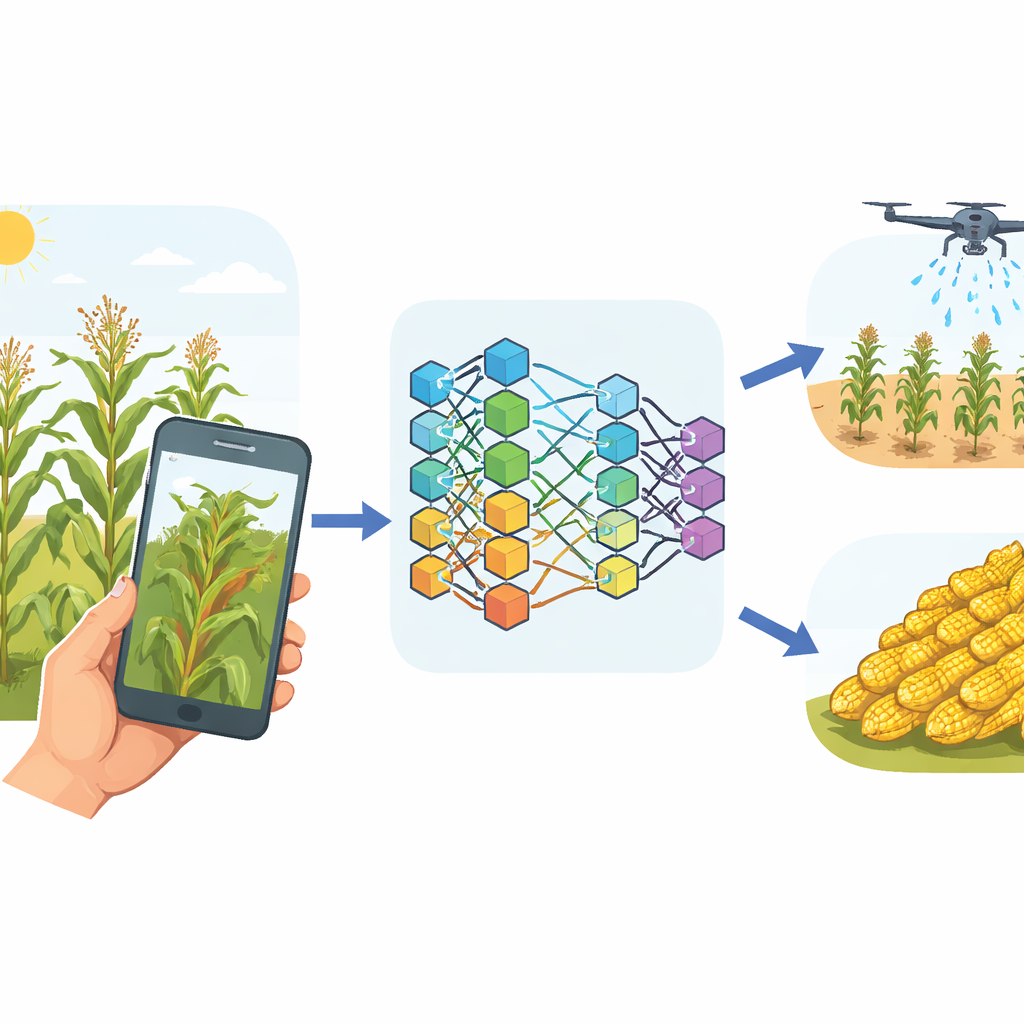
To connect these advances directly to people in the field, the researchers packaged the best-performing AI model and the field-tested fungicide advice into a simple web application built with a lightweight interface. A farmer or extension worker can upload a leaf photo from a phone, receive an immediate judgment of healthy or diseased along with a confidence score, and then view treatment and prevention suggestions drawn from the independent field trials. The advisory part is deliberately rule-based rather than automatically tuned by the AI, to ensure that it remains grounded in agronomic evidence and safety guidelines while still benefiting from rapid digital diagnosis.
What this means for farmers and food security
In plain terms, the study shows that trustworthy computer vision can help farmers catch Southern Corn Leaf Blight early from a simple photo, and that a specific, well-tested fungicide mix can then be applied sparingly yet effectively to rescue much of the potential yield. By weaving these elements into a decision support system, the work outlines a practical path toward more precise use of chemicals, higher harvests, and better livelihoods. The authors emphasize that more pictures from more regions and seasons are still needed to make the system truly universal, but the framework they present could be adapted to many other leaf diseases, bringing advanced diagnostics within reach of farmers armed with nothing more than a smartphone.
Citation: Jadesha, G., Dhole, A., Deepak, D. et al. Digital decision support integrated with diagnostics and precision fungicide application for Southern Corn Leaf Blight in maize. Sci Rep 16, 8217 (2026). https://doi.org/10.1038/s41598-026-38151-0
Keywords: maize disease, plant health AI, precision fungicide, leaf blight, digital farm tools