Clear Sky Science · en
Rhenium adsorption from an organic impurity–containing solution
Turning Waste into a Valuable Resource
Modern technologies, from jet engines to electronics, rely on rare metals that are difficult and expensive to extract cleanly. One of these is rhenium, a metal prized for its strength at high temperatures. Unfortunately, current production methods often contaminate rhenium-rich solutions with stubborn organic chemicals, raising both environmental risks and processing costs. This study explores an elegant idea: use industrial and agricultural waste—special coke fines and rice husks—to build low-cost filters that clean up these messy solutions while recovering rhenium more efficiently.
Why Rhenium and Wastewater Matter
Rhenium plays a quiet but critical role in high-performance alloys and catalysts, yet it is found only in trace amounts and usually as a by-product of copper and molybdenum processing. To separate it, industry relies on liquid extraction with organic solvents. These solvents leak into process streams and wastewater, complicating downstream purification and adding toxic compounds to the environment. Conventional fixes, such as high-temperature roasting or specialized ion-exchange resins, are energy-hungry, expensive, or quickly clogged by organic impurities. Finding a simple, selective way to strip out both organics and rhenium could make rare-metal production cleaner and more affordable.
Reusing Rice Husks and Coke Dust
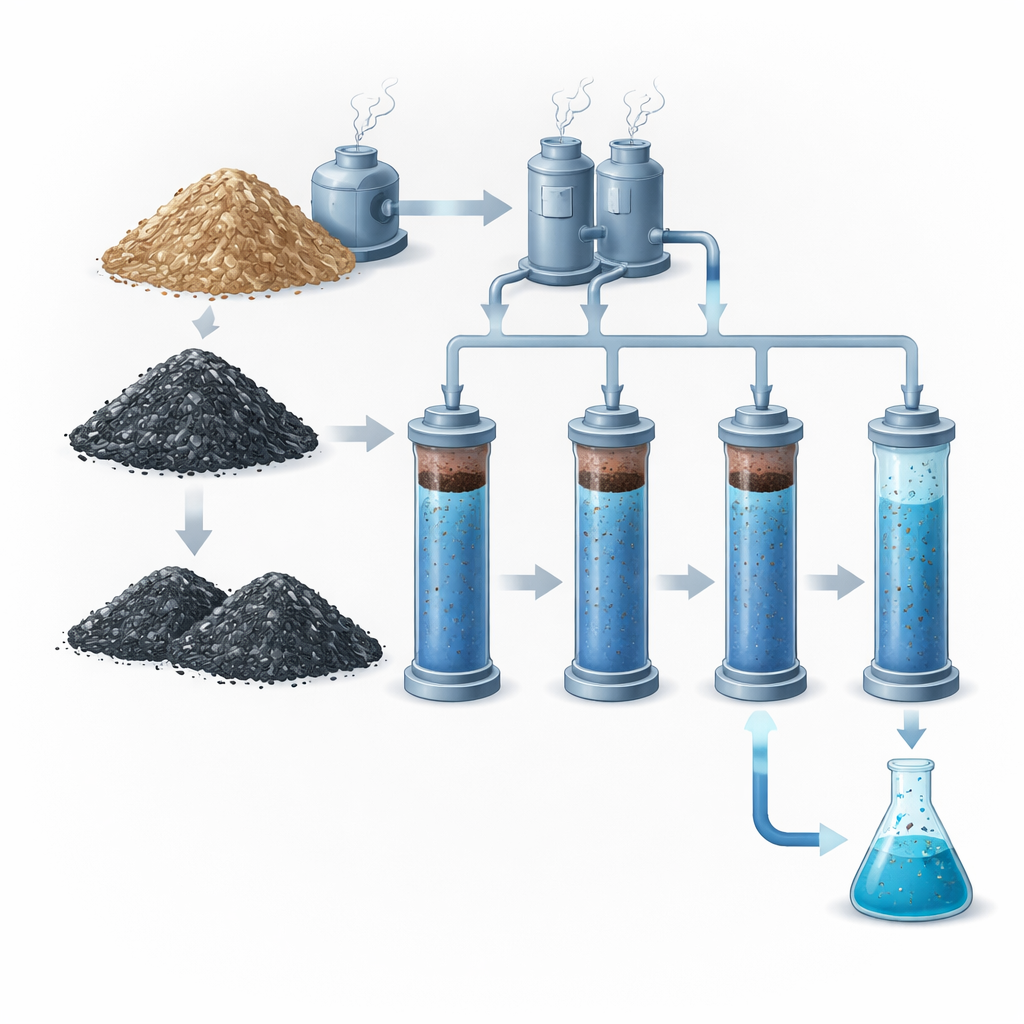
The researchers turned to two plentiful wastes available in Kazakhstan: rice husks from farming and fine particles from special coke used in metallurgy. Rice husks were washed, heated in the absence of air (pyrolysed), then activated with steam and treated with an alkaline solution to create a highly porous carbon material rich in tiny, reactive pores. The coke fines were used directly, without extra processing. Microscopy and chemical analyses showed that both materials are mostly carbon with mineral components, but they differ strongly in pore structure. These differences proved crucial: coke fines were better at soaking up organic impurities, while the modified rice-husk carbon was especially good at capturing rhenium ions.
How the New Filters Perform
In simple mixing tests, each material was exposed to real production solutions containing both rhenium and a complex blend of organic compounds. Coke fines selectively removed organics—up to around a third of them under acidic conditions—while leaving almost all of the rhenium in solution. The activated rice-husk adsorbent, by contrast, captured most of the rhenium (about 90% at modest concentrations) once the organics had been largely stripped away. Its performance followed well-known mathematical models of adsorption, indicating that rhenium formed a compact single layer on the carbon surface and that the process proceeded in a controlled, predictable way. The material’s capacity for rhenium in flow-through tests reached about 120 milligrams per gram of adsorbent, far higher than in static beaker experiments.
From Lab Columns to a Miniature Plant
To mimic industrial operation, the team built a small cascade of glass columns. The first three were packed with coke fines to preclean the incoming solution, which contained high levels of both rhenium and organic pollutants. The final column contained the rice-husk-based adsorbent to grab the metal itself. At an intermediate flow rate chosen to balance contact time and throughput, the system removed roughly three quarters of the organic impurities while recovering up to 97% of the rhenium before the filters became saturated. Chemical fingerprinting of the liquids before and after treatment showed that many problematic organic molecules, including certain acids and aldehydes, were sharply reduced. Spectroscopic measurements confirmed that rhenium binds to the rice-husk carbon as rhenium–oxygen species spread across the carbon fibers.

Closing the Loop in a Circular Process
Beyond capturing rhenium, the researchers also demonstrated that the metal can be washed back out of the rice-husk adsorbent using a warm ammonia solution, recovering about 90% of the bound rhenium while leaving the carbon ready for reuse with only minor loss of performance. Spent coke fines and by-products from rice-husk processing can themselves be diverted into making refractory materials, and process waters are recycled within the scheme. For a layperson, the takeaway is straightforward: by cleverly redesigning waste streams, it is possible to turn agricultural leftovers and industrial dust into a nearly waste-free filtration system that both cleans contaminated process water and salvages a valuable rare metal. If scaled up, this approach could make rare-metal production more sustainable, economical, and environmentally responsible.
Citation: Yefremova, S., Kablanbekov, A. Rhenium adsorption from an organic impurity–containing solution. Sci Rep 16, 7353 (2026). https://doi.org/10.1038/s41598-026-38148-9
Keywords: rhenium recovery, waste-derived adsorbents, rice husk biochar, industrial wastewater treatment, circular economy