Clear Sky Science · en
Rapid hydrothermal triggering of induced seismicity at the Coso geothermal field
Why shaking from clean energy matters
Geothermal power promises round-the-clock, low‑carbon electricity by tapping Earth’s natural heat. But sending water deep underground to harvest that heat can also trigger small earthquakes. This study looks at 15 years of data from the Coso Geothermal Field in eastern California to ask a practical question with global relevance: when operators change how much water they inject, and how cold it is, how does the subsurface respond? The answer helps explain when and where injection‑related earthquakes are likely to happen—and how power companies might adjust operations to reduce that risk while still producing energy.
A natural heat factory under stress
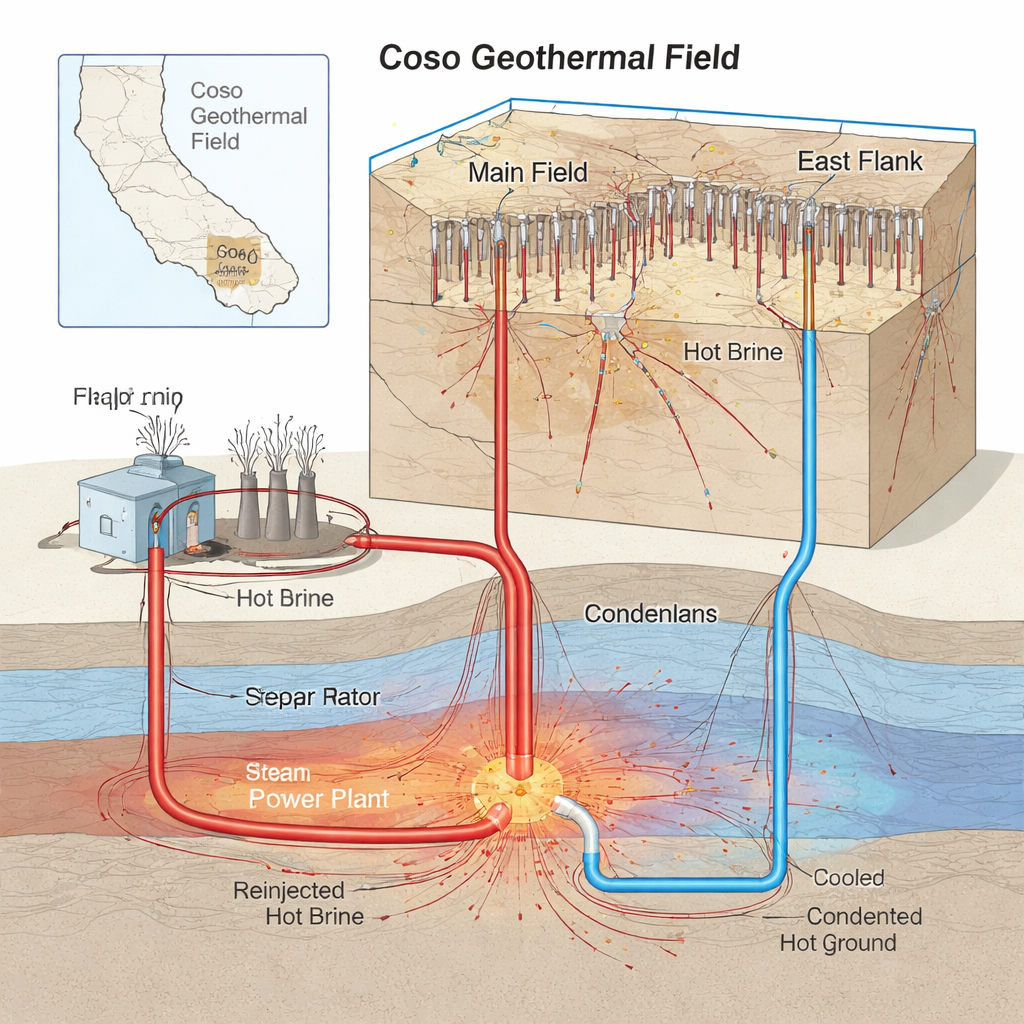
The Coso Geothermal Field sits in a geologically active area laced with fractures and faults above a deep heat source. Since the late 1980s, more than a hundred wells have produced hot, mineral‑rich water that is flashed into steam to spin power‑plant turbines. Afterward, operators reinject two main types of fluid back underground: hotter leftover brine from the separator and cooler condensed steam from the power plants. This constant circulation of hot and cold water changes pressures and temperatures in the fractured rock, subtly loading and unloading the faults. Coso has long been known for its frequent small earthquakes, but until now the short‑term links between daily plant operations and local shaking had not been mapped in detail.
Patterns that repeat with the seasons
The researchers combined a carefully processed local earthquake catalog—nearly 15,000 events of magnitude 1 and larger between 1996 and 2010—with daily records of how much fluid each well injected and how hot or cold it was. Using statistical tools that search for regular cycles in earthquake timing, they found a clear one‑year rhythm in parts of the field: more earthquakes occurred in winter than in summer. When they zoomed in on different zones, the strongest yearly pattern came from the southern part of the main production area, extending a couple of kilometers northward. That spatial fingerprint pointed toward a local cause rather than a broad regional effect such as changes in natural tectonic stress.
Cold water, fast response
To pinpoint what was driving this seasonal behavior, the team inspected the operational history of individual wells. Two neighboring injection wells in the southern main field stood out. In winter, they regularly received large volumes of especially cold condensed steam, whereas in summer overall injection volumes dropped and temperatures were higher. Earthquake rates near these wells, and in a band stretching roughly 2 kilometers to the north, rose sharply soon after the wintertime increase in cold injection began. In many cases, the seismic response was almost immediate and extended far beyond the small zone of rock that could have cooled in a few days, suggesting that simple, slow pressure diffusion of the injected water could not fully explain the observations.
Stresses that reach farther than the water
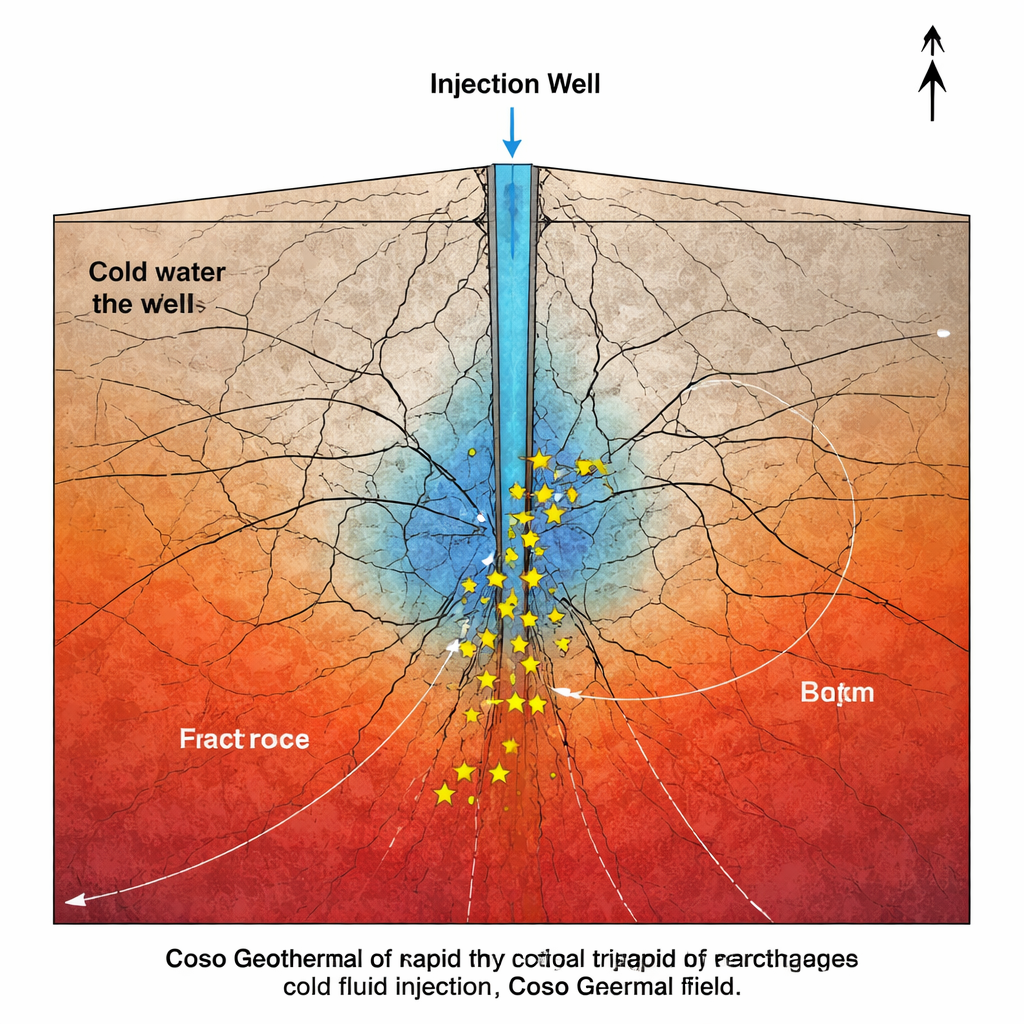
The authors argue that rapid changes in both pressure and temperature around the injection wells send out elastic stress waves through the fractured rock, nudging nearby faults over a much wider area toward failure. In several winters, bursts of earthquakes at distances up to about 2 kilometers coincided not just with rising injection volumes but also with drops in injection temperature during otherwise steady operations—evidence that cooling alone can trigger distant events. Moreover, these bursts lined up mainly along a north–south corridor, while nearby directions showed little or no response. That directional sensitivity suggests that the subsurface is anisotropic: some fracture and fault orientations, aligned with the regional stress field, act as fast‑track pathways for fluid movement and stress transfer, while other directions remain comparatively quiet.
What this means for safer geothermal power
For non‑specialists, the takeaway is that not all injected water is equal. At Coso, short‑term increases in small earthquakes are tied most strongly to periodic injections of colder fluids, especially when large volumes are sent into a fracture‑rich zone already near its breaking point. Because the earthquakes can appear almost instantly and kilometers away from the wells, operators cannot rely solely on slow pressure buildup models. Instead, they need to account for how rapid cooling and rock contraction change stresses along preferred directions in the subsurface. By understanding these patterns, geothermal projects can better design injection schedules—such as smoothing out wintertime cold‑water pulses or distributing them among wells—to maintain permeability and energy production while keeping induced shaking within acceptable limits.
Citation: Holmgren, J.M., Kaven, J.O. & Oye, V. Rapid hydrothermal triggering of induced seismicity at the Coso geothermal field. Sci Rep 16, 7057 (2026). https://doi.org/10.1038/s41598-026-38146-x
Keywords: geothermal energy, induced seismicity, fluid injection, Coso Geothermal Field, reservoir engineering