Clear Sky Science · en
A decadal analysis of drinking water quality and nitrate-related health risk assessment in groundwater sources: a case study of Poldasht County, Northwest Iran
Why this study matters for everyday water drinkers
For people living in dry regions, the water that comes out of the tap often comes from underground — out of sight and usually out of mind. This study looks closely at a decade of drinking water pumped from wells in Poldasht County in northwest Iran, asking two simple but vital questions: how good is the water, and does the level of nitrate, a common fertilizer ingredient, pose a health risk, especially to children?
Looking underground in a thirsty landscape
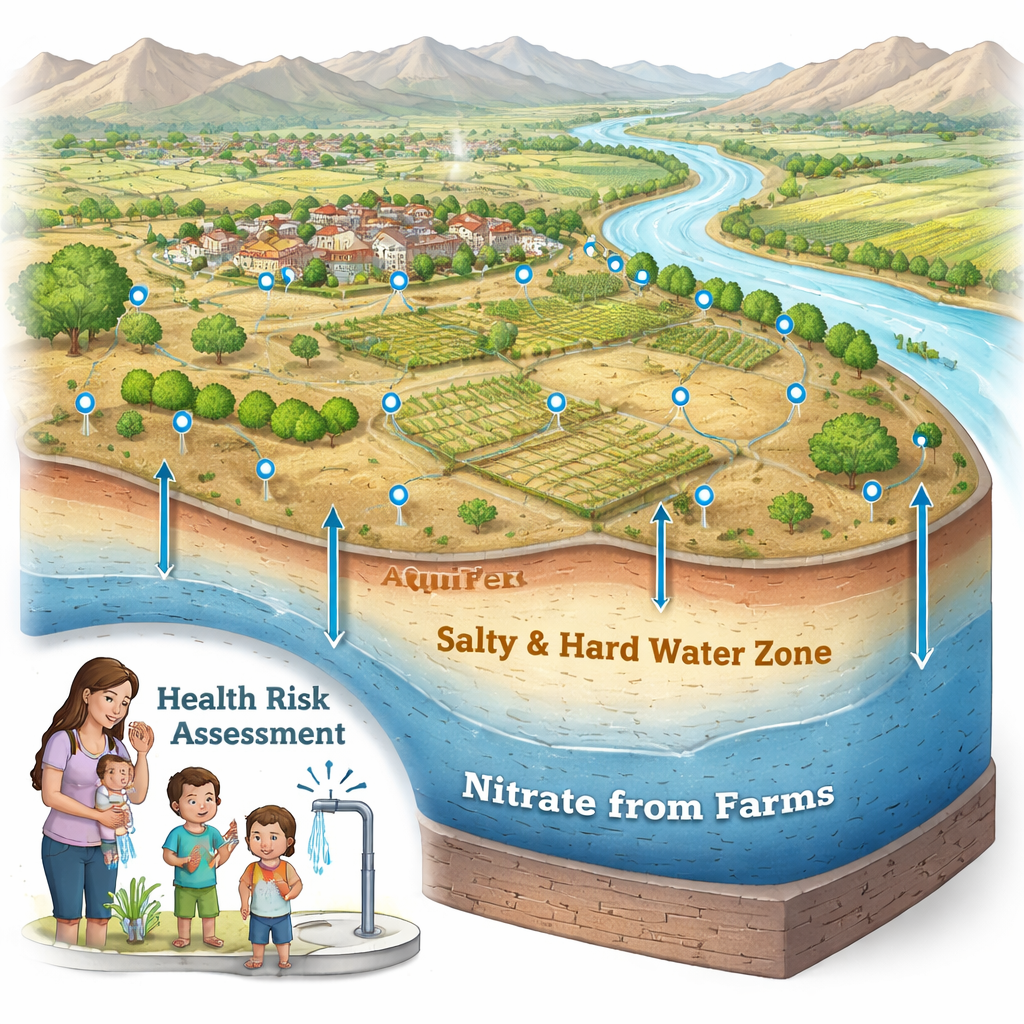
Poldasht lies in a semi‑arid area where rainfall is low and communities rely heavily on groundwater for drinking and irrigation. The research team sampled 17 drinking‑water wells repeatedly over ten years, from 2012 to 2022. They measured basic properties such as acidity (pH), dissolved salts, and hardness, as well as key dissolved ingredients like calcium, magnesium, sodium, chloride, sulfate, bicarbonate, and nitrate. Using mapping software, they created color‑coded maps that reveal how water quality changes from place to place across the county and over time.
Salty and very hard water as the main challenge
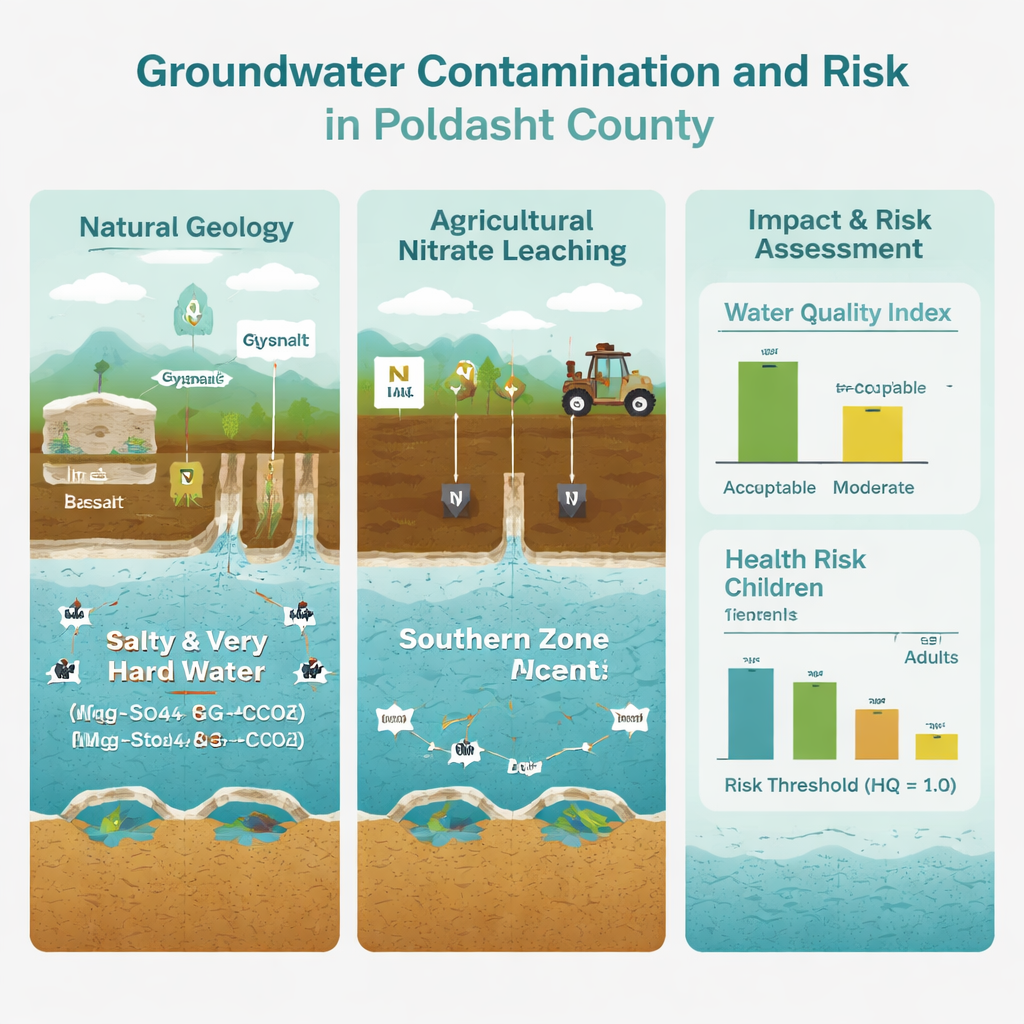
Overall, the water’s acidity stayed in a comfortable range for drinking. The real issues were saltiness and hardness. Many wells contained high levels of dissolved minerals, especially sulfate and magnesium, that push total dissolved solids and hardness above World Health Organization guideline levels. The central part of the plain showed the worst combination of salty and very hard water, while the northern and some southern edges had fresher supplies. These patterns match the local geology: layers of gypsum, limestone, and dolomite rocks gradually dissolve into the water, loading it with minerals that can cause scale in pipes, a bitter taste, and reduced performance of soaps and appliances.
Fertilizers, nitrate, and who is most vulnerable
Nitrate, a form of nitrogen widely used in chemical fertilizers and found in animal waste, is a particular worry because it can seep into groundwater and, at high levels, harm infants and children. In Poldasht, the highest nitrate levels appeared in the southern belt of the county, where farming is most intense, confirming that agriculture is the main human source. To judge health impacts, the researchers used a standard U.S. Environmental Protection Agency method called the hazard quotient. This compares how much nitrate people of different ages take in from water against a reference level considered safe. They ran the numbers separately for infants, children, teenagers, and adults, taking into account typical body weights and daily water intake.
Water quality scores and health risk findings
To give an overall score for each well, the team applied a Groundwater Quality Index that combines several chemical measurements into a single number from 1 to 100. About two‑thirds of wells landed in the “acceptable” class, while one‑third were rated “moderate,” mainly where sulfate, salt, and hardness were high. None fell into the “poor” or “unfit” categories, but many samples were still classified as “very hard” water. When they looked at nitrate health risk, every age group at every well stayed below the hazard threshold — meaning no significant non‑cancer health risk from nitrate at current levels. Children, however, consistently had the highest hazard values because they drink more water relative to their body weight, highlighting them as the most sensitive group, even when the calculated risk is still considered low.
What this means for families and planners
For residents of Poldasht, the results are a mixed message. On the positive side, the study suggests that nitrate in drinking water is not currently high enough to cause direct health problems, even for children. On the cautionary side, many wells deliver very hard and somewhat salty water, and some farming areas show early signs of rising nitrate. The authors argue that regular monitoring, smarter fertilizer use, and targeted treatment or blending of water from different wells are needed to keep problems from worsening. In short, the water is generally safe to drink now, but protecting it for the future will require careful management of both the rocks beneath people’s feet and the farming practices on the land above.
Citation: Valizadeh, A., Asgari, E., Fazli, M.M. et al. A decadal analysis of drinking water quality and nitrate-related health risk assessment in groundwater sources: a case study of Poldasht County, Northwest Iran. Sci Rep 16, 7525 (2026). https://doi.org/10.1038/s41598-026-38143-0
Keywords: groundwater, nitrate, drinking water quality, health risk, Iran