Clear Sky Science · en
Experimental investigation of diffusion flames with different baffle-plate air-hole diameters
Why tiny holes in burners matter
From home heaters to power plants and ship engines, many devices burn gas to make heat. This study looks at a surprisingly simple detail that can strongly affect how clean and efficient that burning is: the size of the small air holes in a metal plate inside the burner, called a baffle plate. By changing only these hole diameters while keeping the fuel supply the same, the researchers show how flame shape, temperature, pollution, and efficiency all shift—insights that can help design safer, more efficient gas appliances.
A closer look at a common gas flame
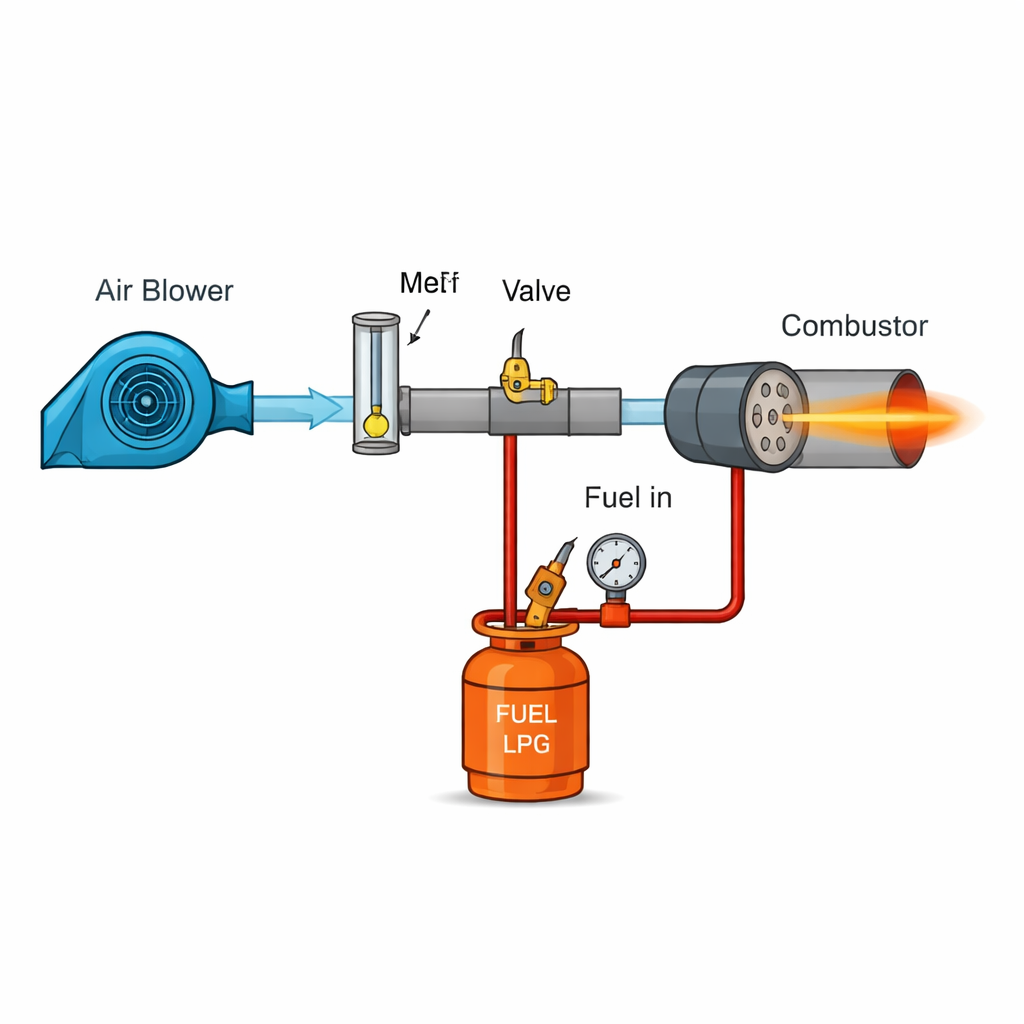
The team focused on “diffusion flames,” the type of flame where fuel and air meet and mix as they burn, rather than being fully blended beforehand. Diffusion flames are popular in industry because they tend to be stable and reliable, but they often waste more fuel and emit more pollutants than well-mixed flames. Here, the fuel was Liquefied Petroleum Gas (LPG), a common blend of butane and propane. The researchers built a metal test chamber—a simple cylindrical combustor—and placed a flat baffle plate with eight circular air holes just upstream of where the gas was injected. By testing five different hole diameters from 8 to 15 millimeters, and four air–fuel ratios, they could see in a controlled way how this one geometric feature changes the entire behavior of the flame.
How the experiment was run
Air was pushed into the chamber by a blower and carefully metered; LPG was fed from a pressurized cylinder through a central nozzle. The total fuel flow was held constant so that the heat input remained at 32 kilowatts, similar to a medium-sized industrial burner, while the air flow was adjusted to reach different air–fuel ratios. The team measured flame stability—how easily the flame ignites and blows off—as well as temperature maps inside the combustor, peak flame temperatures, flame length, and the amounts of oxygen, carbon dioxide, carbon monoxide, and nitric oxide in the exhaust. They also tracked where the heat went: into cooling water, out with the hot gases, or lost through the metal walls, so they could calculate overall combustion efficiency.
What changing the hole size does to the flame
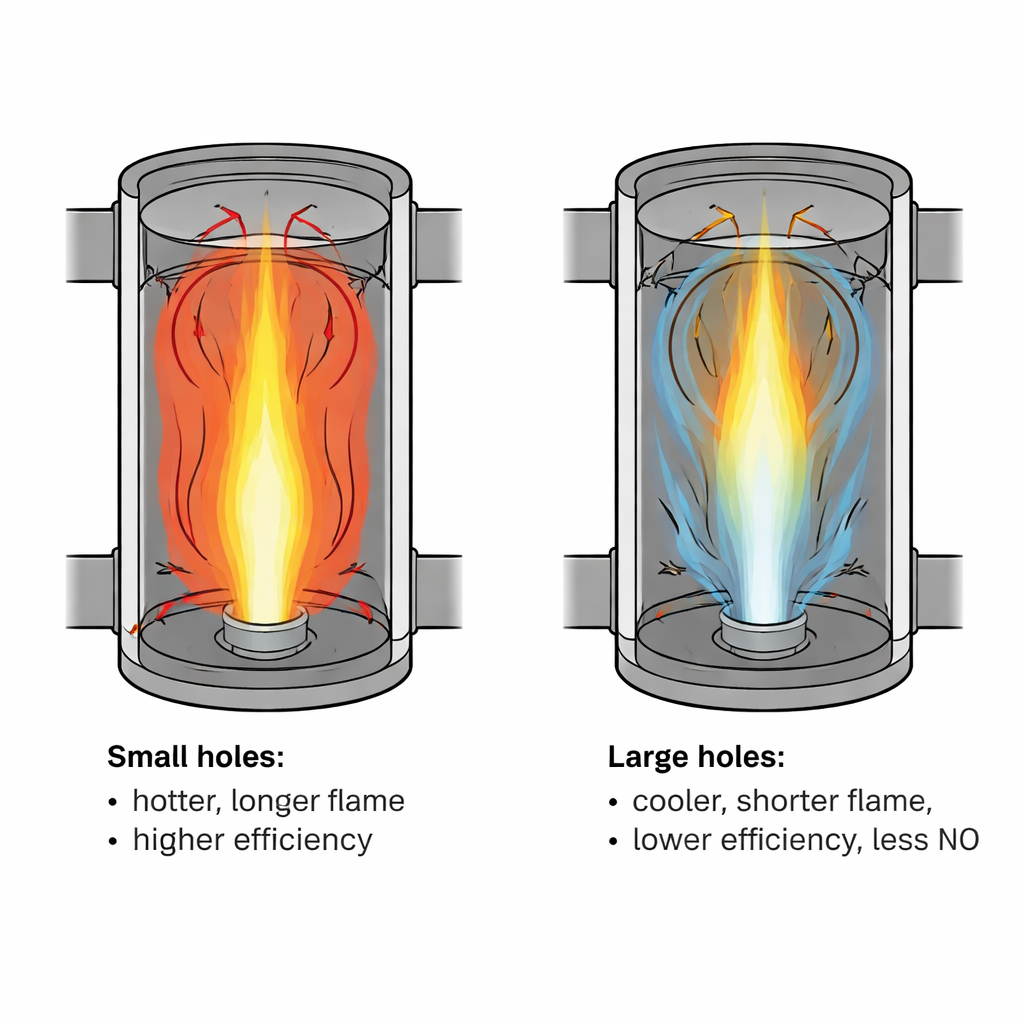
Hole size turned out to be a powerful control knob. Larger holes lowered the speed of the entering air jets and widened the range of conditions over which a steady flame could be kept, giving a broader “stability window.” However, these same larger holes shifted the hottest region closer to the baffle plate and reduced both peak flame temperatures and the visible length of the flame. Smaller holes produced faster air jets that mixed fuel and air more vigorously in the center of the chamber, raising maximum flame temperatures and stretching the flame farther downstream, but at the cost of a narrower safe operating range. The researchers captured these trends in a simple equation that predicts the flame length from just the air–fuel ratio and the hole diameter, matching their measurements within about 2.5 percent.
Pollution and efficiency trade-offs
The gases in the exhaust told a similar story of trade-offs. Larger holes, which cooled the flame, tended to reduce nitric oxide (NO), a temperature-sensitive pollutant that contributes to smog, but increased carbon dioxide and carbon monoxide levels along the flame’s length. Smaller holes, with their hotter, more vigorous flames, produced more NO but allowed carbon monoxide to be more fully burned away. When the team combined all the heat flows into a single combustion efficiency value, they found that efficiency dropped noticeably as the hole diameter increased. For example, increasing hole size from 10 to 15 millimeters reduced efficiency by about 10 to 11 percent under some air–fuel conditions, largely because more heat was carried away or lost to the walls rather than being usefully captured.
What this means for real burners
For a non-specialist, the main message is that tiny design choices inside burners—such as the diameter of air holes in a simple metal plate—can shift the balance between stability, efficiency, and pollution. Smaller holes can squeeze more useful heat from the same amount of LPG but demand tighter control to avoid flame problems and may raise some pollutants; larger holes make the flame more forgiving but waste more fuel and heat. The detailed measurements and simple design rule developed in this work give engineers a practical guide to tune burner hardware for specific goals, whether that is maximum efficiency, lower emissions, or robust operation in compact heating and power systems.
Citation: Mohammed, E.S., Gad, H.M., Ibrahim, I.A. et al. Experimental investigation of diffusion flames with different baffle-plate air-hole diameters. Sci Rep 16, 7479 (2026). https://doi.org/10.1038/s41598-026-38141-2
Keywords: LPG combustion, diffusion flames, baffle plate, burner efficiency, flame stability