Clear Sky Science · en
Mesh sensitivity and experimental verification for randomized arbitrary geometry cavity-based acoustic metamaterials designed with 2D FEM simulations
Quieting Noise with Tiny Labyrinths
Modern life is loud: from factory floors to open-plan offices, unwanted noise can harm our health and concentration. Engineers are now turning to “acoustic metamaterials” – carefully designed structures that tame sound in ways ordinary foam and fiberglass cannot. This paper explores a new, faster way to design a special class of these materials, ones that use maze-like internal channels to soak up sound while staying compact and lightweight.
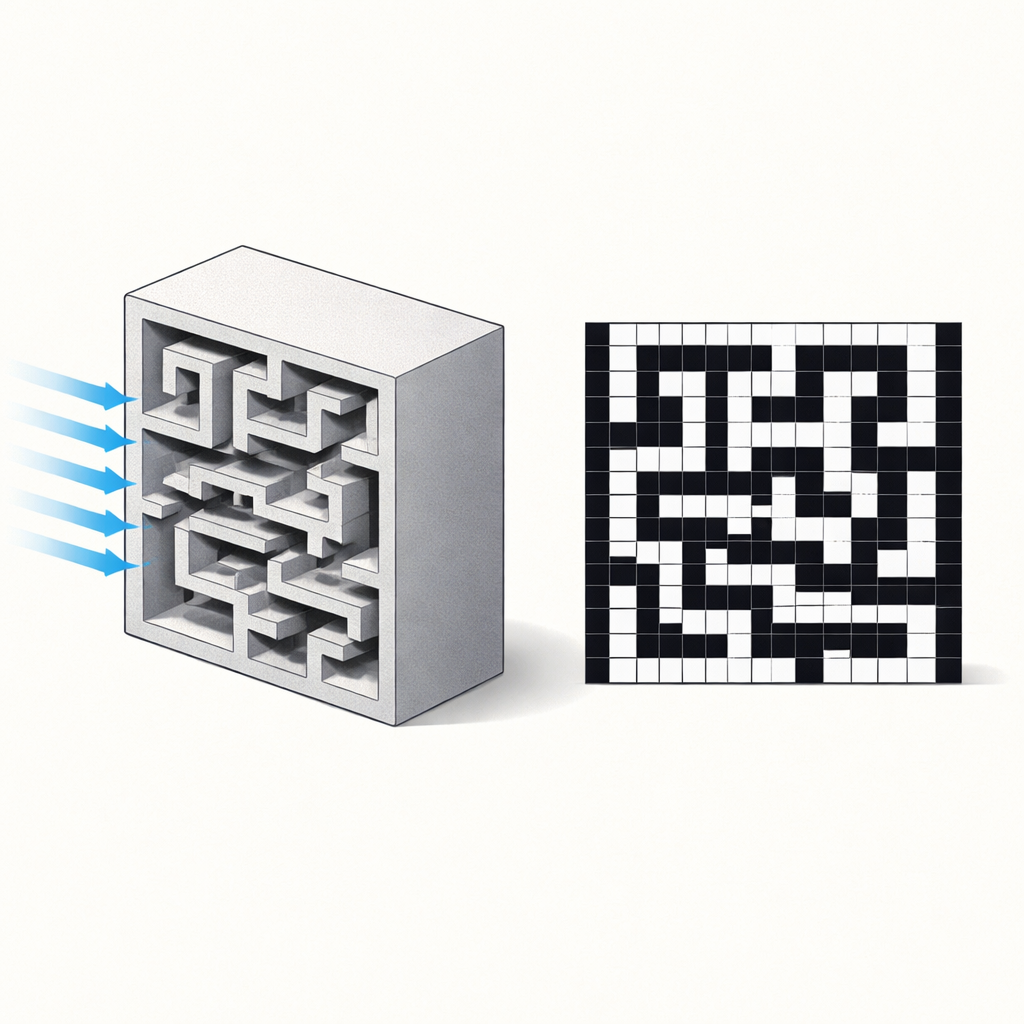
Building Smart Sound-Trapping Mazes
Acoustic metamaterials are repeating building blocks full of narrow cavities and channels that manipulate sound waves. Many of today’s high-performance sound absorbers rely on resonators – small pockets and tubes that vibrate at particular tones and convert acoustic energy into heat. The designs discussed here are “cavity-based” metamaterials, where sound is forced through winding labyrinths of air. As sound squeezes through these tight passages, friction and tiny temperature changes along the walls drain energy from the wave, reducing the noise that passes through.
Why Conventional Simulations Hit a Wall
To design such intricate structures, researchers normally use powerful computer simulations based on the finite element method (FEM). These models track how sound moves and how energy is lost in the thin “boundary layers” of air that hug the channel walls. But when the geometry is complex and truly three-dimensional, faithfully modeling these thermoviscous effects demands an enormous number of calculation points, or mesh elements. In practice, a full 3D model that fully resolves these layers can take days of computing time for a single design, making systematic optimization across many shapes essentially impossible.
Flattening 3D Designs into 2D Maps
The authors propose a different strategy: represent a 3D metamaterial cell by a single 2D cross-section and simulate only that slice. They focus on structures that can be formed by extruding a flat pattern straight out of the plane, such as labyrinth-like channels. Each design is encoded as a simple black-and-white bitmap, where one pixel stands for a 2-millimeter square of either solid wall or air. This turns the design problem into arranging pixels in a grid that obeys basic rules (continuous air paths, no isolated pockets, no single-pixel “spikes” of material), and then using a 2D FEM model that includes thermoviscous losses to predict how much sound the structure will absorb over a range of frequencies.
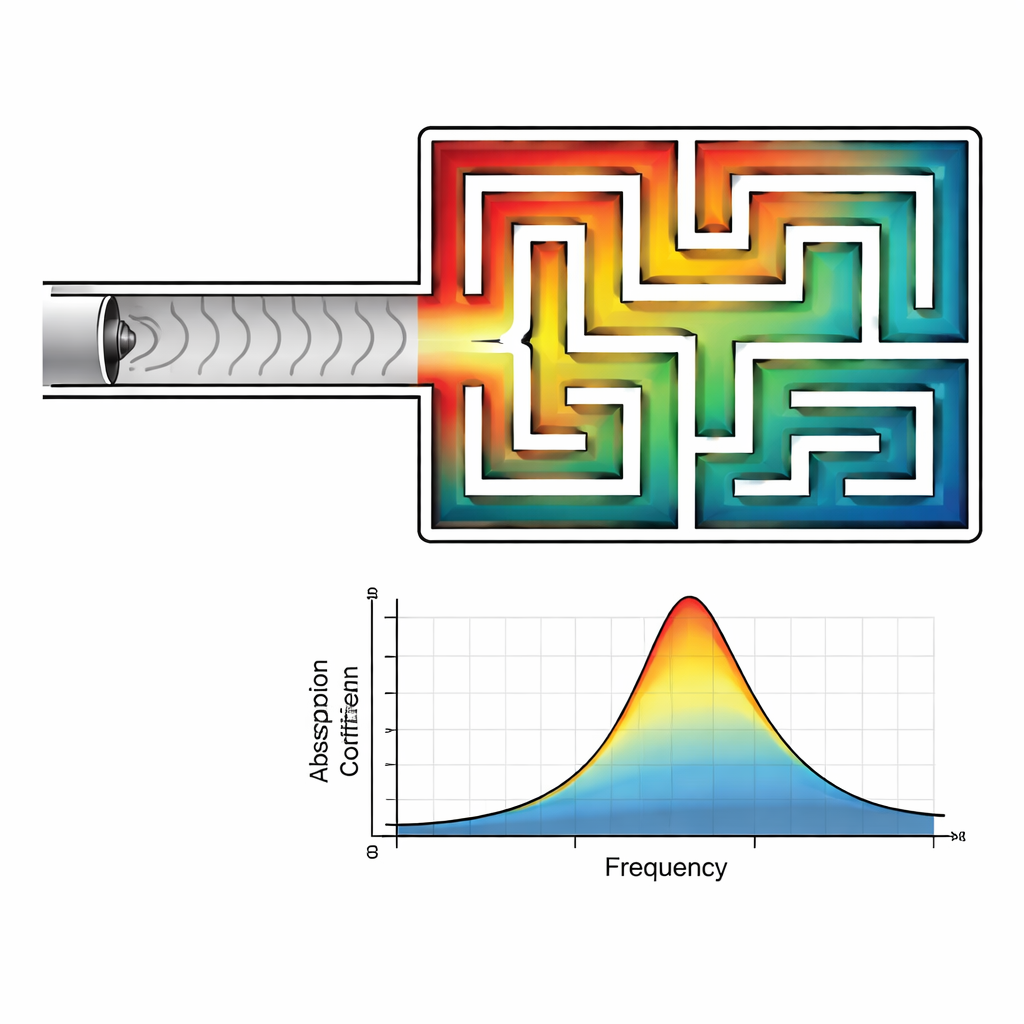
Testing Accuracy and Trimming Computation
To check that a flat model can stand in for a full 3D one, the researchers first compared several approaches on a simple test structure with just two resonators. They looked at analytical formulas (the transfer matrix method), standard 3D FEM, their 2D reduced model, and real measurements in an impedance tube. The 3D simulation with full thermoviscous physics took nearly six days to compute and still showed noticeable frequency shifts. By contrast, the 2D thermoviscous model ran in a few minutes and matched the measured peak absorption frequency within about a quarter of a percent. Encouraged by this, they moved on to more complex, randomly generated labyrinth geometries encoded as 32×32 pixel maps.
How Coarse Can the Mesh Be and Still Work?
Because most of the computing cost comes from resolving the mesh near the walls, the team systematically varied two scaling factors that control how thin the first near-wall layer is and how many such layers are used. Across twenty different maze-like structures and seventy-five mesh settings each, they measured how much the predicted sound absorption curves changed relative to a very fine “reference” mesh. They found that even when the boundary layer mesh was substantially coarsened, the average error in the predicted absorption remained under 0.5% for a wide set of settings, while the number of unknowns in the computation dropped by more than 70%. Finally, they 3D-printed six new structures and compared the 2D model to tube measurements. The model predicted resonance frequencies to within about 2.6% on average, with larger differences mainly in peak height, likely caused by surface roughness and material losses in the printed plastic.
What This Means for Future Noise Control
For a lay reader, the main message is that the authors have shown how to turn a very heavy 3D sound-simulation problem into a much lighter 2D one, without sacrificing practical accuracy for a broad class of maze-like absorbers. By working with pixelated blueprints and carefully tuned meshes, they can explore many more candidate designs on ordinary computers, paving the way for automated optimization and even AI-driven generation of new acoustic metamaterials. While the method does not cover every possible geometry and has so far been tested within a limited frequency band, it offers a powerful shortcut toward quieter machines, rooms and devices built from cleverly arranged, sound-hungry labyrinths.
Citation: Książek, P., Chojnacki, B. Mesh sensitivity and experimental verification for randomized arbitrary geometry cavity-based acoustic metamaterials designed with 2D FEM simulations. Sci Rep 16, 6873 (2026). https://doi.org/10.1038/s41598-026-38139-w
Keywords: acoustic metamaterials, sound absorption, finite element modelling, labyrinth structures, impedance tube