Clear Sky Science · en
Nutrient availability drives local seasonal movements of an endangered marine megafauna species
Why the world’s biggest fish follow invisible food
For many visitors to the Maldives, glimpsing a whale shark is the highlight of a lifetime. But these gentle giants do not appear at random. This study shows that their local movements within a famous Maldivian marine park are closely tied to tiny plant-like organisms in the water, revealing how life at the smallest scale shapes the behaviour of one of the ocean’s largest creatures.
A natural laboratory for gentle giants
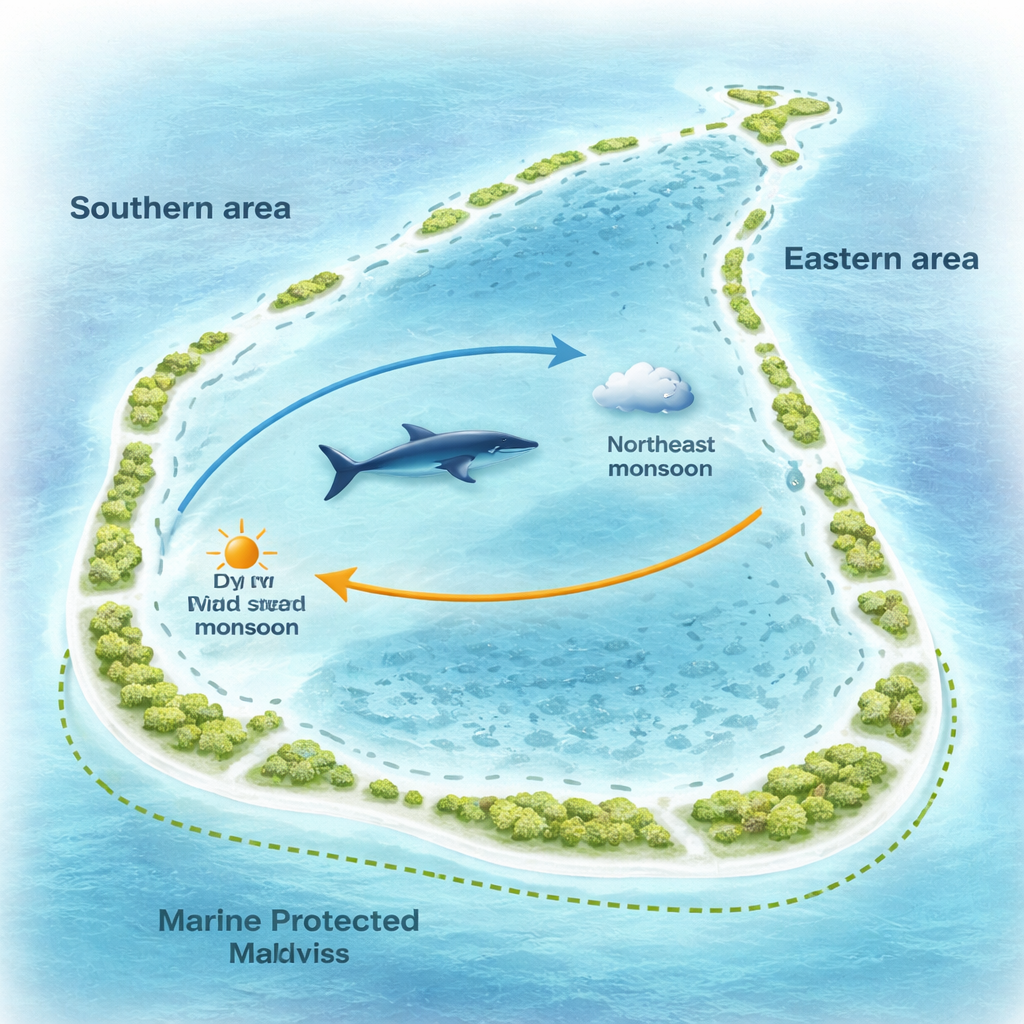
The research focuses on the South Ari Marine Protected Area (SAMPA) in the Maldives, one of the few places on Earth where whale sharks can be seen year-round. Unlike some other hotspots, there is no feeding by humans or artificial lights to lure sharks here, making SAMPA an ideal place to study natural patterns. Most of the sharks are juvenile males that cruise the surface waters, where they are also exposed to intense tourism pressure and frequent boat traffic. Understanding where and when they gather within the protected area is crucial for both their survival and for managing the booming shark-watching industry.
Monsoon seasons and a hidden food chain
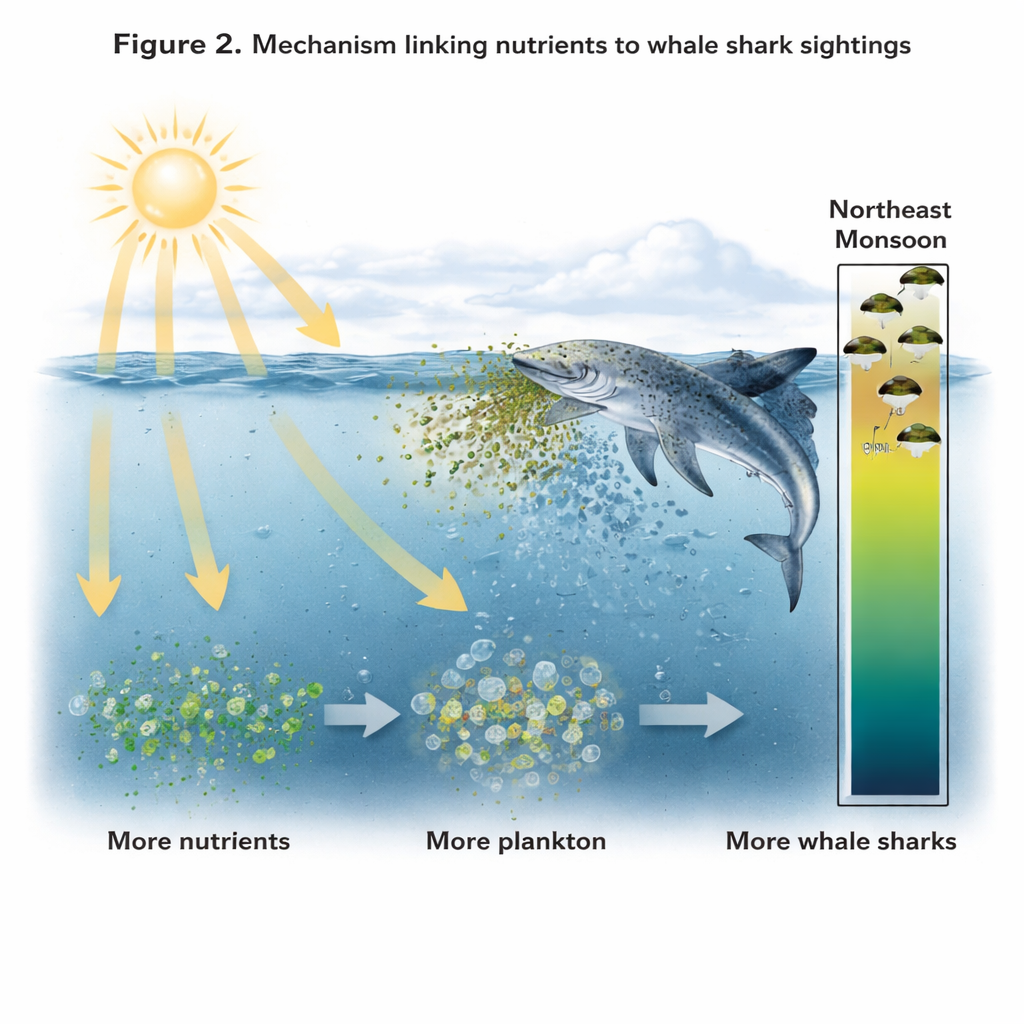
The Maldives experience two main monsoon seasons: a calmer, drier Northeast Monsoon from January to March, and a windier, rougher Southwest Monsoon from mid-May to November, with short transition periods in between. These shifts in wind and weather stir the ocean and affect the microscopic life at its base. The scientists used satellite data to track chlorophyll-a, a green pigment that indicates how much phytoplankton is in the water. Phytoplankton feed zooplankton, which in turn are a key food source for whale sharks. They also measured sea surface temperature to see whether warmer or cooler waters might influence where sharks appear.
Four years of watching sharks and water
Between 2016 and 2019, researchers and trained volunteers ran boat surveys along a 24-kilometre route in SAMPA whenever weather allowed, recording every whale shark sighting and its position. They then divided the protected area into a Southern and an Eastern region and calculated how many sharks were seen per survey in each. Monthly averages of chlorophyll-a and sea surface temperature, taken from NASA’s MODIS-Aqua satellite at a coarse grid scale, were matched to those same regions. Using advanced statistical models, the team tested how shark sightings rose and fell with season, region, and the two environmental measures.
Food, not warmth, sets the schedule
The results revealed clear seasonal rhythms. Chlorophyll-a levels in the south of SAMPA spiked during the Northeast Monsoon, suggesting richer plankton blooms there at that time, while levels in the east stayed more constant. Sea surface temperature changed seasonally too, warming slightly around March and April, but it was similar across both regions. Shark sightings per survey also followed a strong seasonal pattern, peaking in the southern part of the protected area during the Northeast Monsoon and dropping as the seasons shifted. Crucially, shark numbers were strongly linked to chlorophyll-a but not to temperature, and the combination of both factors offered no extra explanatory power beyond chlorophyll alone.
Guiding smarter protection in a changing ocean
These findings point to a simple explanation: within this year-round aggregation, whale sharks move locally to track pockets of abundant prey rather than seeking out warmer water. In practical terms, that means managers can use indicators like chlorophyll-a to predict when and where sharks are most likely to gather, both in SAMPA and potentially at other sites. This could support “dynamic” protection, where patrols, speed limits, and tourism rules are focused in high-use areas during peak seasons. As climate change alters ocean conditions and plankton blooms worldwide, knowing that the world’s largest fish follow these invisible patches of food helps scientists forecast how their hotspots—and the livelihoods built around them—may shift in the future.
Citation: Carroll, D., Zareer, I.H., Pérez, C.C. et al. Nutrient availability drives local seasonal movements of an endangered marine megafauna species. Sci Rep 16, 4997 (2026). https://doi.org/10.1038/s41598-026-38138-x
Keywords: whale sharks, Maldives, plankton, marine protected areas, animal movement