Clear Sky Science · en
Correlations between chromaticity parameters and shear strength of granite residual soil with different free iron oxide content and moisture content
Why the Color of Soil Matters
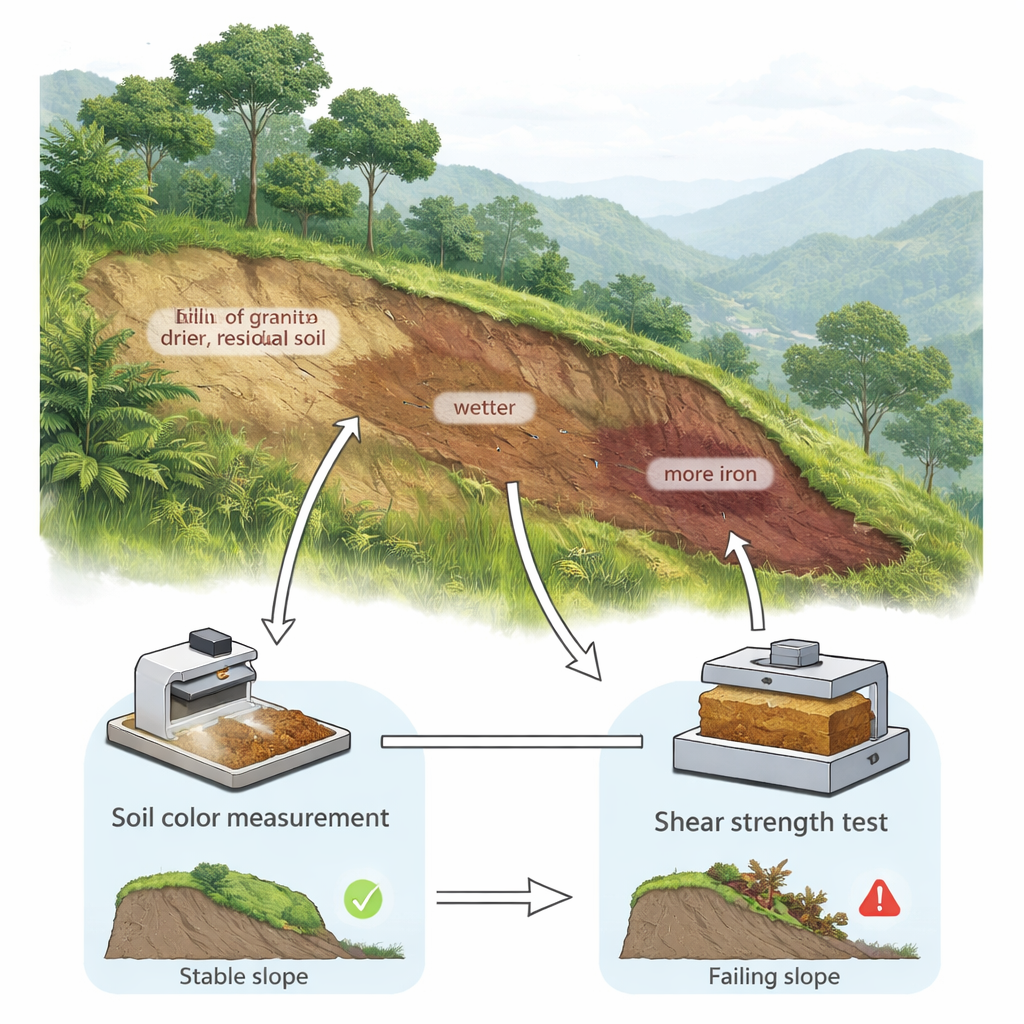
If you have ever noticed how earth ranges from pale brown to deep red, you’ve already glimpsed clues that geologists use to judge whether a hillside might stand firm or give way. In southern China’s hot, rainy climate, slopes are often made of granite residual soil—a crumbly material left behind when granite weathers. This study asks a practical question: can we read that soil’s color, using simple instruments, to quickly estimate how strong it is and how likely it is to fail during storms?
Hillsides Shaped by Heat, Rain, and Rust
Granite residual soil is widespread across the mountains of southern China and is closely tied to landslides and gully erosion. It has many pores, lets water through only slowly, and can weaken sharply when it gets wet. Two ingredients are especially important. One is water, which can either help bind grains together or, in excess, make them slip. The other is free iron oxide—the “rusty” minerals, mainly hematite and goethite, that give the soil its red and yellow-brown tones and act as natural cement between grains. Because both water and iron oxides also control how soil looks, the authors suspected that soil color could serve as a fast, low-cost window into its mechanical strength.
From Red Dirt to Numbers in the Lab
The team collected typical granite residual soil from southeastern Guangxi, where slopes built on this material are common. They carefully adjusted the soil to create samples with five different iron oxide contents and five different moisture levels, mimicking the range seen in the field. For each sample, they used a precise color meter based on the CIE L*a*b* system, which turns color into three numbers: lightness (L*), redness–greenness (a*), and yellowness–blueness (b*). They also performed direct shear tests, which squeeze and slide soil specimens under controlled loads to measure two key strength properties: cohesion (how strongly grains stick together) and internal friction angle (how much the grains resist sliding past one another).
How Water and Rust Change Both Color and Strength
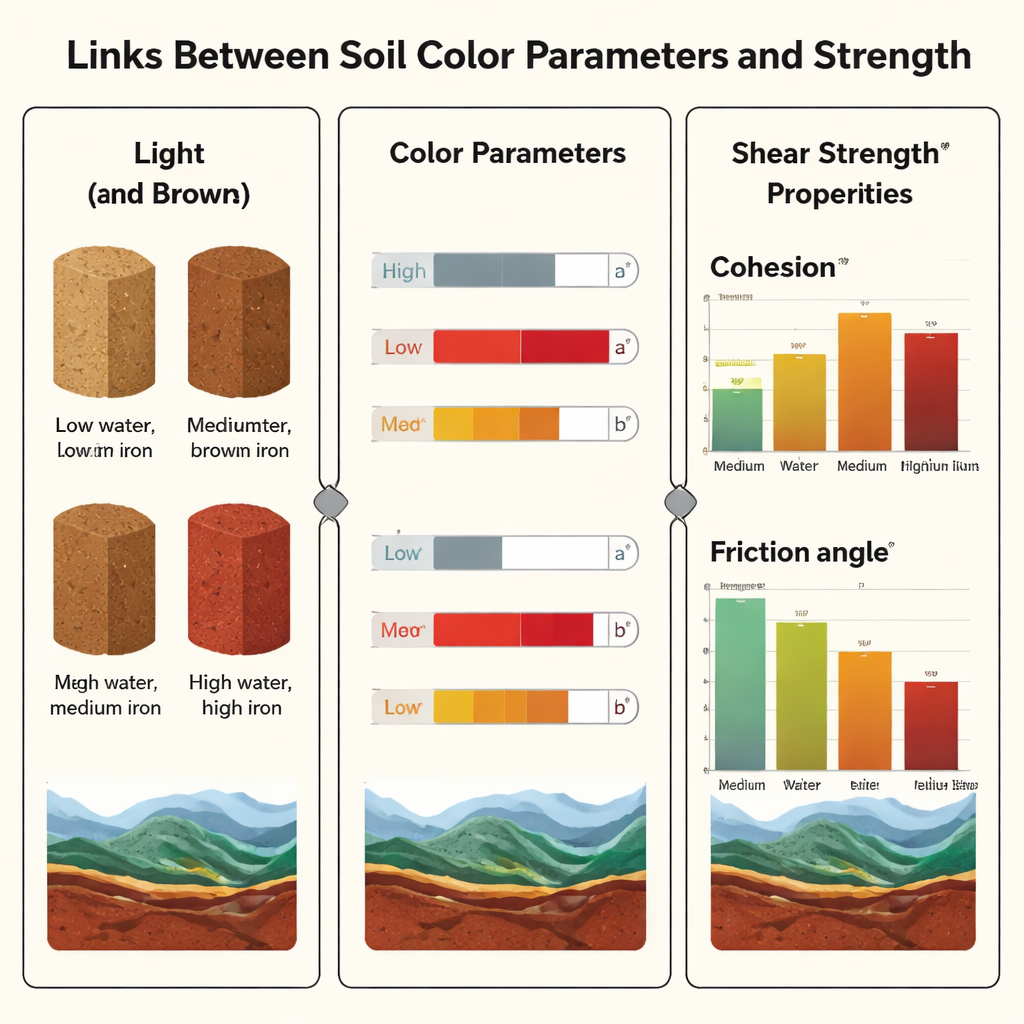
As water content rose, the soil samples became darker and less vivid in color: L*, a*, and b* all decreased. Physically, more water absorbs and traps light in the pores, replacing bright, diffuse reflections with darker, mirror-like reflections from thin water films. Free iron oxide had a different effect. At a given moisture level, more iron made the soil look redder and somewhat more yellow, boosting the a* and b* values, while leaving lightness largely unchanged. The mechanical behavior followed its own patterns. The friction angle steadily dropped as the soil became wetter, because thicker water films lubricate grain contacts and dissolve some of the natural cement. Cohesion, in contrast, first increased and then decreased with added water: a moderate amount helped form cementing bonds, but too much water broke them up. At any fixed moisture level, cohesion rose clearly with higher iron oxide content, confirming that these rusty coatings are an important glue in the soil.
Turning Color Readings into Strength Estimates
Because the same two factors—water and iron oxides—govern both color and strength, the researchers used statistical modeling to link the color indices directly to cohesion and friction angle. They showed that water content could be expressed as a simple function of lightness (L*), and that free iron oxide could be related to the redness index (a*), with additional refinement from L*. Combining these relationships, they derived formulas that estimate friction angle mainly from L*, and cohesion from a combination of L* and a*. When they tested the model on 20 new soil samples from nearby areas, the predicted strength values agreed reasonably well with laboratory measurements, capturing about three-quarters of the variation in both cohesion and friction angle.
A Faster Way to Judge Risk on Red Slopes
For non-specialists, the key message is that the color of these red, weathered soils is more than cosmetic—it encodes information about how much water they hold and how strongly their grains are bound together. By translating color into strength, engineers could one day use simple handheld color meters, or even well-calibrated images, to screen slopes quickly for potential weakness without waiting for time-consuming mechanical tests. While this study focuses on granite residual soils rich in hematite under a humid climate, it points toward a broader future where reading the subtle shades of soil helps keep roads, buildings, and communities safer from landslides.
Citation: Wang, Z., Deng, W., Diao, C. et al. Correlations between chromaticity parameters and shear strength of granite residual soil with different free iron oxide content and moisture content. Sci Rep 16, 6875 (2026). https://doi.org/10.1038/s41598-026-38135-0
Keywords: granite residual soil, soil color, shear strength, iron oxide, slope stability