Clear Sky Science · en
The weight-adjusted waist index predicts sarcopenia in community-dwelling older adults in a nationwide multicenter prospective study
Why your waistline matters as you age
As people grow older, many notice their waistlines expanding even if their weight on the scale does not change much. At the same time, muscles slowly shrink and weaken, raising the risk of falls, disability, heart disease, and even earlier death. This study asks a practical question with big implications: can a simple measurement that combines waist size and body weight help doctors spot older adults who are silently losing muscle before serious problems appear?
A simple number with a deeper message
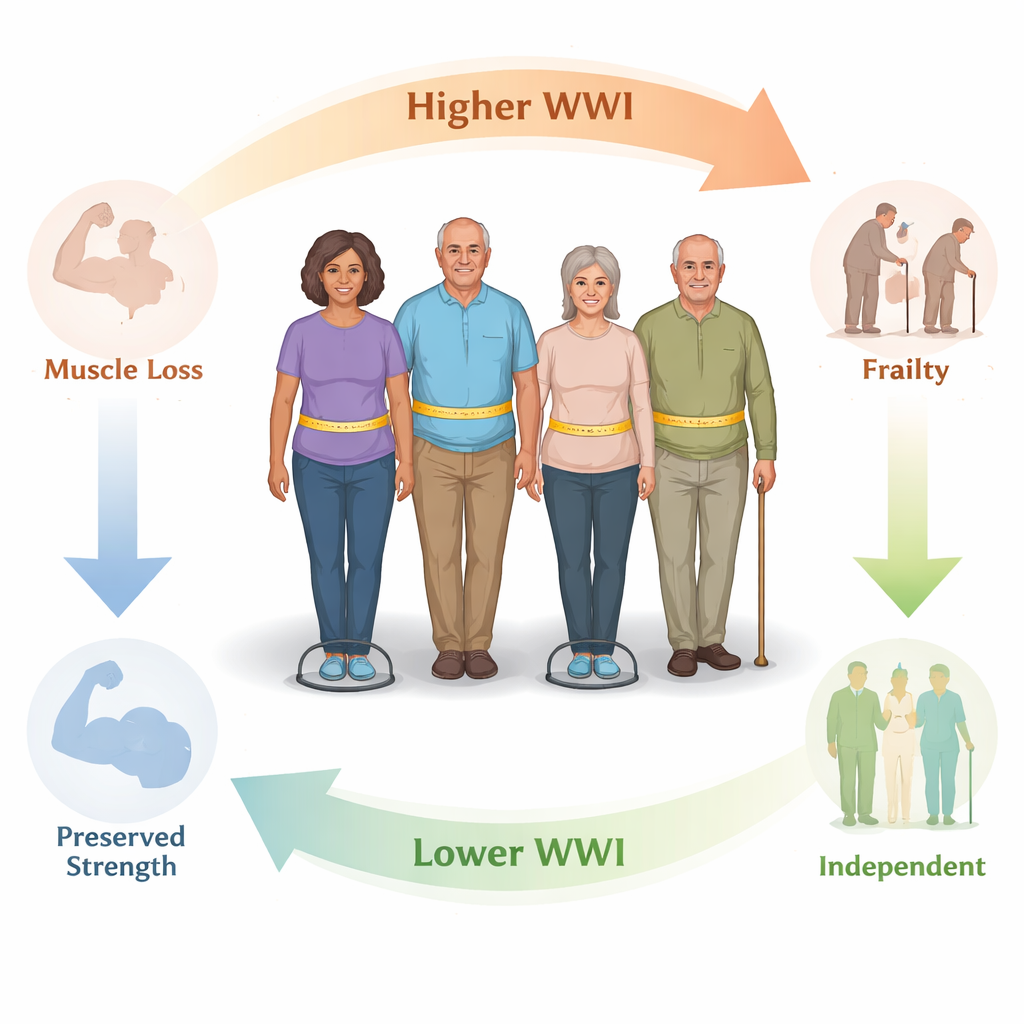
The researchers focused on a measure called the weight-adjusted waist index, or WWI. It is calculated by dividing a person’s waist circumference by the square root of their body weight. Unlike body mass index (BMI), which cannot tell fat from muscle, WWI is designed to highlight extra belly fat while accounting for overall body size. Earlier work suggested that a higher WWI goes hand in hand with more fat, less muscle, and higher risks of diabetes, heart disease, and death. The new study tested whether WWI can also predict who will go on to develop sarcopenia—a condition defined by both low muscle mass and weak grip strength.
Tracking muscle health in everyday life
The team used data from the Korean Frailty and Aging Cohort Study, which follows thousands of community-dwelling adults aged 70 to 84 years. From this large group, they selected 1,724 people who did not have sarcopenia at the start. Each participant had their waist measured, weight recorded, and WWI calculated. Muscle mass in the arms and legs was measured with a body scan and then adjusted for BMI, while handgrip strength was tested with a handheld device. The researchers divided people into four groups based on WWI, from lowest (Q1) to highest (Q4), and followed them for two years to see who developed sarcopenia according to Asian expert guidelines.
What happened over two years
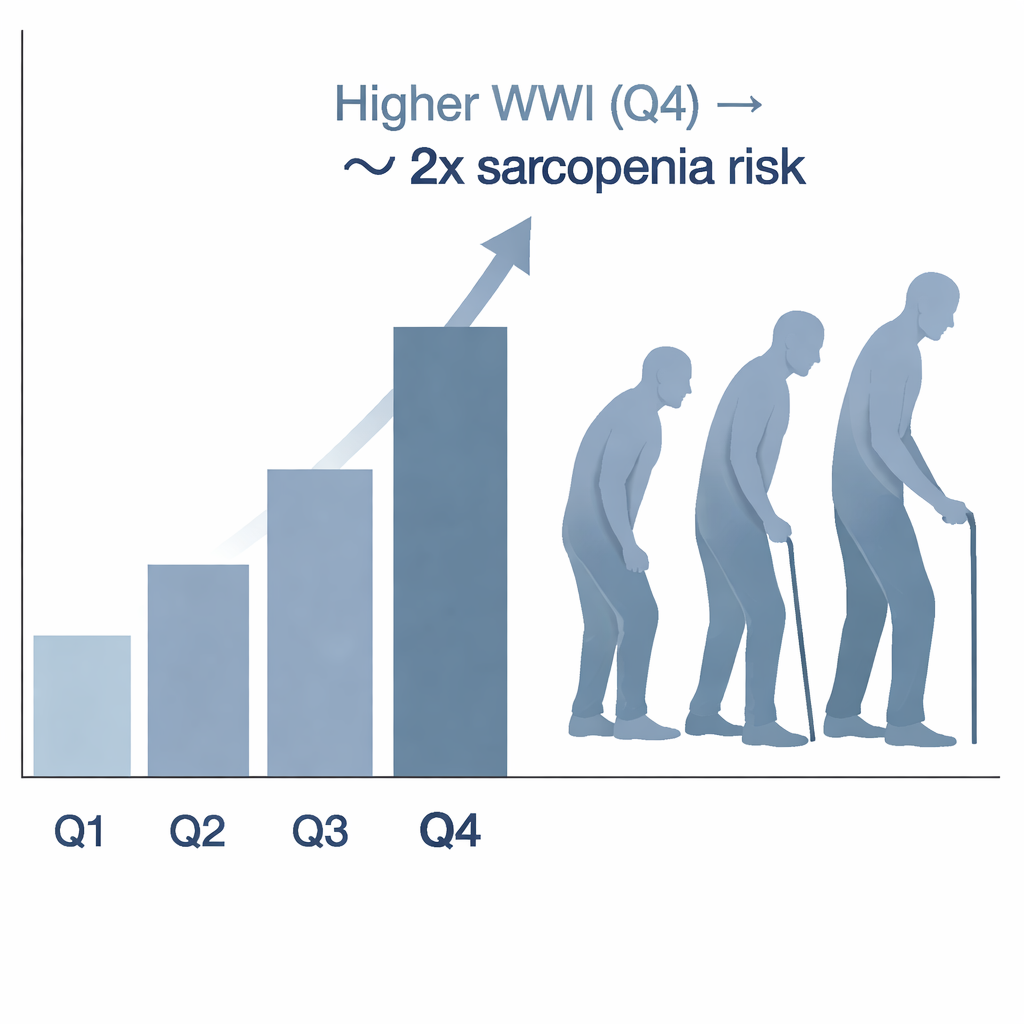
During the follow-up, 167 participants—about one in ten—developed sarcopenia. The higher a person’s WWI at the beginning of the study, the more likely they were to lose both muscle mass and strength. In the lowest WWI group, about 6% developed sarcopenia; in the highest group, that number climbed to nearly 16%. Even after accounting for age, sex, smoking, drinking, income, physical activity, blood pressure, diabetes, cholesterol problems, kidney disease, insulin resistance, inflammation, and vitamin D levels, people in the highest WWI group had roughly double the odds of developing sarcopenia compared with those in the lowest group. This pattern appeared in both men and women, and it remained when people with heart disease, cancer, or memory problems were left out of the analysis.
Who is most at risk
The study also showed that WWI is closely linked to other signs of unhealthy aging. Higher WWI went along with larger waistlines, worse blood sugar and triglyceride levels, lower “good” HDL cholesterol, and more frequent high blood pressure and diabetes. People with higher WWI tended to have lower muscle mass and weaker grip from the start. The dangers were particularly strong among those who were physically inactive: older adults with both a high WWI and low activity had more than three and a half times the risk of developing sarcopenia compared with more active peers in the lower WWI groups. This suggests that an unfavorable body shape and a sedentary lifestyle can combine to accelerate muscle loss.
What this means for healthy aging
The authors conclude that WWI is a simple, clinic-friendly tool that can flag older adults who are on a path toward serious muscle loss, even before obvious weakness sets in. Because WWI uses only a tape measure and a scale, it could be especially useful in busy primary care offices or community health programs where advanced scans are not available. While more research is needed to determine the best cutoff values and to test the measure in other ethnic groups, this work supports the idea that tracking how weight is distributed—particularly around the waist—may help guide early lifestyle changes, such as more physical activity and better diet, to preserve strength and independence in later life.
Citation: Lee, KH., Hwang, S.Y., Heo, J.H. et al. The weight-adjusted waist index predicts sarcopenia in community-dwelling older adults in a nationwide multicenter prospective study. Sci Rep 16, 7284 (2026). https://doi.org/10.1038/s41598-026-38133-2
Keywords: sarcopenia, waist index, older adults, body composition, muscle loss