Clear Sky Science · en
Discovery of age and blood group associated variability in nattokinase mediated thrombolysis and its relevance to cardiovascular management
Why a clot-busting food enzyme matters to you
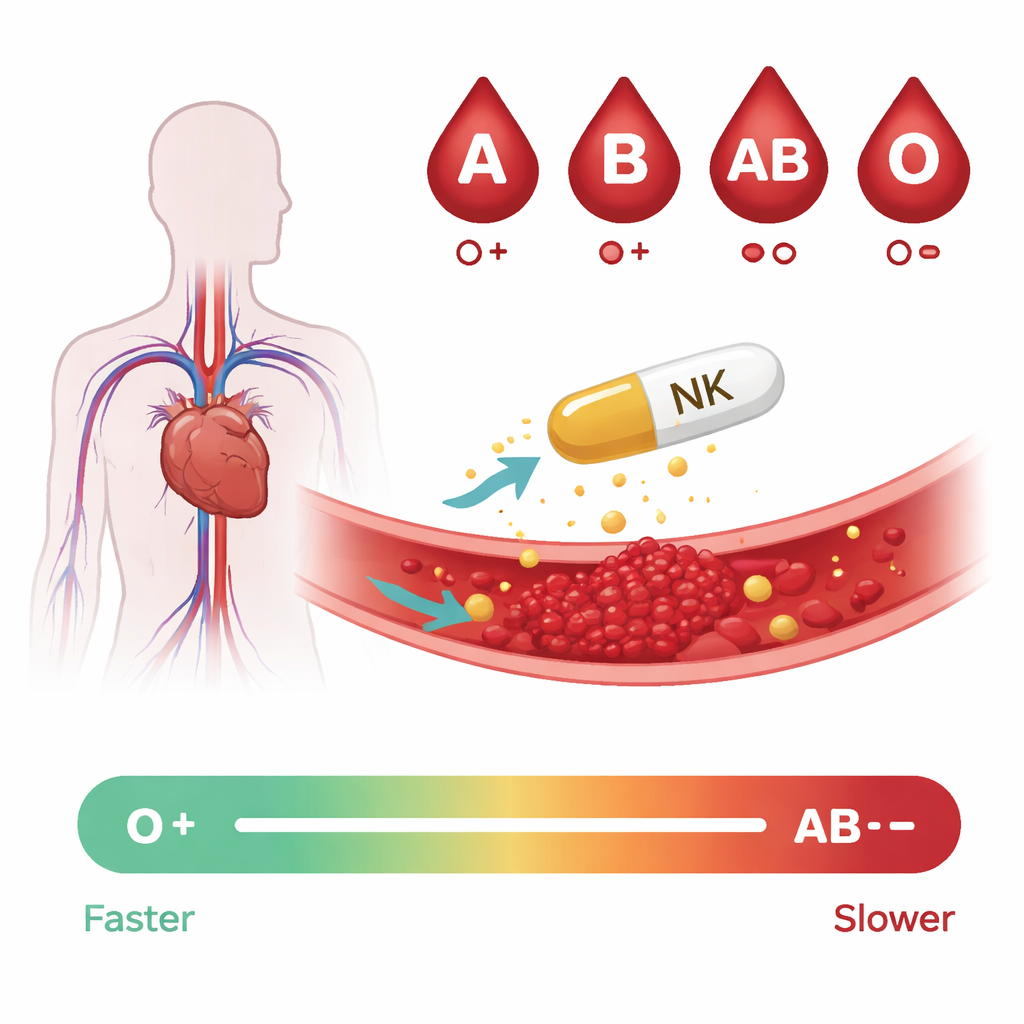
Blood clots that form in the wrong place at the wrong time can cause heart attacks, strokes, and dangerous blockages in the lungs. Doctors already use powerful drugs to dissolve clots, but these medicines can be costly and carry a risk of serious bleeding. A natural enzyme called nattokinase, found in the Japanese fermented food natto and in dietary supplements, has drawn attention as a gentler clot-buster. This study asks a simple but overlooked question: does nattokinase work the same way in everyone, or does its clot-dissolving power depend on your age and blood type?
A closer look at a natural clot-dissolving enzyme
Nattokinase is an enzyme that can break down fibrin, the fibrous protein that acts as the scaffolding of a blood clot. It can also activate the body’s own clot-dissolving system. Earlier research suggested nattokinase may be relatively safe, even when taken for months or years, and might help lower blood pressure and reduce clotting risk. But almost nothing was known about how quickly it can dissolve clots in different people, especially across the common ABO and RhD blood groups. Because cardiovascular disease has risen worldwide in the post‑COVID era, the authors set out to test whether clot breakdown time varies with blood type, age, and sex, and to explore how a key blood protein called RhD might change how nattokinase grips and shreds fibrin.
Testing clots from nearly two thousand volunteers
The researchers collected 1,796 blood samples from healthy people aged 10 to 70 years in western India, covering all eight major blood types (A, B, AB, and O, each with RhD positive or negative). In the lab, they allowed each sample to clot in small tubes, then added a standard amount of nattokinase and timed how long it took for the clot to disappear completely, in seconds. They compared these clot dissolution times across ages, sexes, and blood types, and used statistical tools that can separate the effects of each factor and their interactions. To check that their observations were not unique to one region, they repeated the test with another 562 samples from nine cities across India, again looking for consistent patterns in how quickly clots melted away.
Blood type and age strongly shape clot melting speed
The team found that nattokinase did not act uniformly across the population. On average, clots from people with blood group O dissolved the fastest, followed by B, then A, while AB had the slowest response. Within these groups, RhD‑positive blood clots broke down more quickly than RhD‑negative ones. The shortest clot dissolution time appeared in O‑positive males aged 31–35 years (about 1,510 seconds), while the longest time was seen in AB‑negative females aged 66–70 years (about 2,660 seconds). Overall, younger adults in their early thirties showed the quickest clot breakdown, with times lengthening in both teenagers and older adults, suggesting that the body’s natural balance between clot formation and clot removal shifts with age. Women had only slightly longer times than men, indicating that sex played a smaller role than age or blood type.
Peering into clots and molecules for hidden clues
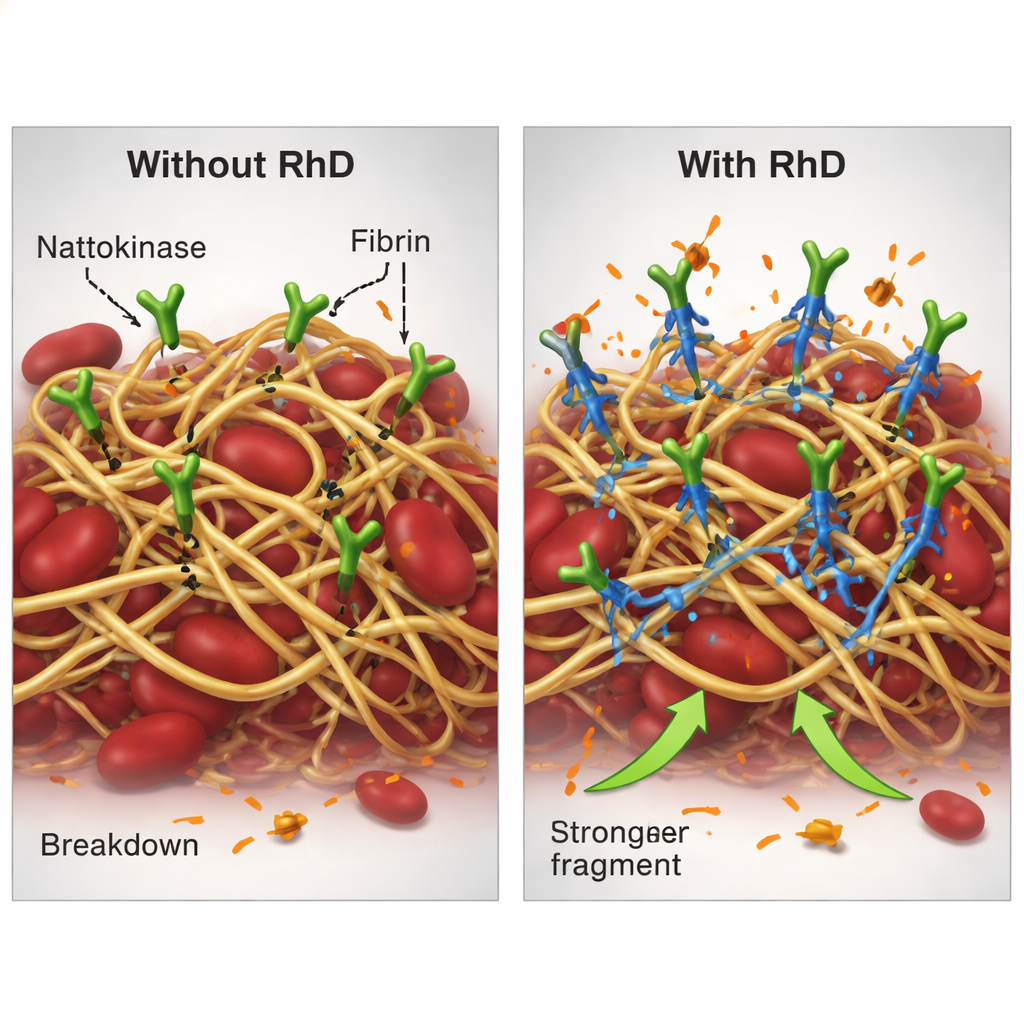
To understand what lay behind these differences, the researchers used scanning electron microscopy to visually track how clots from fast and slow blood types responded to nattokinase. Images of O‑positive and AB‑negative blood samples showed that, after treatment, red blood cells gradually sprang back from being squashed inside the clot to regaining their usual disc-like shape as the fibrin mesh dissolved. This recovery happened sooner in the O‑positive samples, matching their quicker clot melting times. The team then built three-dimensional computer models of nattokinase, fibrin, and the RhD protein and simulated how they dock together. Their calculations suggested that when RhD is present, nattokinase and fibrin can form a tighter, more extensive complex than when RhD is absent. In other words, RhD seems to help nattokinase grab onto fibrin more strongly, offering a molecular explanation for why RhD‑positive blood clots dissolved faster.
Toward more personalized clot-busting strategies
For non-specialists, the take‑home message is that a “natural” clot‑dissolving supplement such as nattokinase is not one‑size‑fits‑all. This work shows that how quickly it can melt a clot depends strongly on your blood group, your RhD status, and your age, with only modest influence from sex. People with O‑type and RhD‑positive blood may respond more briskly, while those with AB or RhD‑negative blood may need more time or different dosing to achieve the same effect. Although these experiments were done in test tubes and supported by computer modeling, not by clinical trials in patients, they lay the groundwork for future studies that could fine‑tune nattokinase use by blood type. In the long run, such personalized approaches might improve the safety and effectiveness of clot‑busting therapies and help reduce the burden of heart attacks, strokes, and other clot‑driven diseases.
Citation: Bhatt, T.C., Bishoyi, A.K. Discovery of age and blood group associated variability in nattokinase mediated thrombolysis and its relevance to cardiovascular management. Sci Rep 16, 7690 (2026). https://doi.org/10.1038/s41598-026-38130-5
Keywords: nattokinase, blood clots, blood type, cardiovascular disease, fibrinolysis