Clear Sky Science · en
Spatial patterns and influencing factors of traditional villages in developed regions: a case study of Zhejiang Province, China
Why Old Villages Still Matter in a Modern Boom
Across China’s booming east coast, glittering cities often sit just a short drive from centuries‑old villages built of wood, stone, and memory. This study zooms in on Zhejiang Province, one of China’s richest regions, to ask a surprising question: in a place racing toward the future, why have so many traditional villages survived, and what puts them at risk? The answers help explain how fast economic growth can either erase or protect living pieces of cultural heritage.
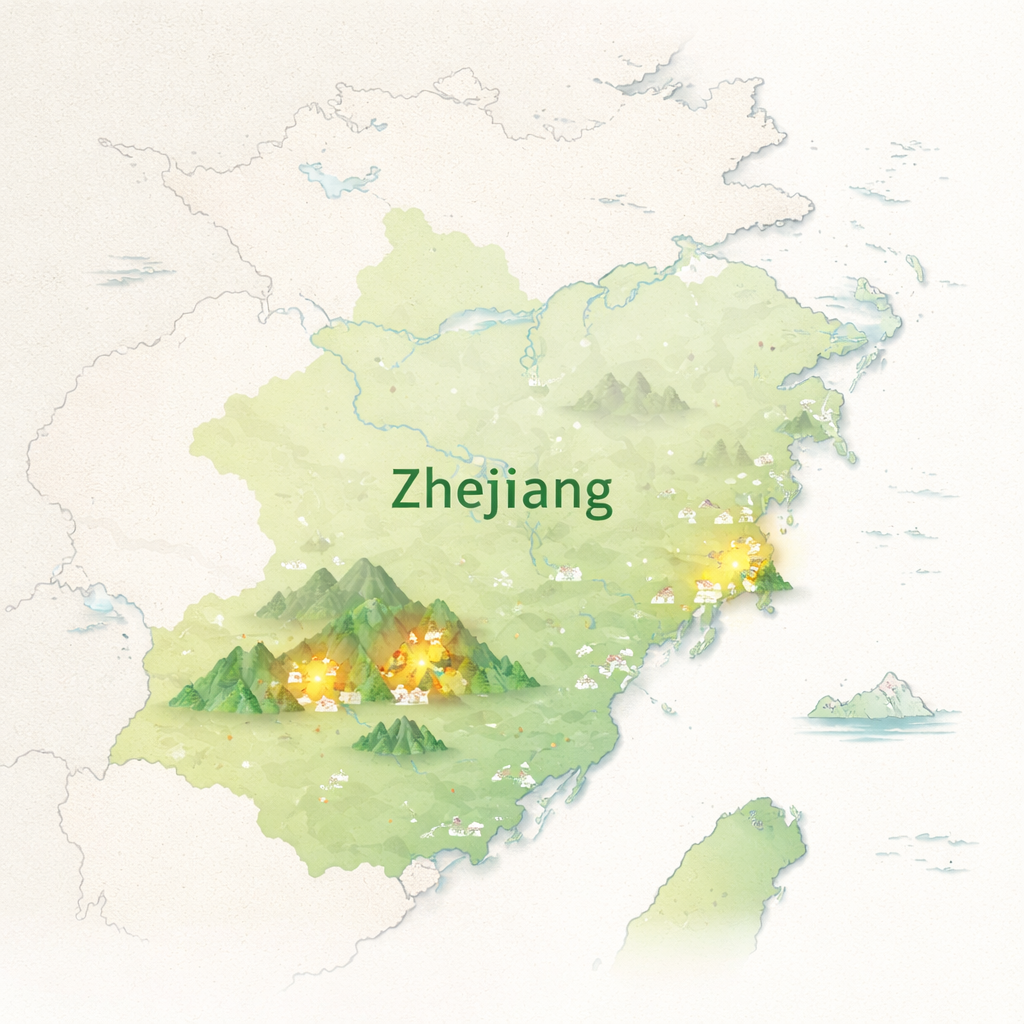
Where the Old Villages Are
Zhejiang is a coastal province in the Yangtze River Delta, home to nearly 67 million people and some of the country’s highest incomes. Yet it also contains 701 officially recognized traditional villages. Using tools normally applied in geography and ecology, the researchers mapped where these villages are clustered. They found a clear pattern they describe as “two cores and multiple points”: two dense clusters of villages in the mountainous southwest, and smaller pockets scattered across the low mountains and hills in the center of the province. In contrast, the flat, heavily developed northeastern plains contain few such settlements.
Mountains, Rivers, and Distance from the City
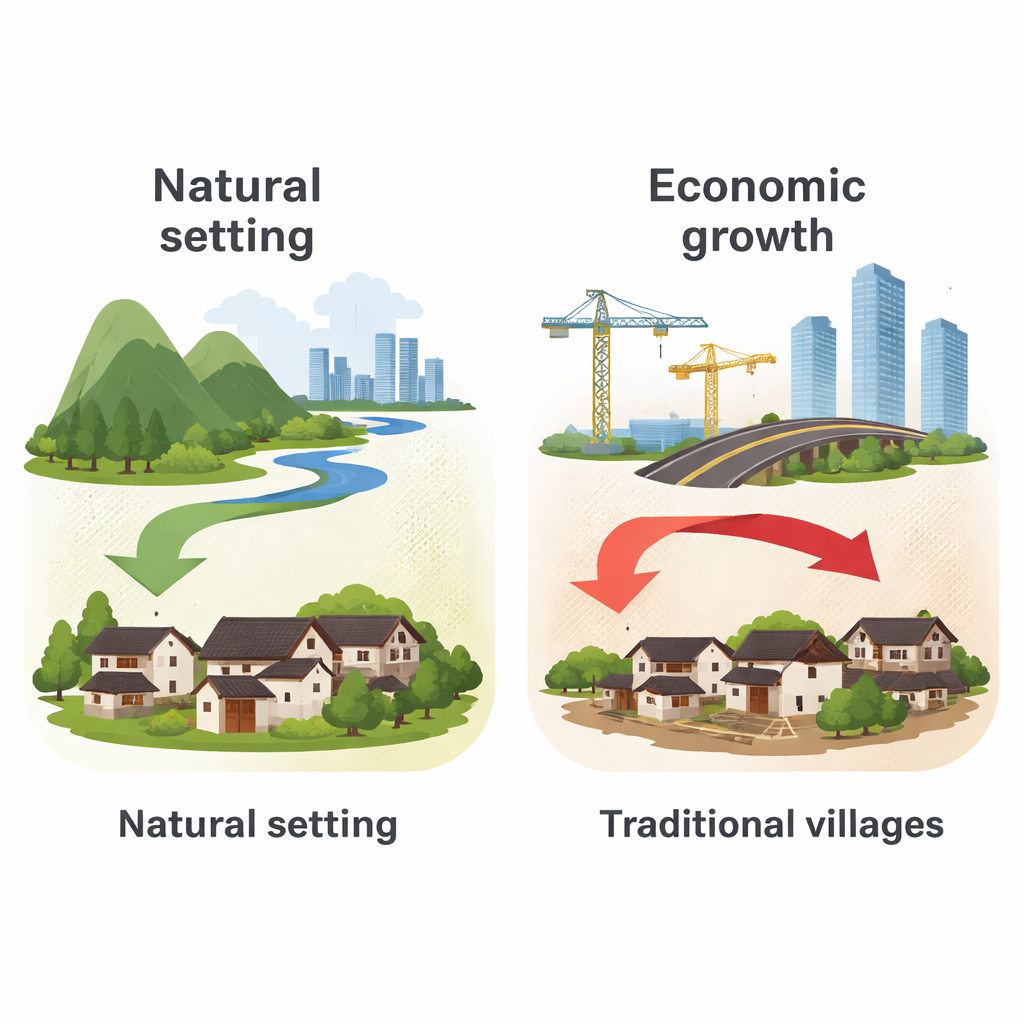
The team showed that nature still matters. Counties with many traditional villages tend to sit at higher elevations, with steep slopes and rugged terrain. In earlier times, these hard‑to‑reach areas offered safety during wars and conflicts. Later, the same isolation slowed road building and large‑scale development, unintentionally shielding old houses and street patterns. Water also plays a role: almost half of the villages lie within 100 meters of a river, and more than 90% within 300 meters. Rivers once provided drinking water, irrigation, and trade routes, so most settlements grew up close to them. At the same time, most villages are far from today’s urban centers—about 70% lie more than 20 kilometers from a central city, and the number of villages drops sharply the closer you get to urban cores.
When Prosperity Becomes a Threat
Because Zhejiang is wealthy, the authors could test how economic growth affects these historic places. They compared village counts in each county with measures such as total economic output, income per person, investment in buildings and infrastructure, and the share of farming in the local economy. The picture that emerged is uneven: the more prosperous and built‑up a county is, the fewer traditional villages it tends to have. Where incomes, roads, and building investment are high, old houses are more likely to be replaced by modern construction. Counties with many surviving villages usually have lower incomes, more farmland, weaker road networks, and less money poured into new projects.
Many Forces Working Together
To move beyond simple one‑to‑one links, the researchers used a statistical tool called a geographic detector to see how different factors combine. They found that no single force explains the pattern on its own. Instead, the strongest effects appear when natural conditions and economic structures interact. High altitude combined with a farming‑based economy, for example, has far more power to predict where traditional villages endure than either factor alone. Meanwhile, the share of factories and industry looks weak by itself but becomes important when paired with other measures like income or investment. This points to a long history in which rugged landscapes first encouraged village formation, and later, uneven economic change reshaped which of those villages lived on.
Protecting Memory in a Changing Landscape
For non‑specialists, the main takeaway is that traditional villages in a rich province like Zhejiang have not survived by accident. They persist mainly in mountain areas where life is less prosperous, development has been slower, and roads are fewer. As modern construction and tourism spread, these last pockets of heritage could quickly disappear unless protection is planned at the scale of whole clusters, not isolated sites. The study suggests that effective policies must balance investment with restraint—supporting local livelihoods while setting limits on construction in and around historic settlements. In short, keeping China’s cultural memory alive in places like Zhejiang will require understanding how land, economy, and history are woven together, and planning so that the next wave of growth does not wash these villages away.
Citation: Chuanbiao, D., Yuzhe, H., Jiacheng, W. et al. Spatial patterns and influencing factors of traditional villages in developed regions: a case study of Zhejiang Province, China. Sci Rep 16, 7264 (2026). https://doi.org/10.1038/s41598-026-38128-z
Keywords: traditional villages, Zhejiang Province, rural heritage, spatial distribution, economic development