Clear Sky Science · en
Multi-responsive, room-temperature self-healing salep-based nanocomposite hydrogels with enhanced mechanical performance as smart biomaterial
Everyday Materials That Heal Themselves
Imagine a soft, jelly-like bandage that can repair its own cuts, respond to magnets, soak up liquid like a sponge, and fight germs—all while being made from a plant-based powder. This study describes exactly such a material: a new kind of “self-healing” hydrogel built from salep, a natural thickening agent already used in foods, and boosted with modern polymers and tiny magnetic particles. The result is a smart, reusable gel that could one day help dress wounds, deliver medicines, irrigate crops more efficiently, or clean up polluted water.
From Orchid Roots to Smart Gel
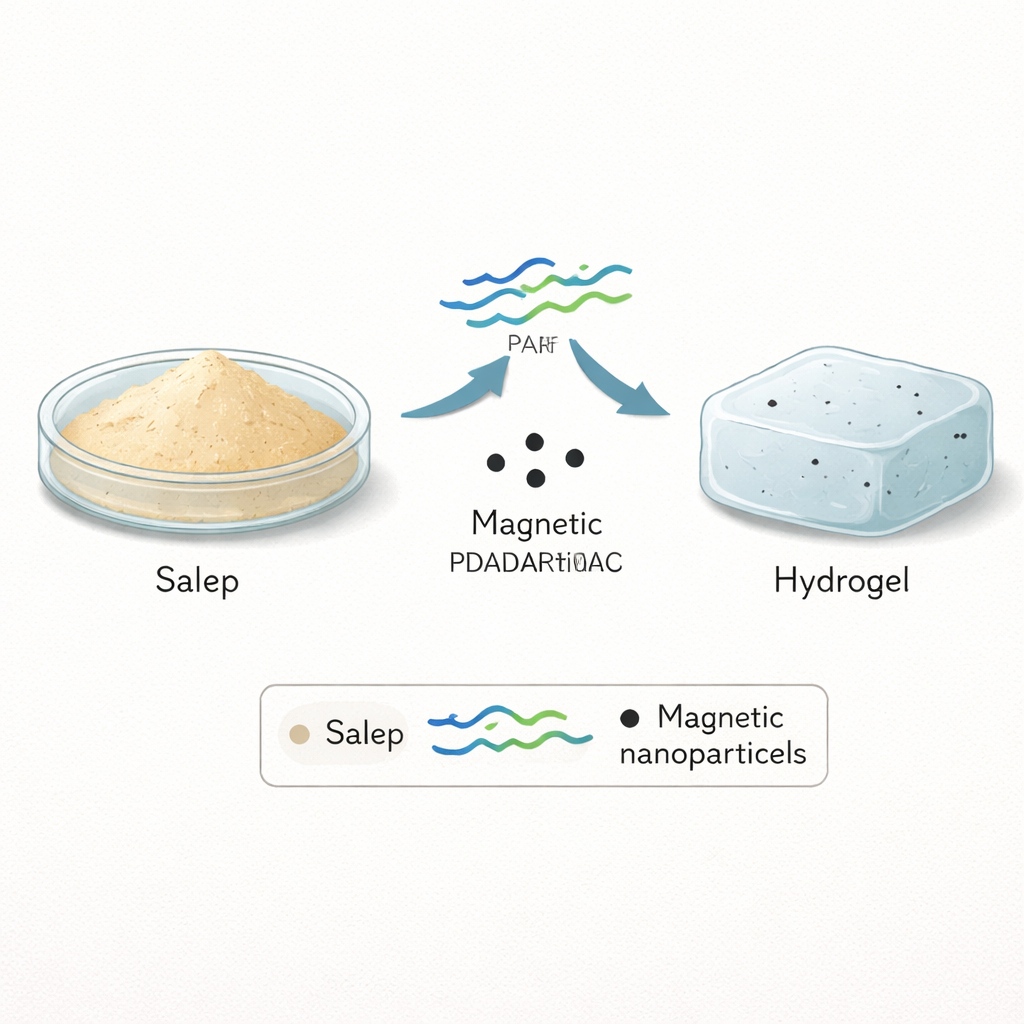
At the heart of the new material is salep, a polysaccharide obtained from the dried tubers of orchids. On its own, salep forms a gentle gel that is biocompatible and biodegradable, but it is too weak and unstable for demanding uses like tissue repair or controlled drug release. To toughen it up, the researchers wove in two well-known synthetic polymers—polyacrylamide (PAM) and poly(diallyldimethylammonium chloride) (PDADMAC)—using a standard free-radical chemistry process. This created what scientists call a “semi-interpenetrating network,” where the natural and synthetic chains interlace without fully merging, giving the material the comfort of a natural gel and the strength of a plastic-like network.
Adding a Magnetic Twist
The team then introduced a second upgrade: ultra-small particles of magnetite (Fe₃O₄), a form of iron oxide that responds to magnetic fields. These nanoparticles do more than just make the gel magnetic. Because they carry many chemical groups on their surface, they form extra links with the surrounding polymer chains, helping the gel hold together better and survive higher temperatures. Under a magnet, the particles help drag and rearrange the chains, speeding up how quickly broken pieces of gel can knit back together. By adjusting how much polymer and how many nanoparticles they added, the scientists could fine-tune how much water the gel absorbs, how strong it becomes, and how fast it heals.
A Sponge That Learns to Repair Itself
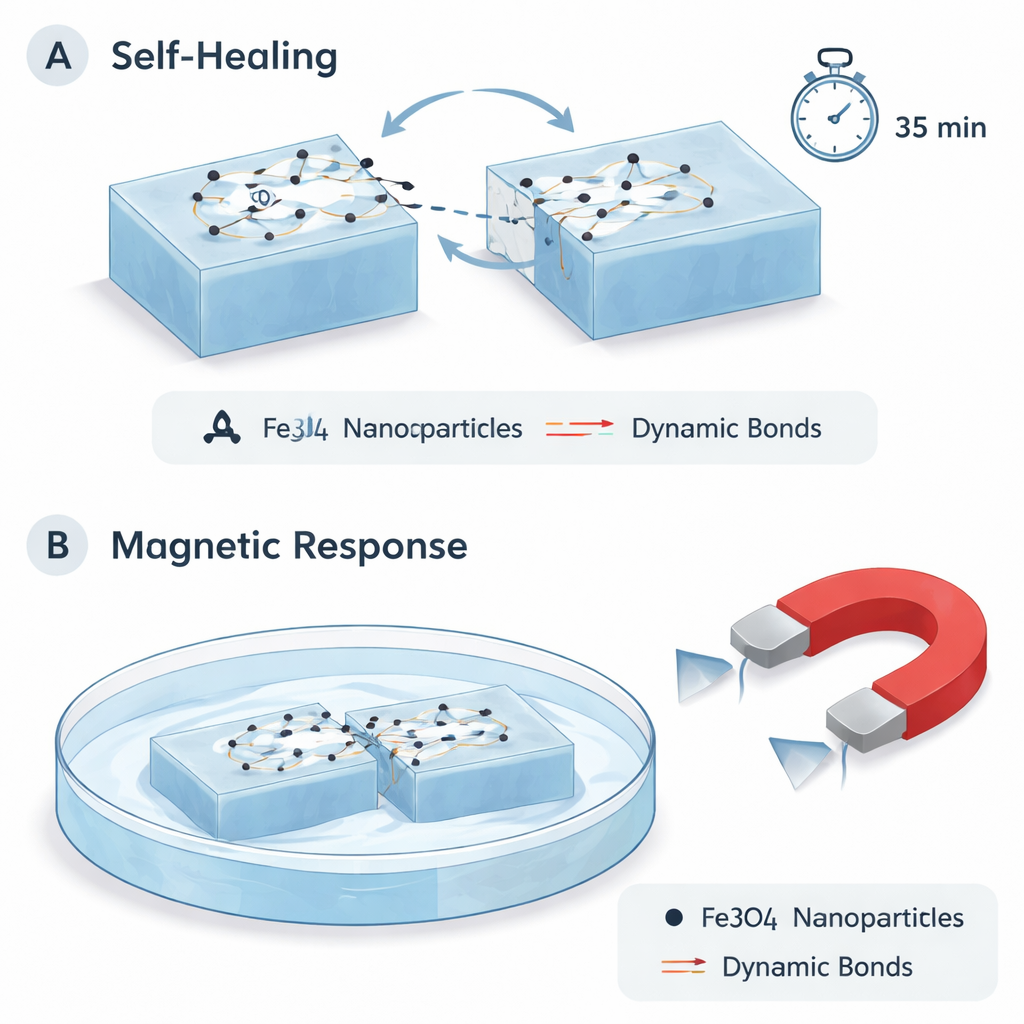
Like all hydrogels, these new materials act as super sponges, swelling when placed in water. The best-performing version—salep modified with PAM and loaded with 7% magnetic nanoparticles—could absorb roughly 23 times its dry weight in water at neutral pH, and close to 27 times at high pH. Versions based on PDADMAC also swelled impressively, though somewhat less. Tests showed that salt in the surrounding liquid and the acidity (pH) could dial the swelling up or down, a valuable feature for drug delivery or soil moisture control. Critically, when the researchers cut the gels into two pieces and simply pressed them back together at room temperature, the PAM-based magnetic gel healed into a single solid block in about 35 minutes, regaining its mechanical integrity. Similar gels without nanoparticles healed more slowly, and pure salep gels did not heal at all.
Strong, Stretchy, and Germ-Resistant
Beyond self-repair, the salep-based gels became much tougher after modification. Plain salep tore easily, but the enhanced PAM gel could stretch to about six times its original length before breaking, with a tensile strength around 0.66 megapascals—remarkable for a water-rich material. Adding nanoparticles further boosted this strength and stability, even at elevated temperatures. The hybrid gels also showed antibacterial activity. When tested against common microbes like Staphylococcus aureus and Escherichia coli, only the formulations containing magnetic nanoparticles produced clear zones where bacteria failed to grow. This likely arises from reactive oxygen species generated by the iron oxide, coupled with the gel’s ability to swell and keep the particles in close contact with microbes.
Why This Matters for Everyday Life
To a non-specialist, the bottom line is that the researchers have turned a familiar, food-grade thickener into a high-performance, “smart” gel by weaving in modern polymers and magnetic nanoparticles. The resulting material is soft yet strong, can heal its own cuts at room temperature, responds to magnets, holds huge amounts of water, and shows antibacterial effects. Because salep is natural and relatively inexpensive, and the chemistry used is straightforward, this approach points toward future wound dressings, drug depots, smart irrigation beads, and pollution-absorbing pads that are safer, more sustainable, and longer lasting than many current options.
Citation: Zanbili, F., Poursattar Marjani, A. & Mahmoudian, M. Multi-responsive, room-temperature self-healing salep-based nanocomposite hydrogels with enhanced mechanical performance as smart biomaterial. Sci Rep 16, 7090 (2026). https://doi.org/10.1038/s41598-026-38127-0
Keywords: self-healing hydrogel, magnetic nanoparticles, biomaterials, wound healing, drug delivery