Clear Sky Science · en
Durability and damage evolution of cement-fly ash stabilized aeolian sand gravel under high-temperature curing and freeze–thaw cycles
Turning Desert Sand into Road-Building Gold
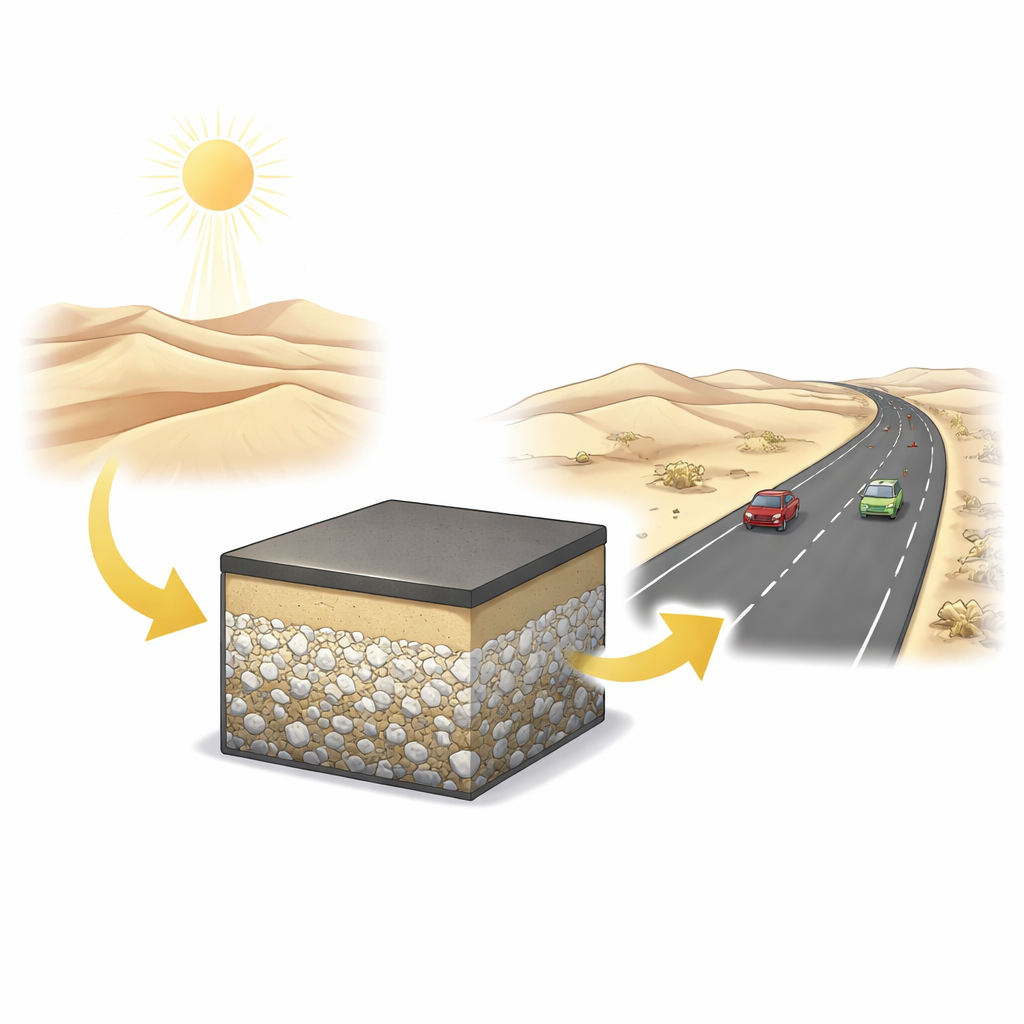
Many fast-growing desert regions struggle to build and maintain roads because ordinary construction gravel and sand are scarce and expensive to haul in. This study explores a simple but powerful idea: can the loose wind-blown sand that blankets deserts be turned into a strong, long-lasting base for asphalt highways when mixed with cement, fly ash, and gravel? The answer matters not only for lowering costs, but also for cutting carbon emissions by using local materials and industrial waste.
Why Builders Look to the Dunes
Desert nations are pushing to expand transportation networks just as high-quality stone and river sand near their cities are becoming harder to find. In contrast, aeolian sand—the fine grains carried and deposited by the wind—is abundant but usually considered too weak for heavy-duty structures. The researchers set out to test a new road base material in which all of the usual fine sand is replaced by aeolian sand, while gravel provides a skeleton and cement plus fly ash act as the glue. If this recipe, called cement–fly ash stabilized aeolian sand gravel, can stand up to harsh desert conditions, it could turn a waste resource into the backbone of modern highways.
Testing in Heat, Ice, and Salt
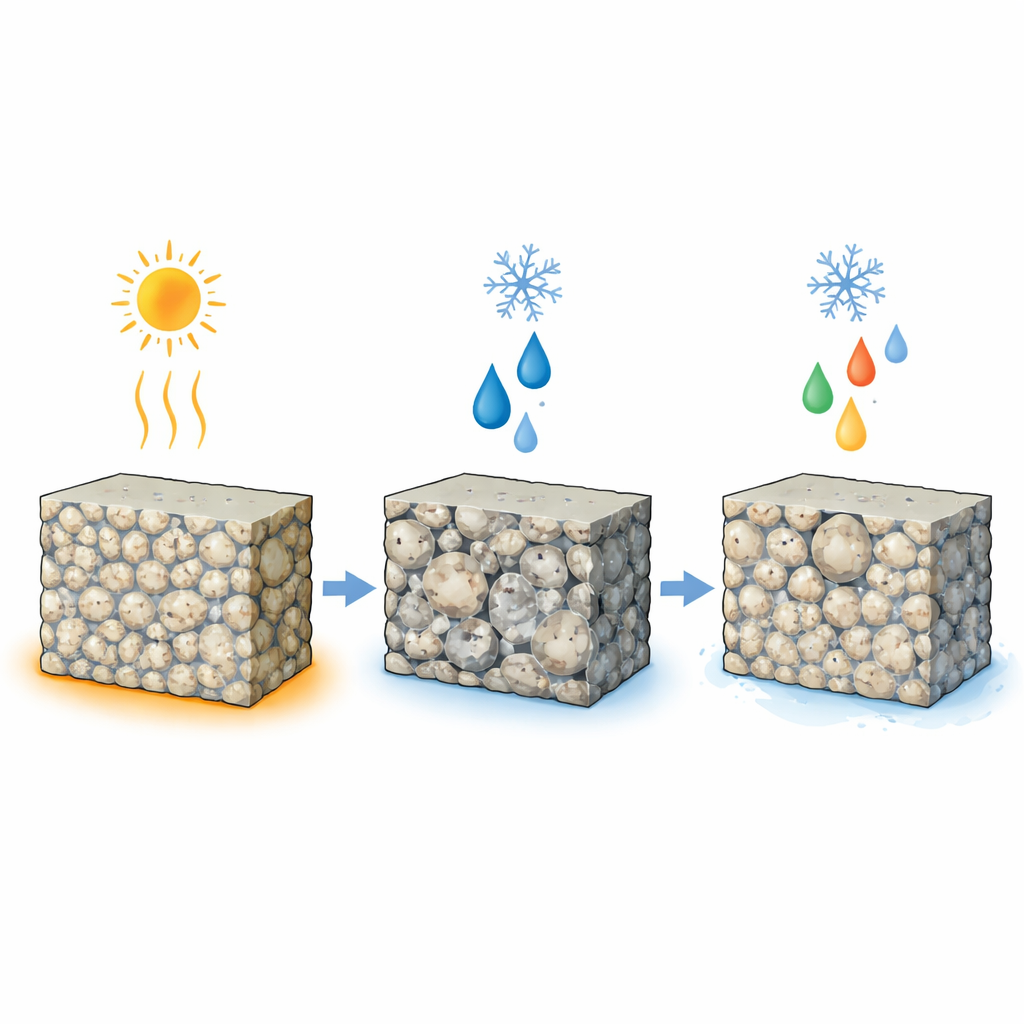
Real desert pavements endure scorching summers and cold, sometimes salty, winters. To mimic this, the team molded cylindrical samples of the new mixture with different amounts of aeolian sand and two levels of how tightly they were compacted. They then cured the samples at moderate to high temperatures typical of road construction in hot regions and later exposed them to repeated freeze–thaw cycles, both in plain water and in a weak salt solution. Throughout, they measured how much force the material could withstand before crushing, how its mass changed as parts flaked away, and how its internal chemistry (tracked by pH) evolved.
How Heat and Ice Change Strength
The experiments showed that curing temperature is a double-edged tool—but can be used to advantage. Compared with standard conditions, warmer curing made the material noticeably stronger, with about 40 °C emerging as the sweet spot. At this temperature, the cement reacts faster, and the fly ash—a recycled ash from power plants—takes part in secondary reactions that fill pores and tighten the internal structure. However, pushing curing temperatures higher eventually dries out the mix too much and encourages tiny cracks, reducing the gains. When the samples were later subjected to repeated freezing and thawing, their strength gradually dropped, especially as the share of aeolian sand increased or the compaction level decreased. Salt in the freezing water first seemed to fill pores and slightly slow down early damage, but over many cycles it helped break the bond between sand, gravel, and binder, increasing flaking at the surface.
Watching Cracks Grow in Real Time
To see not just how much damage occurred but how it spread, the researchers used a camera-based technique that tracks tiny movements on the specimen surface as it is loaded. This digital image method revealed a three-stage pattern: an initial phase where strain is spread out, a growth phase where narrow bands of concentrated strain appear, and a final phase where a main crack suddenly links up across the sample and causes brittle failure. Lower compaction and higher aeolian sand content made these strain bands stronger and more tangled, showing that a looser, sandier mix is more prone to rapid crack growth. The team also built mathematical models that link mix design and freeze–thaw history to strength, with accuracy above 98 percent, offering engineers a practical way to predict long-term performance.
What This Means for Desert Highways
Overall, the study finds that a road base made from gravel, cement, fly ash, and high proportions of aeolian sand can be both durable and economical if it is well compacted and cured around 40 °C. While increasing aeolian sand weakens the material’s resistance to freezing and thawing, especially in salty conditions, the right balance of sand, binder, and compaction still meets strength standards for many classes of highway. Because the recipe also uses industrial fly ash and cuts long-distance hauling of aggregates, it offers a lower-carbon pathway for building roads across vast deserts—turning a once troublesome wind-blown sand into a practical foundation for modern transport.
Citation: Wang, B., Zhao, Y., Zheng, P. et al. Durability and damage evolution of cement-fly ash stabilized aeolian sand gravel under high-temperature curing and freeze–thaw cycles. Sci Rep 16, 8519 (2026). https://doi.org/10.1038/s41598-026-38126-1
Keywords: desert roads, aeolian sand, freeze–thaw durability, fly ash concrete, pavement base materials