Clear Sky Science · en
CDK2 inhibition promotes neuronal differentiation in neuroblastoma
Why this childhood cancer study matters
Neuroblastoma is one of the most common solid cancers in young children and remains deadly for many high‑risk patients despite intensive treatment. This study explores a new way to tackle the disease: instead of only trying to kill cancer cells, it asks whether we can push them to grow up into harmless, nerve‑like cells. The work focuses on a protein called CDK2 and shows that blocking it may both slow tumor growth and encourage cancer cells to mature, opening the door to gentler, more targeted therapies.
A trouble‑making protein in aggressive tumors
The researchers began by mining several large collections of tumor samples from children with neuroblastoma. They asked a simple question: when is the CDK2 gene turned on the most? The answer was striking. Tumors with the highest CDK2 levels tended to be advanced stage, classified as high risk, and more likely to come back after treatment. Children whose tumors had a lot of CDK2 generally did worse over time. These cancers often carried extra copies of another powerful cancer‑driving gene, MYCN, and under the microscope they looked more primitive and less like normal nerve cells. Together, these patterns suggested that CDK2 is closely linked to the most dangerous forms of the disease.
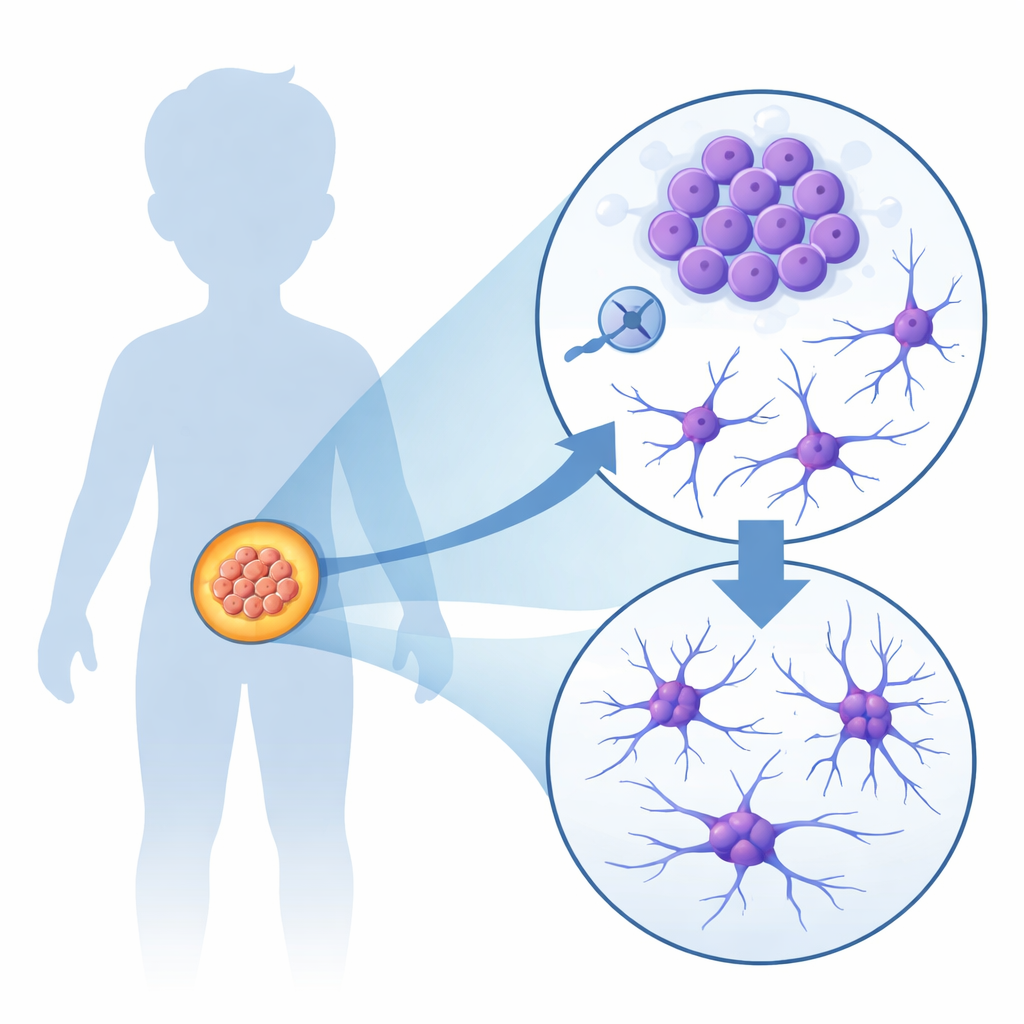
From fast‑dividing cells to nerve‑like branches
To see what CDK2 actually does inside tumor cells, the team used human neuroblastoma cell lines grown in the lab. They either switched off the CDK2 gene or blocked the CDK2 protein with drug‑like molecules. In both cases, something remarkable happened: instead of dividing endlessly as cancer cells usually do, many cells began to extend long, thin projections that resemble the branches of developing nerve cells. Genes associated with nerve growth and communication were turned on, while genes linked to cell division and DNA repair were turned down. These changes were strongest in cells carrying extra MYCN, the very subtype that causes the most aggressive disease in children.
CDK2 and MYCN: a reinforcing loop
Diving deeper, the scientists found that CDK2 and MYCN are connected in a feedback loop. MYCN binds directly to the DNA near the CDK2 gene and boosts its activity, helping keep CDK2 levels high in tumor cells. When MYCN was reduced, CDK2 levels fell. In turn, loss of CDK2 dampened the broader MYC signaling program that drives rapid growth. This means that, in many high‑risk tumors, MYCN and CDK2 work together to keep cells in a fast‑cycling, immature state and to block their natural tendency to mature into nerve cells.
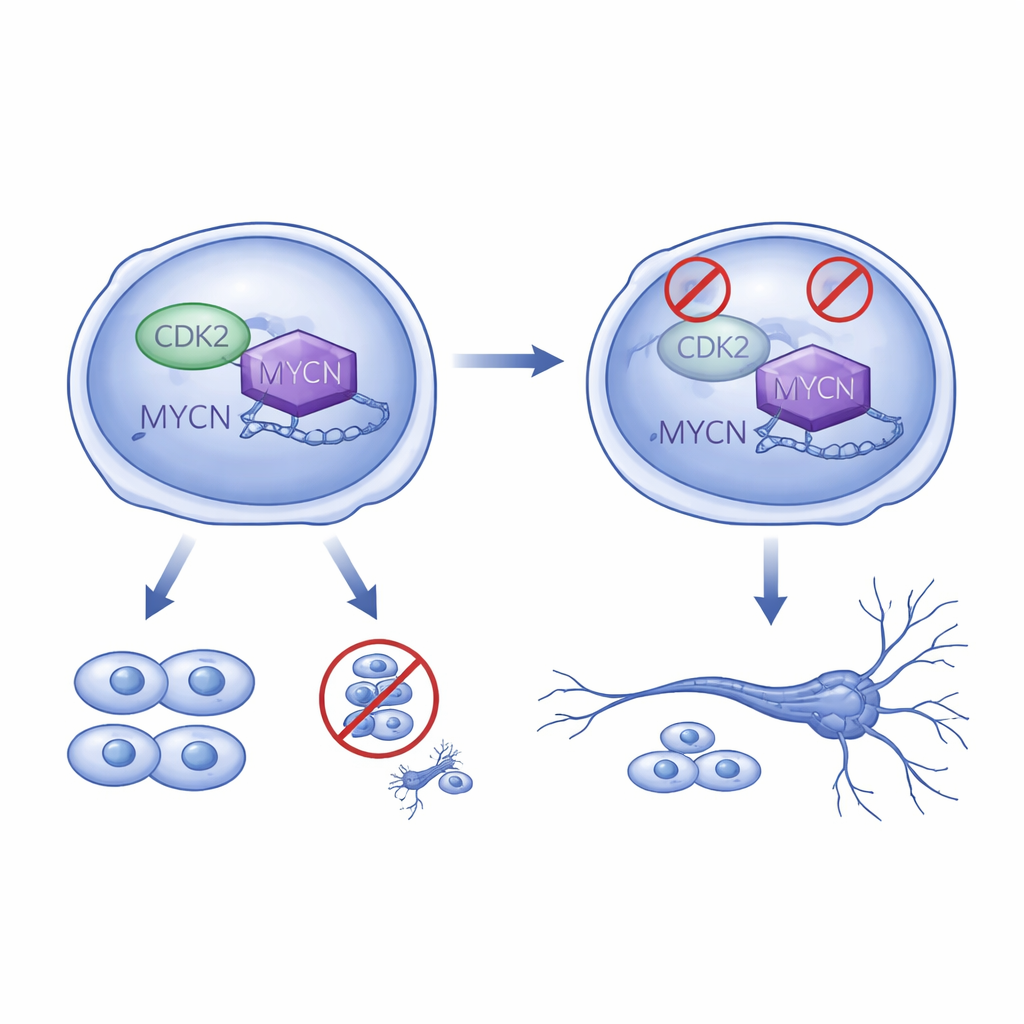
Boosting existing treatments by pushing cells to mature
Because CDK2 and MYCN cooperate, the researchers tested combinations of CDK2‑blocking drugs with experimental MYC‑targeting compounds. In several neuroblastoma cell models, these pairs of drugs reduced cell survival more than either alone and often produced more nerve‑like outgrowths, suggesting stronger differentiation. They also combined CDK2 inhibition with all‑trans‑retinoic acid (ATRA), a vitamin A‑related drug already used to help neuroblastoma cells mature after chemotherapy. In lab dishes, the combination of CDK2 blockers and ATRA produced higher "differentiation scores"—longer branches and stronger nerve markers—than single treatments, pointing to a possible way to enhance an existing standard therapy.
What this could mean for children with neuroblastoma
In simple terms, this study shows that high CDK2 levels mark particularly aggressive, immature neuroblastoma tumors, and that lowering CDK2 activity can nudge cancer cells to behave more like normal nerve cells and sometimes to die. Because CDK2 is wired into the same growth‑driving network as MYCN, hitting both at once—or combining CDK2 blockers with retinoid drugs like ATRA—may one day offer a more effective, differentiation‑based treatment strategy. While these findings are still at the cell‑culture stage and require careful testing in animal models and clinical trials, they outline a promising route toward therapies that do not just attack tumor cells, but coax them to grow up and calm down.
Citation: Alzrigat, M., Mahmoud, L., Topçu, A.N. et al. CDK2 inhibition promotes neuronal differentiation in neuroblastoma. Sci Rep 16, 5255 (2026). https://doi.org/10.1038/s41598-026-38123-4
Keywords: neuroblastoma, CDK2 inhibition, neuronal differentiation, MYCN, retinoid therapy