Clear Sky Science · en
30,000 years of fire history in the Cerrado
Why ancient fires matter today
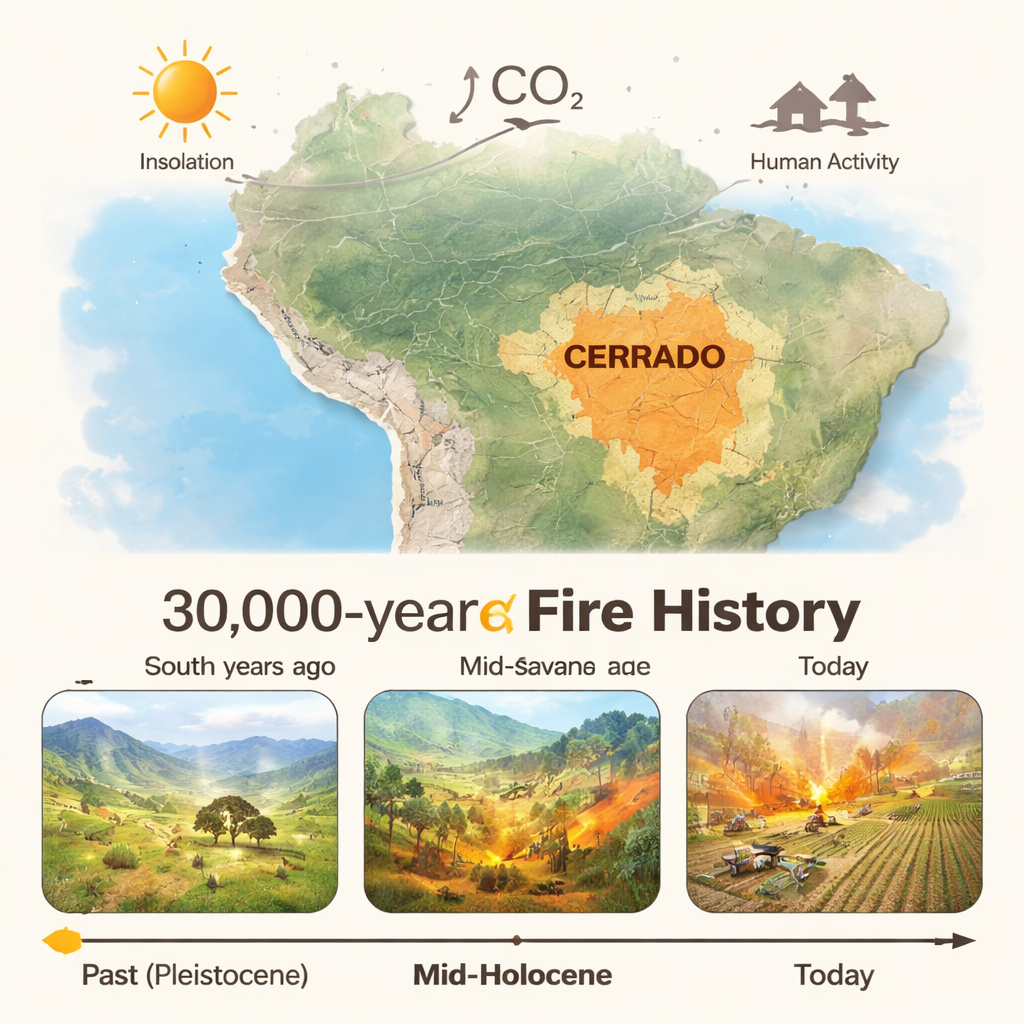
Across central Brazil lies the Cerrado, a vast tropical savanna that is both a global biodiversity hotspot and one of the most frequently burned landscapes on Earth. Today its fires are often linked to deforestation, cattle ranching, and crop expansion, raising alarms about greenhouse gases and species loss. This study asks a deceptively simple question with big implications: over the past 30,000 years, how and why have fires in the Cerrado changed—and what does that history tell us about managing fires safely in a warming, human-dominated world?
A long memory written in lake mud
Because no one was around to watch fires tens of thousands of years ago, the researchers turned to natural archives. When plants burn, they leave behind tiny charcoal fragments that can be carried by wind and water into nearby lakes and swamps, where they settle and build up layer by layer. By extracting sediment cores from 12 lakes and marshes across northern, central, and southeastern Cerrado, and counting the charcoal grains under a microscope, the team reconstructed when fires were common, how intense they were, and whether they mostly burned grasses or wood. They combined this with pollen records, which reveal how much of the surrounding vegetation was grass versus trees, and with independent records of past climate and atmospheric carbon dioxide (CO₂) levels.
Natural fires in an ancient savanna
The records show that fire has been part of the Cerrado story for at least 30,000 years, but its character has shifted with the planet’s rhythms. During the last ice age, when global temperatures and CO₂ were low, the Cerrado held plenty of grassy fuel, yet the charcoal evidence points to rare and generally weak fires. Under these colder conditions, vegetation was less productive and woodier plants were sparse, which limited how much could burn. As Earth warmed and CO₂ rose during the transition from the Pleistocene to the Holocene around 13,000 to 11,000 years ago, fire activity increased in several regions. Stronger summer sunlight in the Southern Hemisphere, shifts in tropical rainfall belts, and a more vigorous monsoon brought conditions that supported more plant growth and drier seasons—ideal ingredients for more frequent burns, even before large human populations were present.
From climate control to human hands
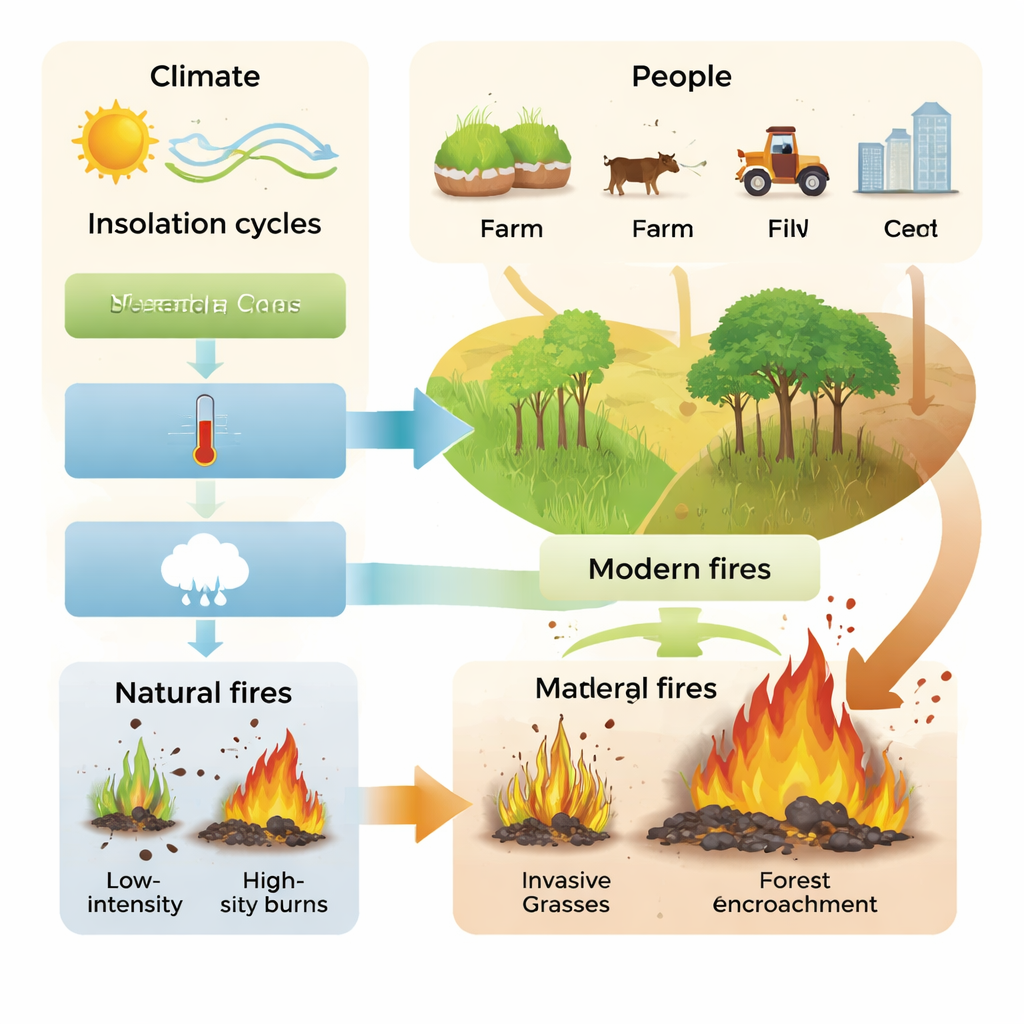
Over the last 5,000 years, fire activity rose again across much of the Cerrado, but this time the picture becomes more uneven from place to place. In some areas, fires became more common just as tree cover expanded; in others, charcoal peaks appeared at different times in neighboring sites. Archaeological evidence points to increasing human presence near many of these lakes and swamps, with Indigenous peoples using fire for hunting, small-scale farming, and managing grasslands. The charcoal particles suggest that many of these fires remained surface burns fueled by grasses, in line with a savanna that is adapted to burn without collapsing into desert or dense forest. The study concludes that by this stage, climate and people together were shaping the fire regime—climate setting the broad background, and human communities adding local pulses of burning.
The age of intense, frequent burning
In the last thousand years, and especially in recent centuries, the balance tipped further toward human control. Fire intervals, once separated by centuries or millennia, shortened to decades and now often to just a few years. European colonization brought both strict fire bans in some areas and highly destructive clearing fires in others, paving the way for extensive cattle ranching and industrial agriculture. Modern satellite data confirm that roughly 40% of the Cerrado burned at least once between 1985 and 2022. At the same time, fire exclusion inside protected areas has allowed trees to invade open grasslands, changing fuel loads and making eventual fires more intense. Invasive African grasses also create denser, more continuous fuel that can turn ordinary burns into severe wildfires.
What this means for the future
To a non-specialist, the key message is straightforward: for tens of thousands of years, Cerrado fires were mainly controlled by nature—by changes in sunlight, climate, and CO₂—and the savanna proved remarkably resilient, maintaining its overall structure through very different fire regimes. In the last millennium, and especially in the last few decades, humans have become the dominant fire starter and fire suppressor, often overwhelming the natural rhythms. With CO₂ and temperatures now rising faster than at any time in this 30,000-year record, the authors warn that simply repeating today’s standard practice of burning every three to six years may not be safe or sustainable. Instead, fire management will need to be flexible, regularly reassessed, and informed by both Indigenous knowledge and this deep-time history if the Cerrado’s unique biodiversity is to survive in a hotter, more fire-prone world.
Citation: Ledru, MP., Franco Cassino, R., Escobar-Torrez, K. et al. 30,000 years of fire history in the Cerrado. Sci Rep 16, 7684 (2026). https://doi.org/10.1038/s41598-026-38119-0
Keywords: Cerrado savanna, fire history, paleoecology, climate change, fire management