Clear Sky Science · en
Foot arch morphology and lower-limb biomechanical characteristics in university students: a cross-sectional multifactorial analysis of 1,078 participants
Why the shape of your foot arch matters
Most of us rarely think about the shape of our feet, yet the curve of the inner foot arch quietly helps us stand, walk, and play sports. This study followed more than a thousand university students to see how different arch shapes—very low, average, or very high—relate to body alignment, how forces pass through the feet, and how steadily people can stand. The results suggest that both “too flat” and “too high” arches, as well as differences between the left and right foot, may change how our bodies manage load and balance, even before pain or injury shows up.
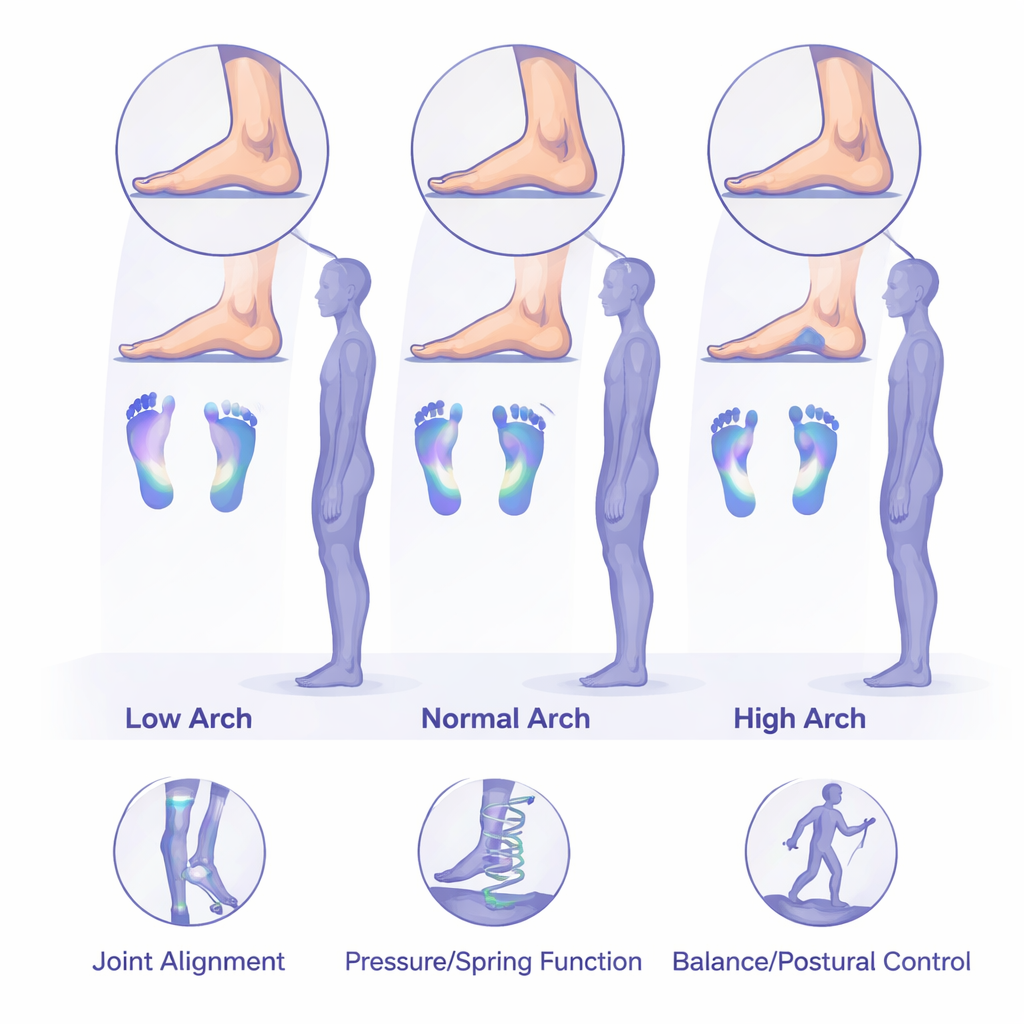
Different kinds of arches in everyday feet
The researchers examined 1,078 university students who came to a sports science lab for a brief standing test. Using a three-dimensional foot scanner, they measured arch height and the angles of the big toe and heel. A pressure plate under the feet recorded how weight was distributed across the soles and how the arch behaved like a spring when compressed. A separate force plate tracked tiny shifts in the body’s center of pressure over time, which reflect how hard our nervous system is working to keep us upright. Each foot was classified into several types ranging from very flat to very high, and the left and right feet were analyzed separately to capture side-to-side differences.
How arch shape links to toe and heel alignment
The team found clear links between arch shape and the angles of the big toe and heel. Students with lower arches tended to have the big toe tilted outward more and the heel leaning inward, patterns often associated with flatfoot and bunion-like deformities. On the other hand, some students with very high, stiff arches also showed less favorable toe and forefoot alignment. This suggests that problems are not limited to flat feet: extremes at either end of the arch spectrum may change how bones in the front and back of the foot line up. These patterns were strongest in the left foot, hinting that everyday habits and leg dominance might influence how structure and alignment interact.
The arch as a built‑in spring
Beyond static shape, the study looked at how well the arch acts as a spring, storing and releasing energy as we load our feet. Two measures captured this behavior: how much the arch deforms elastically under pressure, and how efficiently pressure “bounces back” when the load is reduced. Severe flat feet showed a marked loss of this spring function, with much lower scores on both measures, meaning they stored less elastic energy and recovered more slowly. High arches also showed reduced spring-like behavior, but for a different reason: they appeared too stiff and less able to deform and return energy. Together, these findings suggest that both overly soft and overly rigid arches may pass more shock up the leg instead of buffering it.
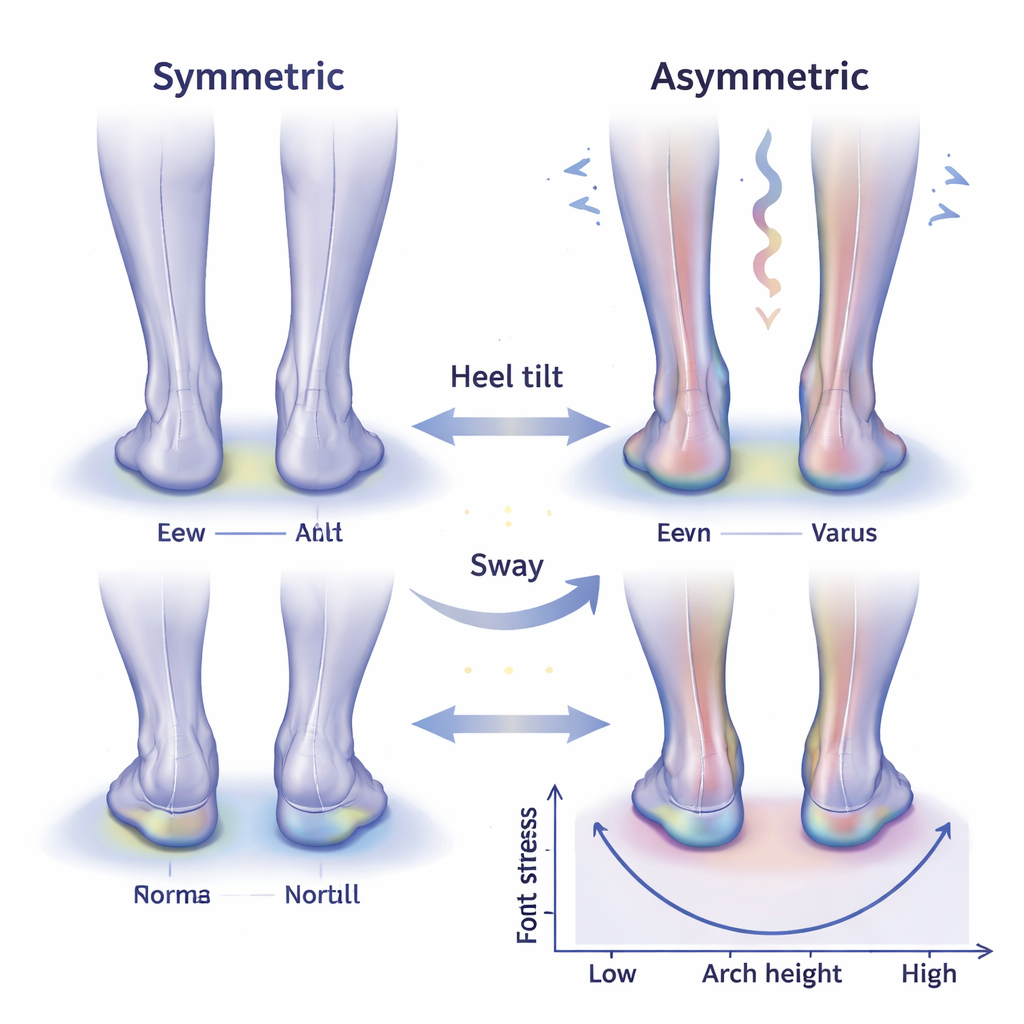
When left and right feet don’t match
The study also highlighted the importance of symmetry. When the two arches differed in height, students swayed more and showed greater side-to-side shifts in their center of pressure, even while simply standing still. Larger differences between feet were linked to stronger signs of imbalance and more irregular sway patterns, suggesting that the brain and muscles had to work harder to keep posture steady. Differences in arch “type” between the two sides explained more of this imbalance than height differences alone, pointing to a combined effect of structure and function. These quiet-standing changes may not cause symptoms by themselves, but they could indicate an underlying imbalance that becomes important during running or jumping.
What this means for students and active people
For a layperson, the message is that arch shape, how springy the arch is, and how similar your two feet are all seem to matter for how your body handles load and balance. Among these students, both very low and very high arches showed less favorable patterns in alignment, shock absorption, and postural control, and noticeable differences between left and right arches were tied to less stable standing. The authors suggest using a broad screening approach—looking at arch type, arch function, and asymmetry together—to flag students who might benefit from follow-up advice on footwear, strength training, or balance exercises. However, they stress that their study measured associations during quiet standing only; it does not prove that any particular arch shape causes injury. Long‑term studies and intervention trials are needed to learn whether changing arch support or doing targeted exercises can actually reduce pain or prevent sports injuries.
Citation: Xu, Z., Lin, Y., Chen, Y. et al. Foot arch morphology and lower-limb biomechanical characteristics in university students: a cross-sectional multifactorial analysis of 1,078 participants. Sci Rep 16, 7329 (2026). https://doi.org/10.1038/s41598-026-38118-1
Keywords: foot arch, flatfoot, balance, plantar pressure, sports injury