Clear Sky Science · en
A novel stacking ensemble model for predicting discharge coefficient of submerged multi parallel radial gates
Why smarter water gates matter
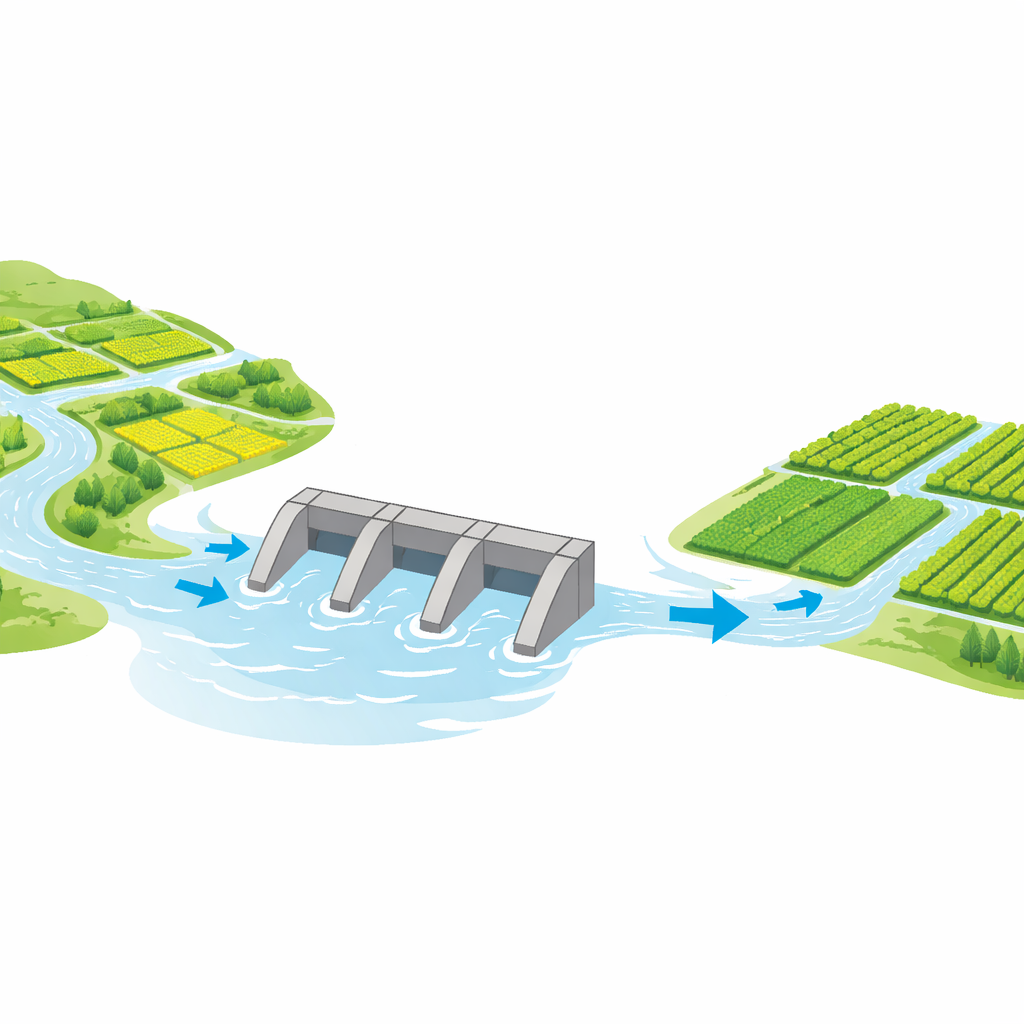
Across irrigated farmlands, metal gates in canals quietly decide who gets water and when. When these gates are even slightly mis‑calibrated, some fields are overwatered while others go dry, wasting a scarce resource and harming crops. This study tackles that hidden problem by using advanced computer learning to make flow through these gates easier and far more accurate to predict, without demanding complex equations or trial‑and‑error in the field.
Hidden challenge inside canal gates
Modern irrigation networks rely heavily on so‑called radial gates, curved steel doors that can be raised or lowered to regulate how much water passes downstream. Under many real‑world conditions, these gates operate while being "submerged"—that is, water levels are high on both the upstream and downstream sides. In this situation, a key quantity called the discharge coefficient determines how much water actually passes beneath a partly open gate. Traditional methods to compute this coefficient are complicated, depend on many assumptions, and can be wrong by tens of percent when the gate is submerged. For engineers and water managers, these inaccuracies translate directly into poor control of deliveries to farms.
Teaching a model from real river data
The researchers turned to machine learning, allowing computers to learn patterns directly from measurements instead of relying only on hand‑crafted formulas. They gathered 782 data points from three large regulators in Egypt’s Nile Delta, each with multiple curved gates serving hundreds of thousands of acres. For every operating condition they recorded upstream and downstream water levels, gate opening and geometry, and the resulting flow. They then converted these into simple ratios—for example, how deep the water is downstream compared with upstream—so that the model could focus on the most influential aspects of gate behavior. Earlier work had shown that the ratio of downstream to upstream water depth is especially important, and this new analysis confirmed that it is the single most powerful predictor of discharge performance.
Many minds, one final answer
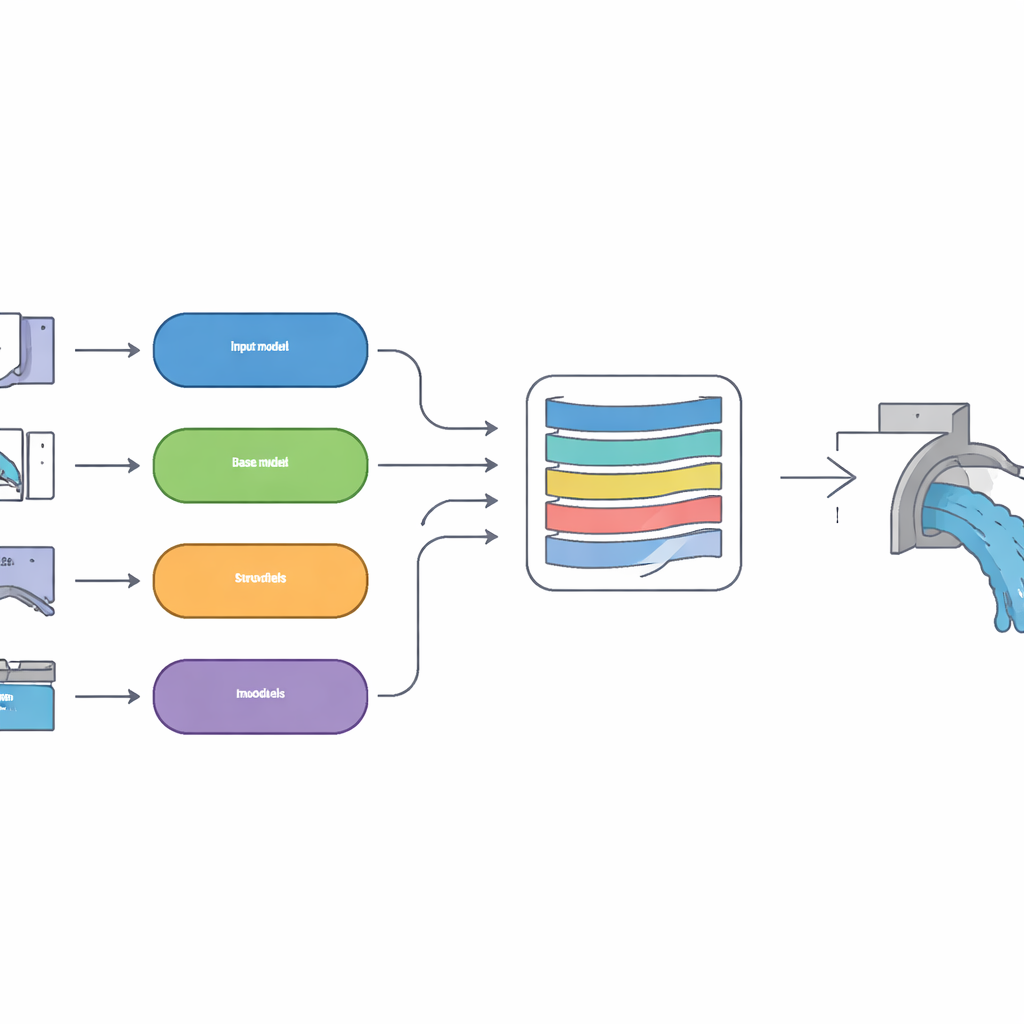
Instead of betting on a single learning method, the team built a "stacking" approach that combines several different prediction tools. Four base models, each using a different style of pattern recognition, first produce their own estimates of the discharge coefficient. These include methods that are good at expressing uncertainty, methods that work well with complex curves, and methods that excel at picking up subtle relationships. Their outputs are then fed into a higher‑level deep learning model known as a long short‑term memory network, which is equipped with an attention mechanism. This top layer learns how much trust to place in each base model under different flow conditions, much like an experienced engineer weighing multiple expert opinions before deciding on a final value.
How well does it work?
The combined system was trained and tested using careful cross‑validation, where the data are repeatedly split into separate learning and checking groups to avoid over‑fitting. Across these tests, the ensemble model consistently produced discharge coefficients that matched field measurements extremely closely. Its typical error was only a few percent, and it outperformed every individual base model as well as several widely used traditional regression techniques. Visual comparisons showed that the model’s predictions fell almost exactly along the ideal one‑to‑one line with observed values, indicating that it remained accurate over the full range of operating conditions seen in the canals.
What this means for real canals
For non‑specialists, the practical takeaway is simple: by letting several learning methods "vote" and then teaching a smart final judge how to weight these votes, engineers can predict how much water will pass through submerged radial gates with high reliability. Because the required inputs are just water levels, gate openings, and fixed gate dimensions—values already measured in most automated canal systems—the method can be plugged into existing control software as a decision‑support tool. Used wisely within the range of conditions it was trained on, this kind of intelligent ensemble model can help irrigation agencies deliver water more fairly, reduce waste, and respond more confidently to changing demand and climate‑driven pressures on rivers.
Citation: Abdelazim, N.M., Hosny, M., Abdelhaleem, F.S. et al. A novel stacking ensemble model for predicting discharge coefficient of submerged multi parallel radial gates. Sci Rep 16, 7953 (2026). https://doi.org/10.1038/s41598-026-38117-2
Keywords: irrigation canals, radial gates, machine learning, water management, discharge prediction