Clear Sky Science · en
Novel eugenol/limonene nanoplatform as a new remedy against bacterial lung infections
Why kitchen spices matter for lung health
Most of us know orange and clove as flavors in desserts or holiday drinks, not as weapons against dangerous germs. Yet the rise of antibiotic‑resistant bacteria is pushing scientists to look again at familiar plants for new medical tools. This study explores whether key ingredients from orange peel and clove oil, packaged into ultra‑tiny droplets called nanoemulsions, can help fight stubborn lung infections while still being gentle enough for delicate airway tissues.
Turning citrus and clove into tiny medicine droplets
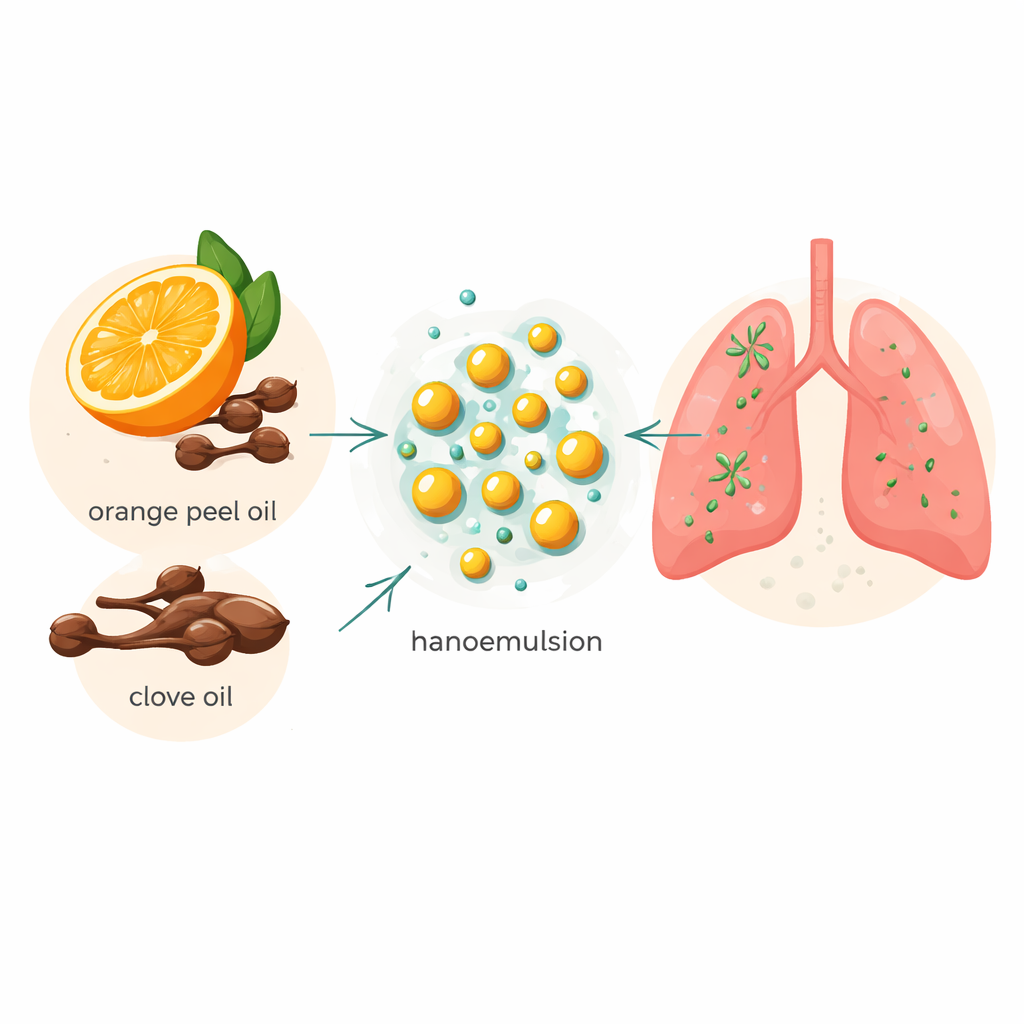
The researchers began by carefully analyzing essential oils distilled from Egyptian orange peels and clove buds. They found that orange oil is dominated by a citrus‑smelling compound called D‑limonene, while clove oil is rich in eugenol, which gives clove its spicy aroma. Although these molecules behave differently in water and fat, their chemical “friendship” allows them to pack together into nanosized droplets when mixed with safe surfactants and shaken intensely. The team used high‑energy mixing and ultrasound to create a stable nanoemulsion in which the oil droplets were about 100 billionths of a meter across—small enough to spread evenly in water and potentially penetrate biological barriers more effectively than regular oil.
How the new blend targets bacteria and inflammation
Beyond simply mixing the oils, the scientists asked how eugenol might latch onto proteins that bacteria and inflamed tissues rely on. Computer modeling suggested that eugenol could fit into the pockets of several important enzymes, including those that help bacteria build DNA and break down common antibiotics, as well as a receptor involved in airway inflammation. These predictions were followed by lab tests on an enzyme called dihydrofolate reductase, crucial for DNA production. The orange–clove nanoemulsion did slow this enzyme’s activity, though far less powerfully than a standard chemotherapy drug used as a reference. Even so, the results confirmed that the natural blend can directly interact with key molecular machinery that bacteria depend on.
Putting the nanoemulsion to the test against lung germs
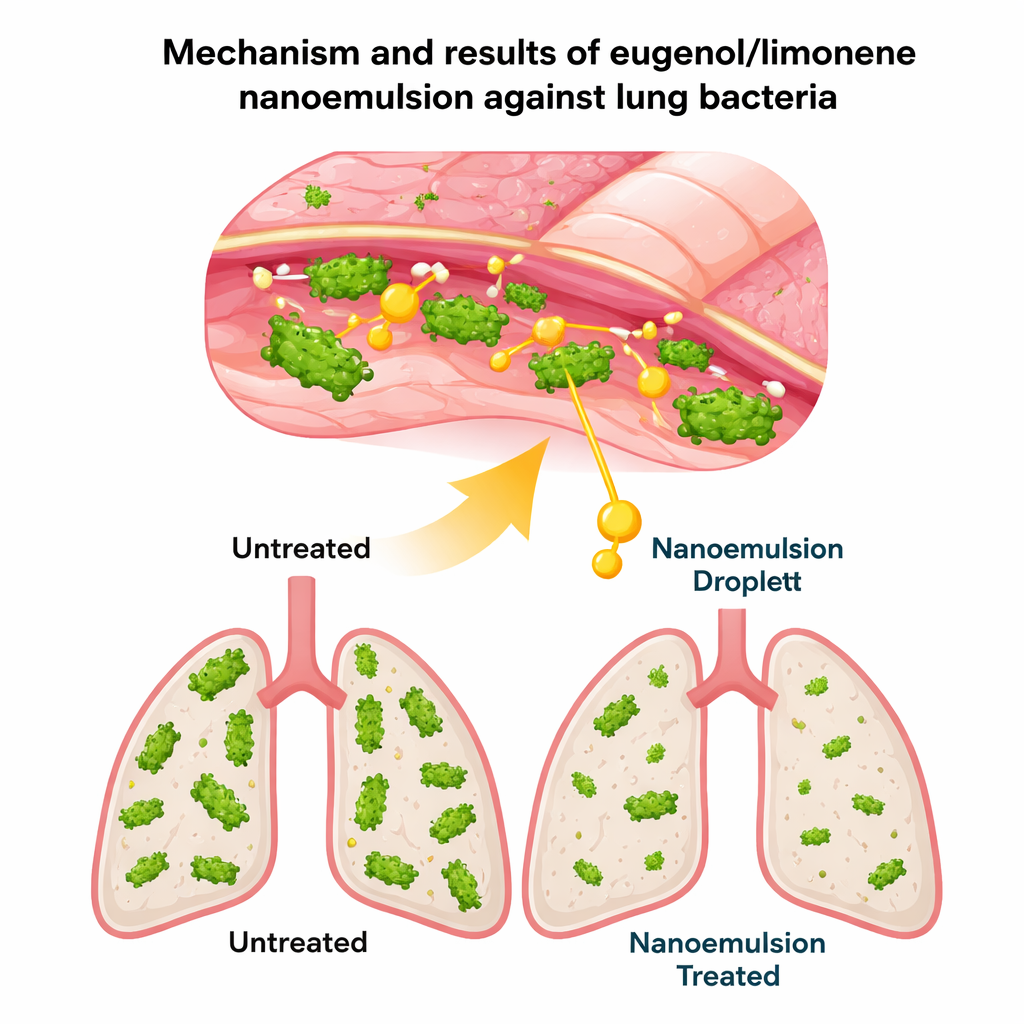
The central question was whether the new formulation could actually stop disease‑causing bacteria. Using multidrug‑resistant strains of Pseudomonas aeruginosa—an organism that often plagues people with chronic lung diseases—the team compared plain eugenol, plain limonene, and the combined nanoemulsion. In petri‑dish tests, the mixture produced much larger clear zones where bacteria could not grow, and it killed the microbes at lower doses than either oil alone. Electron microscope images showed deformed, damaged bacterial cells after treatment, suggesting that the nano‑sized droplets physically disrupt bacterial membranes while also delivering their chemical payload more efficiently.
Safety checks in lung cells and animal lungs
Because any future treatment would likely be inhaled, the scientists checked how the nanoemulsion affected human‑like airway cells grown in the lab. These cells tolerated relatively high concentrations of the formulation before their survival was cut in half, pointing to a usable safety window. The team then moved to a rat model of lung infection. Animals were infected with Pseudomonas and then treated with either single oils or the combined nanoemulsion delivered directly into the airways. Across the treated groups, bacterial counts in lung tissue fell sharply compared with untreated infected animals, with the nanoemulsion group showing both strong germ reduction and better‑preserved lung structure under the microscope.
Balancing power and safety in a natural remedy
Microscopic examination of lung tissue painted a nuanced picture. Untreated infected lungs showed severe damage, with collapsed air sacs and thickened walls clogged by immune cells. Animals given only one of the oils sometimes showed airway irritation and structural breakdown, likely reflecting the harshness of concentrated essential oils on sensitive tissues. By contrast, the orange‑clove nanoemulsion tended to maintain more normal air spaces and cell types, even though some signs of irritation and congestion remained. This suggests that spreading the active ingredients across many tiny droplets may temper their harshness while preserving their antibacterial punch.
What this work means for future treatments
For non‑specialists, the message is that everyday plant ingredients like orange and clove can be re‑engineered into sophisticated, nano‑sized packages that act as multi‑purpose tools: they poke holes in bacteria, interfere with crucial enzymes, and may soothe inflammation—all at once. The study does not claim that this particular mixture is ready to replace antibiotics, and it highlights that careful attention to dosage and lung safety is essential. But it demonstrates a promising direction: using smart nano‑formulations of natural compounds to bolster our arsenal against resistant lung infections while striving to protect the fragile tissues we are trying to heal.
Citation: Elwakil, B.H., Shaaban, M.M., Bakr, B.A. et al. Novel eugenol/limonene nanoplatform as a new remedy against bacterial lung infections. Sci Rep 16, 7728 (2026). https://doi.org/10.1038/s41598-026-38114-5
Keywords: essential oils, nanoemulsion, lung infection, antibiotic resistance, Pseudomonas aeruginosa