Clear Sky Science · en
Problematic internet users develop enhanced perceptual processing to offset neural deficits in conflict monitoring
Why heavy screen time matters for your brain
Many of us spend hours each day online, whether for work, school, or entertainment. But for some people, internet use becomes so excessive that it disrupts sleep, mood, relationships, and daily responsibilities. This pattern, known as problematic internet use or internet addiction, has been tied to changes in brain function. The study summarized here asks a subtle question: when people with problematic internet use seem to perform normally on everyday thinking tasks, is their brain working in the same way as everyone else—or are they quietly relying on different neural strategies to keep up?
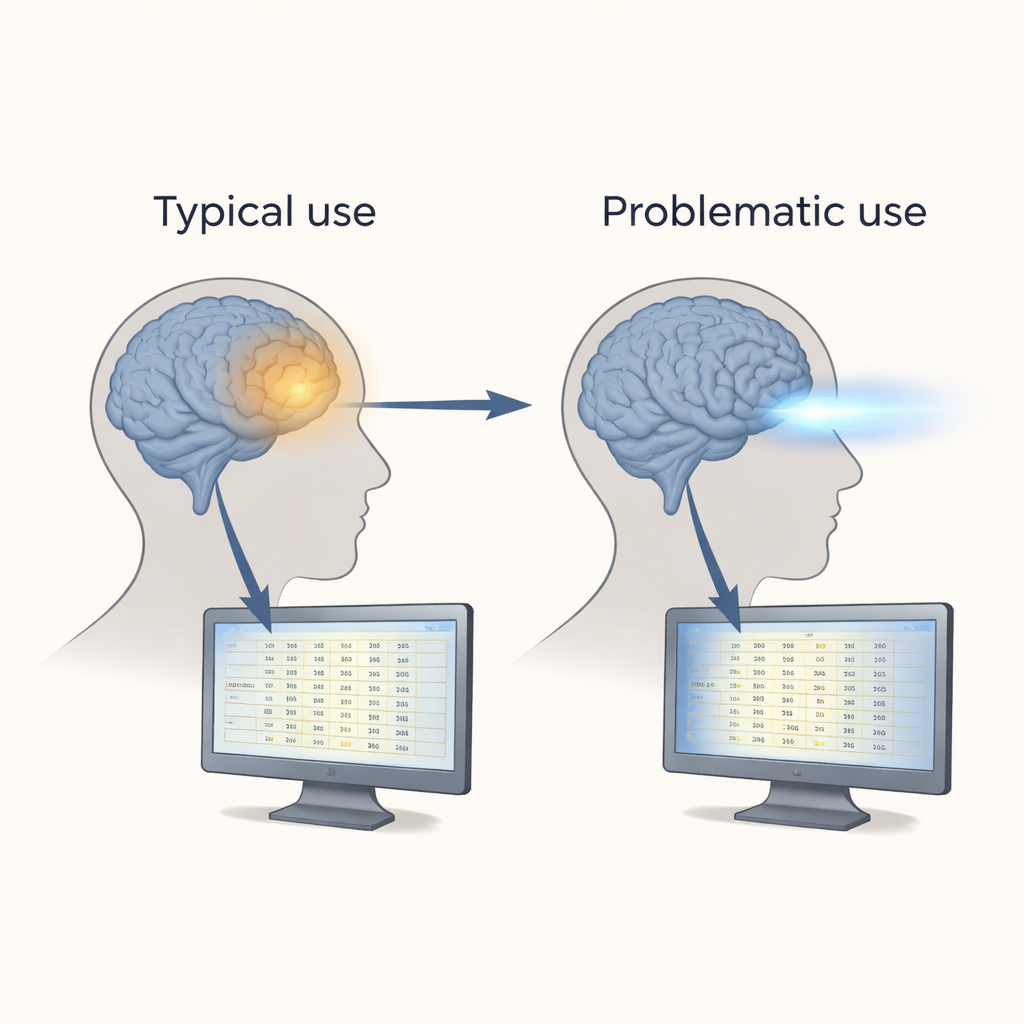
A thinking test that pits number against size
To probe this, researchers recruited university students and divided them into two groups: those with typical internet habits and those whose scores on a standardized questionnaire indicated problematic use. Everyone completed a “numerical Stroop” task while their brain activity was recorded using EEG, a technique that measures tiny voltage changes on the scalp. On each trial, two numbers appeared on the screen. Sometimes the numerically larger digit was also physically larger (a helpful match), sometimes both digits were the same physical size (neutral), and sometimes the numerically larger digit was physically smaller (a confusing mismatch). Volunteers had to choose which digit was numerically larger as quickly and accurately as possible, ignoring the distracting size information.
Outwardly normal, inwardly different
On the surface, those with problematic internet use behaved just like the control group. Both groups were fastest and most accurate when number and size matched, performed worst when they conflicted, and fell in between for neutral trials. In other words, the distracting size information sped people up when it helped and slowed them down when it conflicted, regardless of how much they used the internet. This might suggest that problematic internet use has little impact on basic thinking skills. However, the EEG recordings told a more complex story, revealing that the two groups’ brains were solving the task in different ways.
Early boost in visual attention
The researchers focused on several well-studied brain signals that unfold over fractions of a second after each number pair appeared. One of the earliest, called the N100, reflects how sharply the brain tunes its attention to incoming visual information. In the problematic internet group, both helpful and conflicting size–number combinations produced a stronger N100 than neutral trials, hinting that these participants were generally more sensitive to differences in the physical appearance of the digits. In contrast, the control group showed this extra early response only when number and size conflicted, suggesting they reserved heightened attention for situations where it was truly needed.
Weakened conflict signal, stronger help from simple features
Later in time, another brain response called the N450 is known to track how hard the brain works to detect and resolve conflict between competing pieces of information. Here, the control group showed the expected pattern: a clear increase in N450 when number and size disagreed, signaling robust conflict monitoring. The problematic internet group, however, showed a reduced conflict signal—an indication that this monitoring system was not engaging as strongly. Yet their overall performance did not suffer. Instead, other brain signals tied to perceptual evaluation and decision making (the N200 and a later positive wave called the LPC) showed larger “facilitation” effects in people with more severe problematic use. When size and number aligned, their brains seemed to gain extra mileage from this simple visual cue, and the strength of that boost rose with the severity of their internet problems.
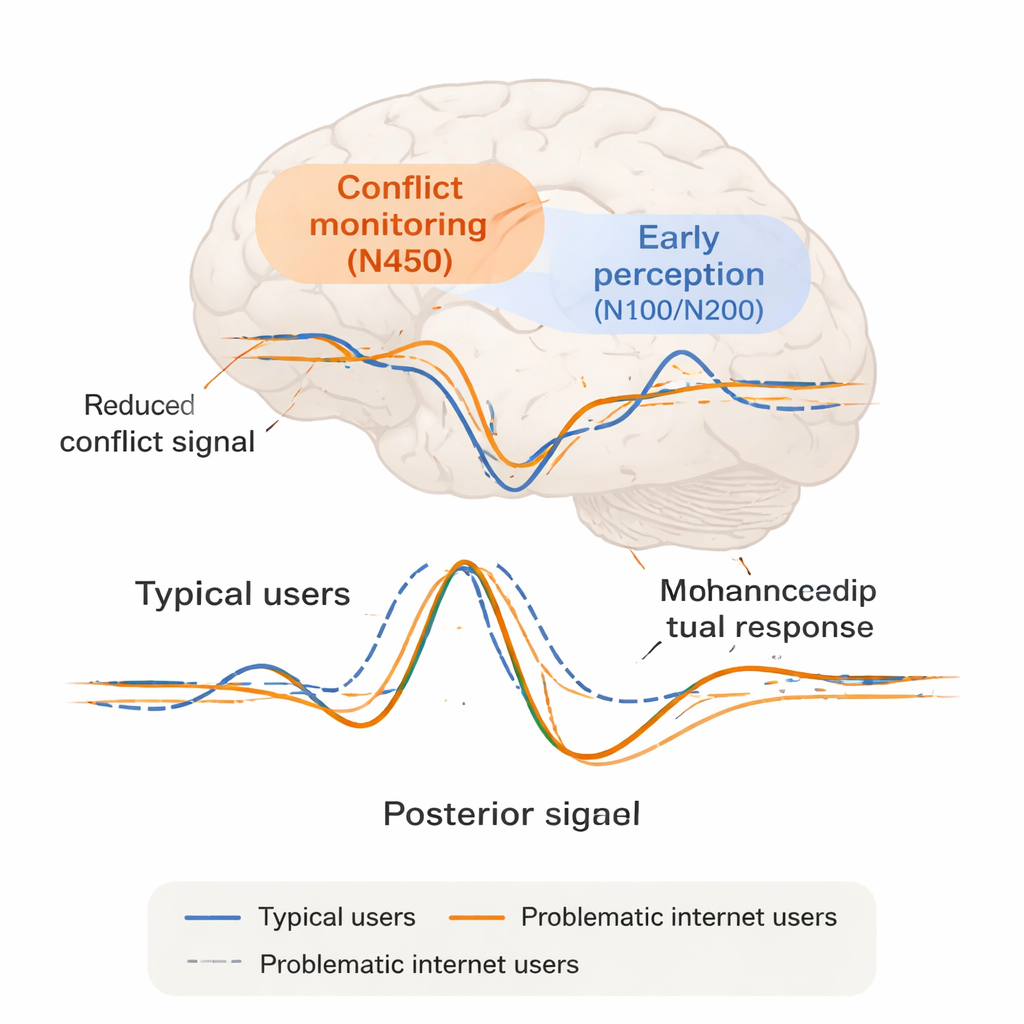
A brain that leans on quick impressions
Taken together, the findings suggest that individuals with problematic internet use do not simply have weaker cognitive control. Rather, they appear to compensate for a dulled conflict-monitoring system by amplifying early, bottom-up processing of simple sensory features like size. Their brains latch onto easy visual cues more strongly and more broadly than those of typical users, and this heightened perceptual sensitivity helps them maintain normal performance on challenging tasks. For everyday life, this may mean that heavy, compulsive internet users become especially attuned to eye-catching on-screen details and rapid visual changes, while finding it harder to rely on slower, more deliberate control processes—illustrating both the brain’s flexibility and the subtle costs of constant online engagement.
Citation: Lin, Q., Huang, CM., Mak, H.Y. et al. Problematic internet users develop enhanced perceptual processing to offset neural deficits in conflict monitoring. Sci Rep 16, 7603 (2026). https://doi.org/10.1038/s41598-026-38111-8
Keywords: problematic internet use, cognitive control, attention, Stroop task, event-related potentials