Clear Sky Science · en
Walnut-shell-derived porous carbon for efficient room-temperature adsorption of organic dyes
Turning Kitchen Scraps into Clean Water Helpers
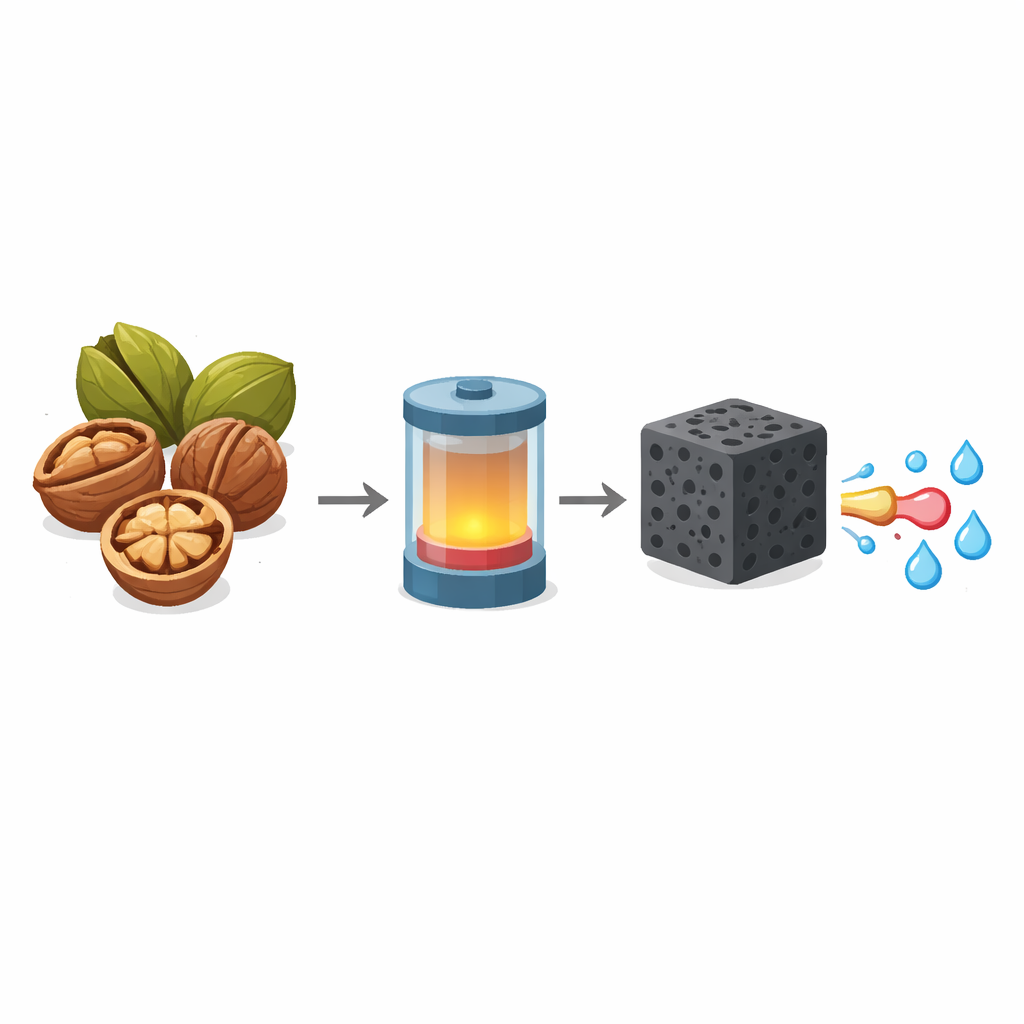
Colorful dyes make our clothes bright and our food appealing, but when they end up in rivers and lakes they can be toxic, long‑lasting, and hard to remove. This study explores a surprisingly simple idea: transforming discarded walnut shells, a common agricultural waste, into a powerful sponge‑like material that can strip stubborn dyes from water at room temperature. By doing so, the work connects everyday foods, cleaner industry, and safer drinking water in a way that is both practical and environmentally friendly.
Why Stubborn Dyes Are a Big Problem
Modern dyes are engineered to cling strongly to fabrics and to survive sunlight, heat, and washing. Those same traits make them difficult to remove once they leak into wastewater. The textile industry alone uses thousands of tons of dyes every year, and a significant fraction is released into waterways. Certain dye families, including those that give vivid blue, orange, and red colors, can break down into substances linked to cancer and genetic damage. Conventional treatment methods often struggle with these molecules or are too costly for broad use. Finding low‑cost materials that can pull many different dyes out of water quickly is therefore a pressing challenge.
Walnut Shells as a Hidden Resource
Walnut shells are usually thrown away after the edible kernel is removed, yet they are rich in carbon and plant chemicals. The researchers collected shells, cleaned and ground them into fine particles, and then mixed them with simple salts containing potassium. This mixture was heated in a controlled oven to either 700 or 800 degrees Celsius in the absence of oxygen. Under these conditions, the shells are transformed into a light, charcoal‑like material riddled with invisible holes and channels. The team tested several versions and found that using potassium carbonate at the higher temperature produced a form of walnut‑shell carbon with an exceptionally large internal surface area and a network of pores of different sizes.
A Nano‑Sponge That Loves Color
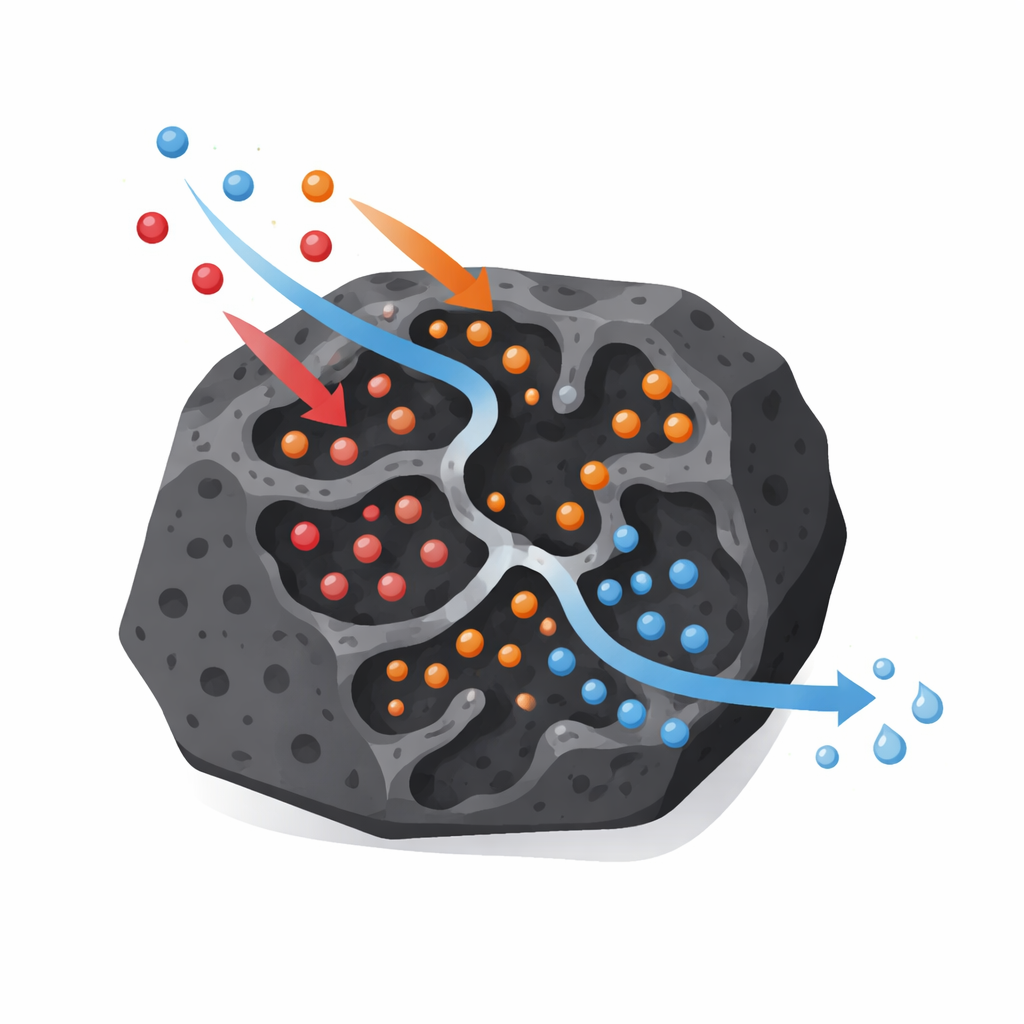
To see how well this new material works, the scientists tested it on three common dyes that represent different chemical types: a bright blue, a yellow‑orange, and a deep red. They placed a small amount of the walnut‑based carbon into dye solutions at room temperature and watched how quickly the color faded. For low dye levels similar to those found in treated wastewater, the blue and orange solutions became almost completely clear within half an hour, and the red solution followed closely behind. Even at higher dye levels, the material continued to pull in large amounts of color, just taking slightly longer to reach its limit. These results show that the porous carbon acts like a nano‑sponge, giving dye molecules many places to land and settle.
Peering Inside the Cleaning Process
Detailed measurements helped the team understand how the walnut‑shell carbon does its job. Microscopy images revealed a foam‑like structure made of thin carbon walls and interconnected tunnels, while other optical tests confirmed that the carbon had a partially ordered, graphite‑like nature. When the researchers tracked how fast dyes disappeared from solution, the data matched models in which the rate is controlled by how quickly dye molecules find and attach to active spots on the carbon surface. For the blue and orange dyes, surface attachment dominated, while the bulkier red dye moved more slowly through the pores before being trapped. Overall, the material showed strong performance for dyes with very different sizes and charges, suggesting a broad range of uses.
What This Means for Cleaner Water
The study concludes that porous carbon made from walnut shells in a single heating step can rival or outperform many more complex, expensive adsorbents used today. Thanks to its enormous internal surface and well‑connected pore network, only a small amount of this material is needed to clean heavily colored water quickly at room temperature. Because walnut shells are abundant agricultural leftovers, this approach turns waste into a valuable tool for pollution control. In plain terms, the work shows that something as humble as a nut shell can be upgraded into a highly effective filter, offering a low‑cost and sustainable path to clearer, safer water.
Citation: Kitenge, V., Shams Khameneh, A., Heshmatian, S. et al. Walnut-shell-derived porous carbon for efficient room-temperature adsorption of organic dyes. Sci Rep 16, 9756 (2026). https://doi.org/10.1038/s41598-026-38102-9
Keywords: wastewater treatment, activated carbon, organic dyes, agricultural waste, adsorption