Clear Sky Science · en
Correlational analysis of halotolerant palynomorphs peculiarities by integrating morphological and morphometric characterization using scanning electron microscopy
How Tiny Grains Tell a Big Story
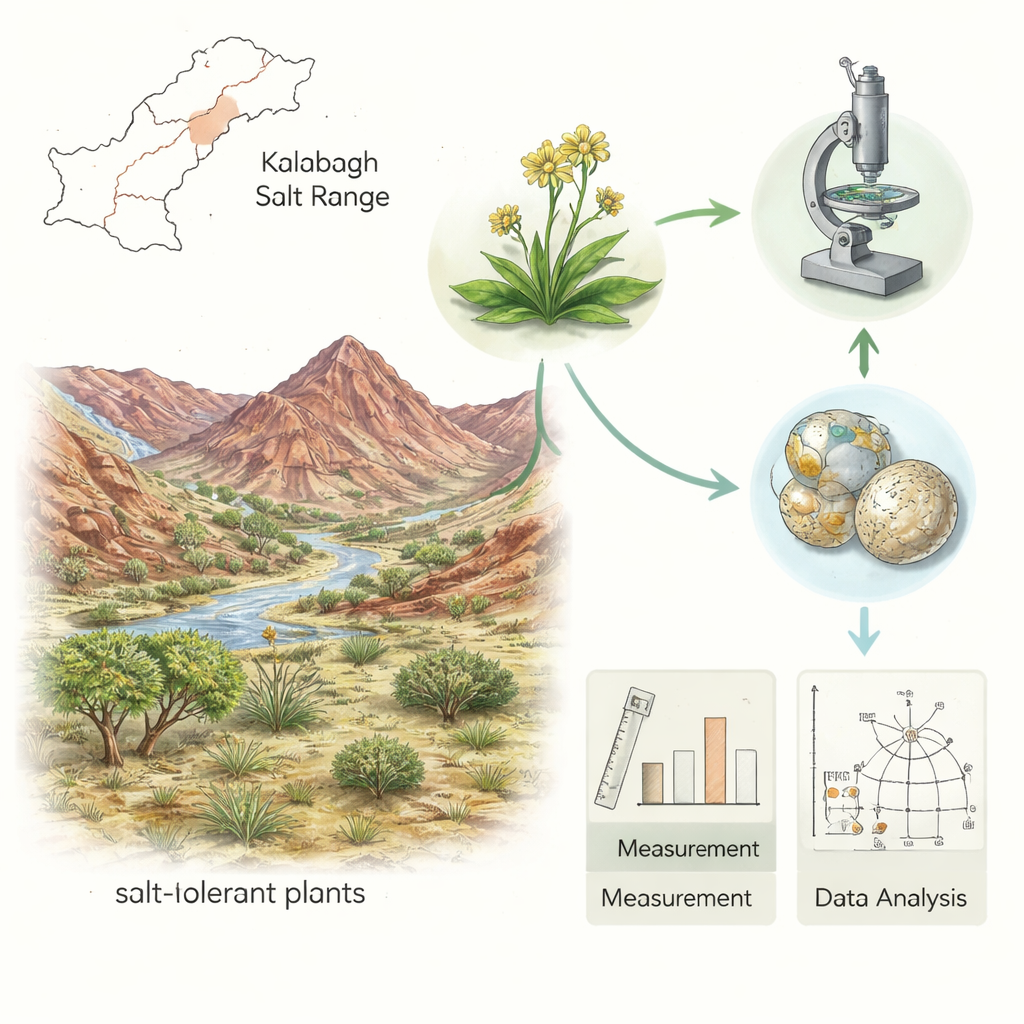
In the salt-scorched hills of Pakistan’s Kalabagh Salt Range, a tough cast of wild plants quietly survives where most crops would die. This study looks not at their leaves or roots, but at something far smaller and more revealing: their pollen. By examining the size, shape, and surface patterns of pollen grains, the researchers show how these salt-tolerant plants are adapted to harsh environments and how such microscopic clues can help scientists classify species, track environmental change, and even guide future conservation and breeding efforts.
Life on a Salty Stage
Salty soils are expanding worldwide, threatening farmland and food security. Halotolerant plants, which can grow in soils loaded with salt, are natural “survival experts” in these conditions. In the Kalabagh Salt Range, where red hills overlook the Indus River, these plants hold soils in place, stabilize sand dunes, and form the backbone of the local ecosystem. Because different species respond to climate and soil in distinct ways, they also act as living sensors of environmental change over time.
Why Pollen Makes a Reliable Clue
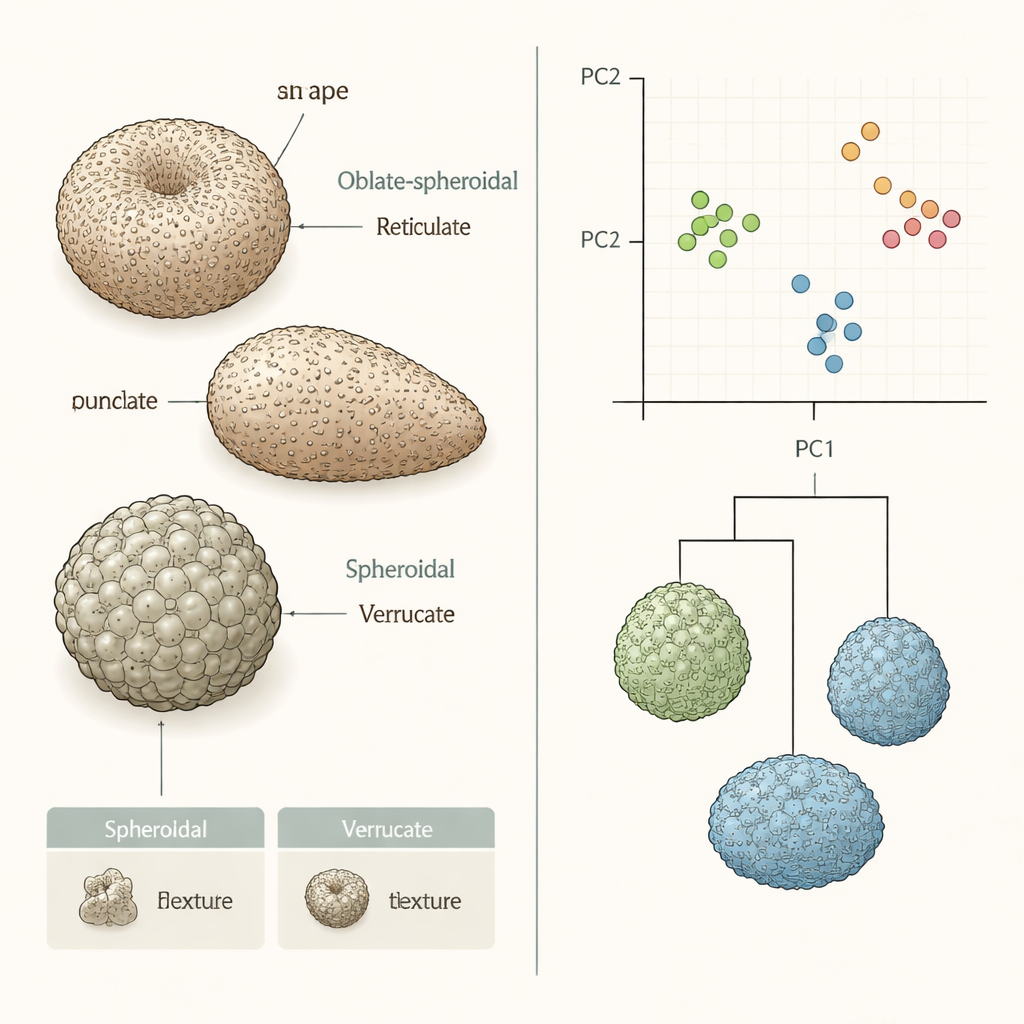
Pollen grains are remarkably tough. Their outer wall, called the exine, resists decay far better than leaves or stems and is only weakly influenced by day-to-day weather. That stability means pollen carries a long-lasting record of a plant’s identity. Features such as overall shape, the number and length of grooves or pores, and the detailed surface texture behave like a microscopic fingerprint. Palynology—the study of pollen—uses these traits to untangle which plants are closely related, to clarify confusing species, and to reconstruct past vegetation from fossil pollen trapped in sediments.
Peering at Pollen in High Detail
The research team collected flowers from 15 dominant salt-tolerant species belonging to 12 different plant families, ranging from shrubs like Tamarix to herbs such as Citrullus colocynthis and Fagonia indica. Working in the lab, they prepared pollen for both standard light microscopes and powerful scanning electron microscopes, which can reveal surface patterns thousands of times smaller than a grain of sand. They carefully measured each grain’s length, width, wall thickness, and the size of its openings, and recorded whether grains were viable—able to function in fertilization—using simple staining tests. Across species, pollen shapes ranged from almost spherical to distinctly elongated, and surfaces varied from net-like to prickly or finely pitted.
Finding Hidden Patterns in Numbers
Because each species has many pollen measurements, the team used statistical tools more familiar from big data than from botany. With principal component analysis, they reduced a tangle of measurements into a few axes showing which traits mattered most. This revealed, for example, that some species grouped together because they shared large equatorial diameters and thick walls, while others clustered due to smaller, thinner-walled grains. A second method, cluster analysis, grouped the 15 species into two main clusters that cut across traditional family boundaries. Species like Cleome viscosa and Fagonia indica, though unrelated, ended up side by side because their pollen dimensions and surface textures were strikingly similar. Importantly, nearly all species showed high pollen viability—above 80 percent, with Euphorbia caducifolia reaching over 92 percent—signaling strong reproductive health in salty soils.
What This Means for the Future
By turning pollen grains into measurable data, this study shows that the microscopic world can guide big-picture decisions. The detailed pollen “profiles” of these 15 salt-tolerant plants create a reference library that can help researchers recognize related lineages, trace how salt tolerance evolved, and pick out species best suited for rehabilitating degraded, saline land. The tight link they found between pollen traits and viability suggests that pollen can serve as a quick health check for plant populations facing environmental stress. While more work—especially genetic and field-based studies—is needed, the message for non-specialists is clear: understanding how these hardy plants succeed, down to the level of a single pollen grain, may offer clues for growing food and restoring ecosystems in an increasingly salty world.
Citation: Nazish, M., Zubair, M., Shah, M.H. et al. Correlational analysis of halotolerant palynomorphs peculiarities by integrating morphological and morphometric characterization using scanning electron microscopy. Sci Rep 16, 7142 (2026). https://doi.org/10.1038/s41598-026-38101-w
Keywords: halophytes, pollen morphology, salt tolerance, plant taxonomy, scanning electron microscopy