Clear Sky Science · en
The effects of leg prosthesis stiffness and take-off board stiffness on long jump performance
Why This Study Matters for Sports Fans
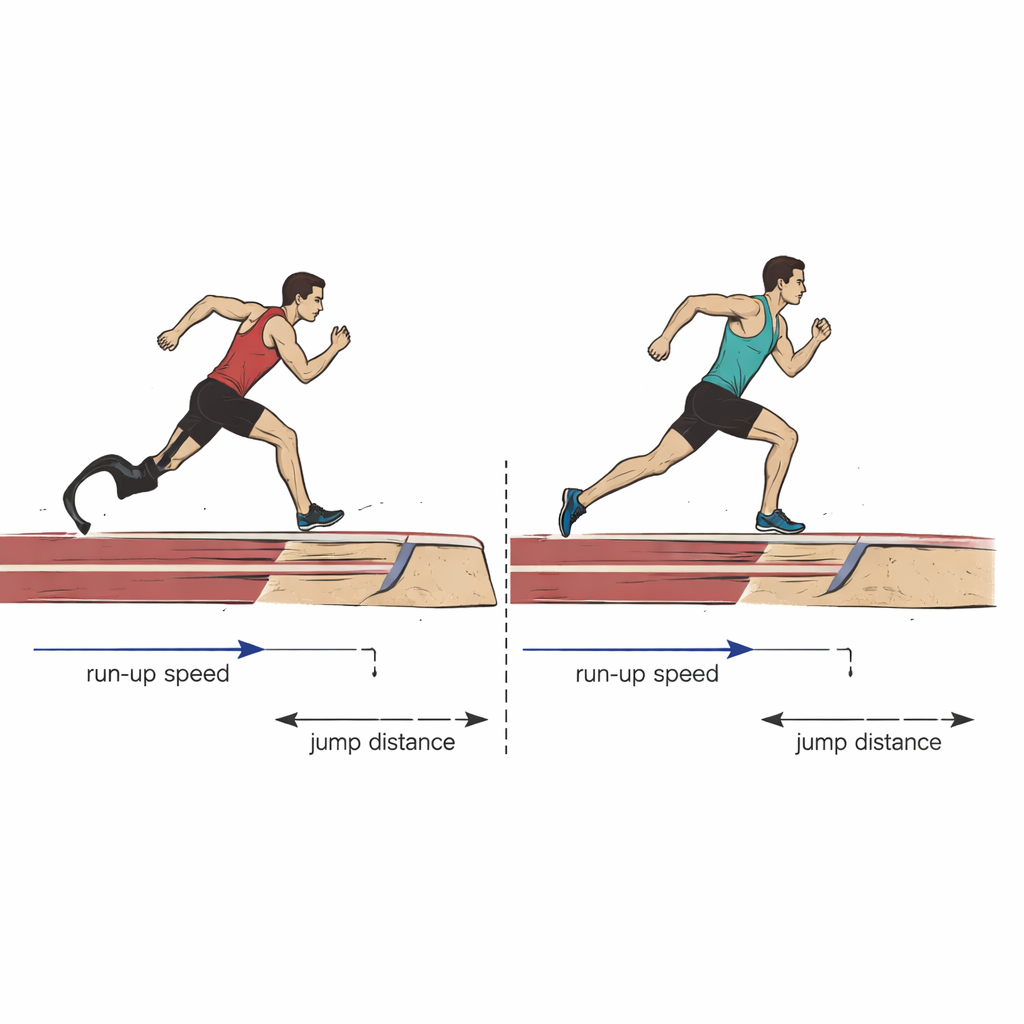
Long jump is one of track and field’s most dramatic events: a full-speed sprint ending in a single explosive leap. This study asks a question that matters for athletes, coaches, and anyone interested in fairness in sport: how do high-tech prosthetic legs and the stiffness of the take-off board itself change how far people can jump? By comparing elite long jumpers with a below-the-knee amputation to top college jumpers without amputations, the researchers explored whether carbon-fiber running prostheses provide an advantage, and how the “springiness” of the surface under the foot affects performance.
How Jumping Far Depends on Speed and Technique
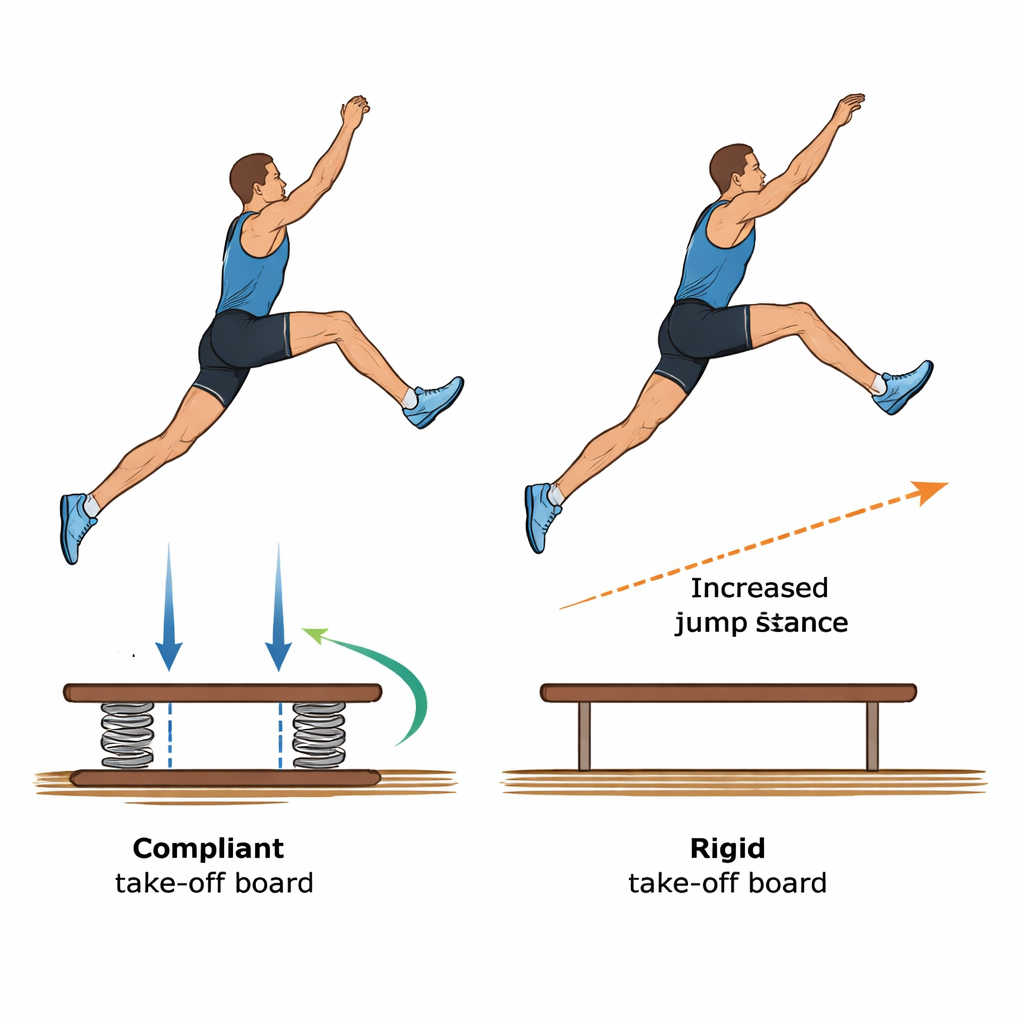
In long jump, success starts long before the athlete hits the board. The distance traveled is largely set by how fast the athlete is running just before take-off and how well they convert that horizontal speed into upward lift without braking too much. When the take-off leg hits the ground, it behaves a bit like a spring, squashing and then rebounding while also interacting with the track surface. The combined stiffness of the leg and surface influences how much elastic energy can be briefly stored and then returned, helping to launch the jumper forward. The study builds on earlier work showing that people naturally adjust how stiff their legs are when they move on softer or harder surfaces, fine-tuning this leg–surface system to keep their motion efficient.
Prosthetic Legs: More Spring, Same Distance
Two world-class athletes with a transtibial (below-knee) amputation took part using carbon-fiber running-specific prostheses of three different stiffness levels: one softer than the manufacturer’s recommendation, one at the recommended stiffness, and one stiffer. Despite clear mechanical differences—the softer prosthesis bent more and stored more elastic energy—their top run-up speed and jump distance did not change in a meaningful way across these settings. What did matter was speed: for every 1 meter per second increase in run-up velocity, these athletes jumped about half a meter farther. In other words, even though their prosthetic blades could store large amounts of energy, the key performance driver was how fast they arrived at the board, not how springy the blade was within the range tested.
Springy Take-Off Boards Help Non-Amputee Jumpers
Eight collegiate long jumpers without amputations were tested on three different take-off platforms: a standard stiff track surface and two custom-built, much softer “springboard” platforms mounted on metal coils. Their maximum run-up speed barely changed between surfaces, but their jump distances did. On average, the athletes jumped farther from the more compliant platforms, gaining about 7% distance on the softest board compared with the regulation one at similar speeds, and roughly 16% farther than the prosthesis users on their recommended setup. The softer boards compressed more and stored more elastic energy, yet the analysis suggested that the improvement in distance was linked mainly to platform stiffness itself, not simply to how much energy the platform stored. This points to subtle changes in how the leg and body use that springy support to reduce speed loss at take-off.
Who Really Has the Advantage?
When the researchers compared conditions that reflect real-world competition—a recommended-stiffness prosthesis on a standard track for athletes with amputations, versus regular legs on the same surface for non-amputees—they found no meaningful differences in either run-up speed or jump distance. This was true even though the prosthetic blades could store vastly more elastic energy than the ordinary track surface. The authors suggest that non-amputee athletes can adjust the stiffness of their own legs to make up for the track’s limited spring, while prosthesis users are constrained by the fixed stiffness of their devices. For sports governing bodies, the key takeaway is that current carbon-fiber prostheses, at typical setup levels, do not let long jumpers with transtibial amputations outperform non-amputee athletes simply because of extra energy storage. Instead, performance still hinges on fundamentals: speed on the runway and effective technique at take-off, regardless of whether the leg is biological or made of carbon fiber.
Citation: Ashcraft, K.R., Grabowski, A.M. The effects of leg prosthesis stiffness and take-off board stiffness on long jump performance. Sci Rep 16, 7418 (2026). https://doi.org/10.1038/s41598-026-38100-x
Keywords: long jump, running prosthesis, surface stiffness, elastic energy, Paralympic sport