Clear Sky Science · en
Optimization of specific spray volume for spray application in pomegranate orchard using response surface methodology
Why smarter spraying matters for fruit lovers
Pomegranates are prized for their jewel-like seeds and healthful juice, but keeping the trees free of pests and disease comes at a cost. Farmers often blanket orchards with large volumes of pesticide-laden spray, much of which never lands on the leaves and fruit. That wasted mist drifts into the air and soil, raises costs, and can harm the environment. This study explores how to fine‑tune spray volumes in Indian pomegranate orchards so that trees get just enough protection—no more, no less.
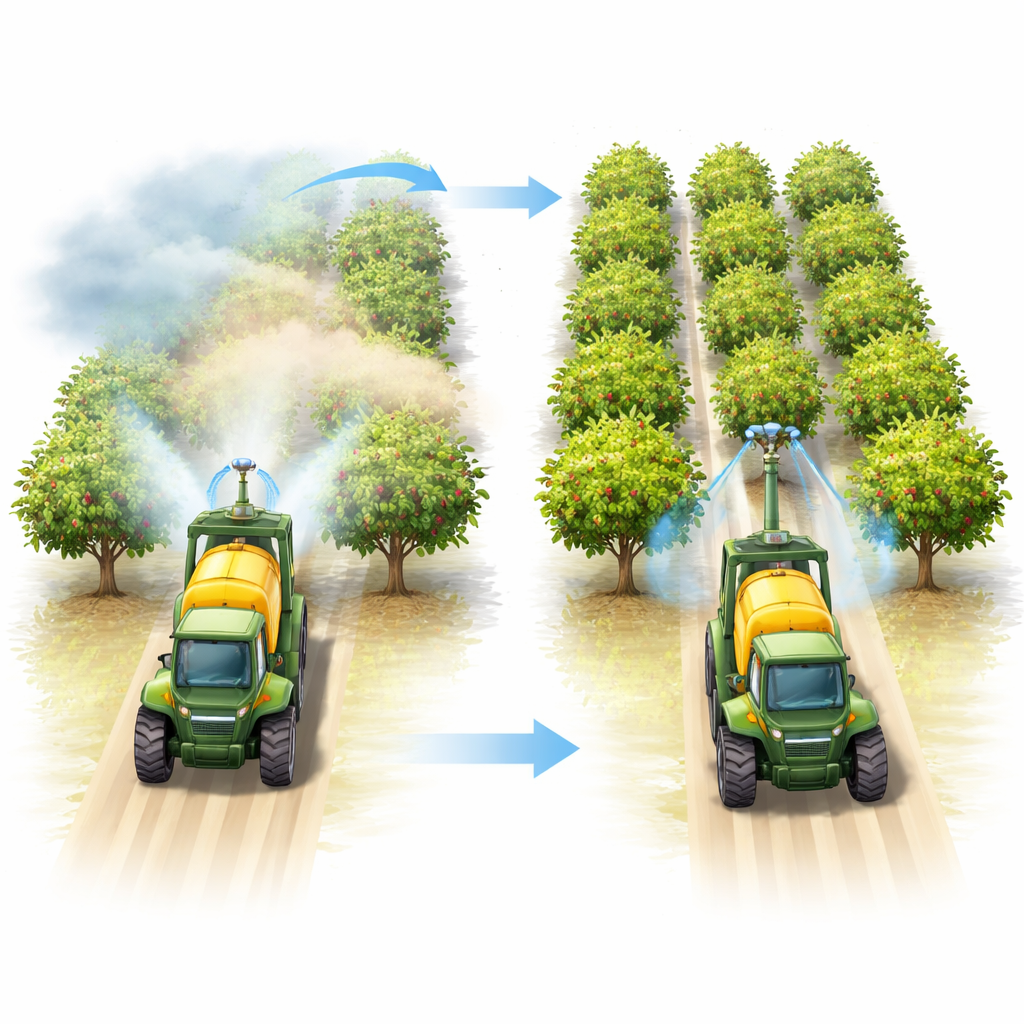
The problem with one-size-fits-all spraying
Most orchard sprayers work like a garden hose locked fully open: they deliver a constant flow, regardless of how big the trees are or how dense their foliage is. In India, pomegranate growers commonly apply hundreds of liters of spray per hectare and may treat their orchards more than forty times a season. Earlier research has shown that only about a third of sprayed pesticide typically reaches the canopy, with the rest drifting away or running off. That not only wastes chemicals and water but also increases the risk of contamination of soil, water, and nearby habitats.
A smart sprayer tailored to tree size
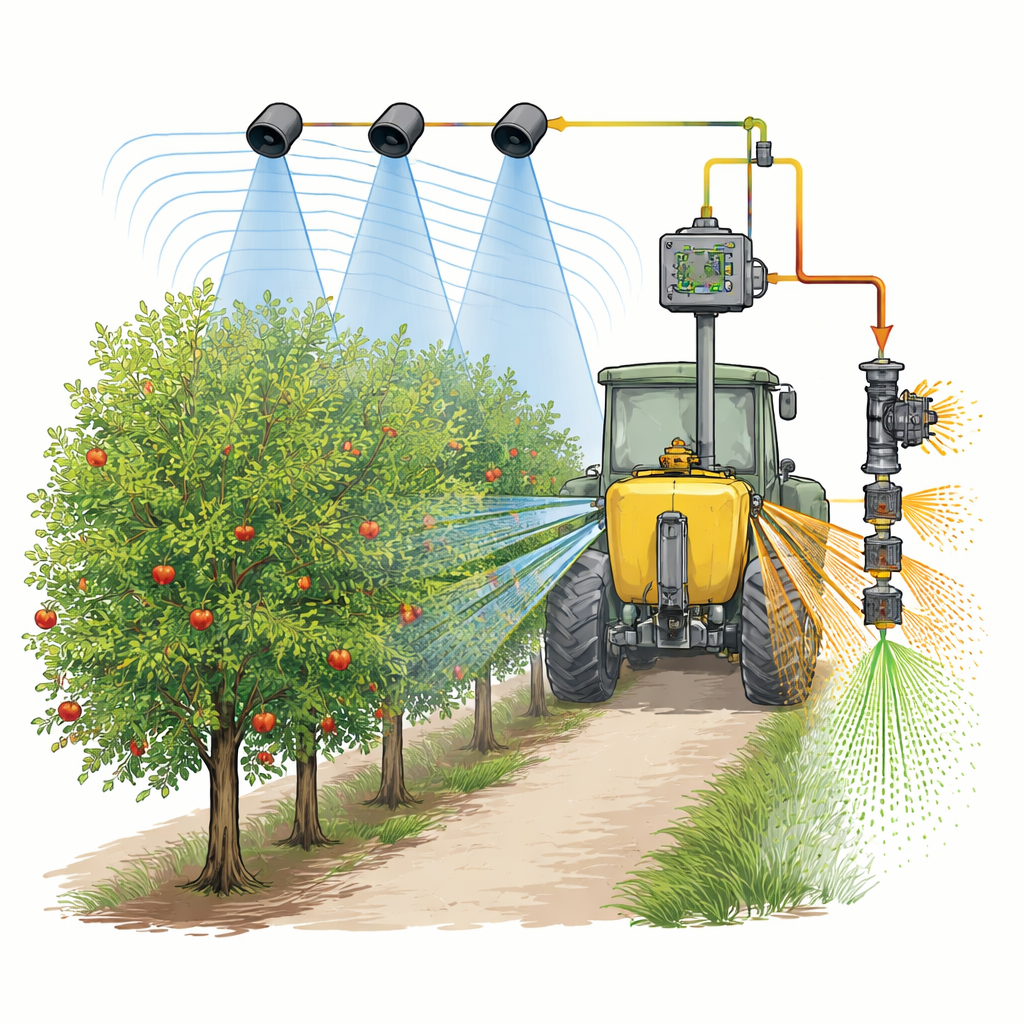
To tackle this, the researchers adapted a tractor‑pulled air‑blast sprayer into a “variable rate” machine that can change how much liquid it releases based on the size of the tree canopy in front of it. They fitted the sprayer with three ultrasonic sensors that measure the distance to the foliage at different heights. Aligned with those sensors are three nozzles whose flow is regulated electronically using a pulse‑width‑modulated valve controlled by a small computer. As the tractor moves down the row, the sensors detect where the canopy begins and ends, and the system turns spray on only when there is foliage to hit. This setup makes it possible to explore how nozzle flow and driving speed interact to determine how much spray actually lands on the trees.
Testing spray patterns in real orchards
The team tested the system in three commercial pomegranate orchards in Maharashtra, India, planted with the widely grown Bhagwa variety. The orchards ranged from two to eight years old, so the trees differed in height and canopy volume. In each orchard, the researchers ran the sprayer at three nozzle flow rates and three forward speeds, creating nine operating combinations. To measure how well the spray penetrated the canopy, they clipped water‑sensitive papers to leaves in both the outer layer of foliage and deeper inside the tree. After each pass, they scanned these cards and used image‑analysis software to quantify three key outcomes: how much of the card surface was covered, how many droplets landed per square centimeter, and how much liquid was deposited.
Finding the sweet spot for spray volume
Across all orchards, a clear pattern emerged. Slower tractor speeds and higher nozzle flow produced better coverage, more droplets, and higher deposits, especially on the outer canopy. Inner zones consistently received less spray, reflecting the barrier created by dense foliage. Using a statistical technique called response surface methodology, the authors built models that link speed and flow rate to the three spray outcomes in each orchard. They then searched for operating settings that kept coverage within a practical range and droplet density above thresholds known to be effective for insecticides and fungicides. This optimization yielded recommended “specific spray volumes” — the amount of liquid per cubic meter of canopy — of about 0.093, 0.084, and 0.077 liters per cubic meter for the young, middle‑aged, and older orchards, respectively.
Less mist, same protection
When the smart sprayer was run in a “targeted” mode—releasing spray only when foliage was present—the total volume applied per hectare dropped dramatically compared with a conventional continuous spray. Depending on orchard age and tree layout, spray savings ranged from roughly 38% to 60%, while still meeting accepted benchmarks for droplet coverage and density on leaves. In simple terms, the trees were just as well protected but with far less chemical and water use. For farmers, that could translate into lower input costs and fewer refills per day; for the environment, it means less off‑target drift and reduced risk to soil and water. Although the tests were limited to pomegranate under specific conditions, the study suggests that tuning spray volume to canopy volume, guided by sensors and careful optimization, can make fruit production both more sustainable and more economically efficient.
Citation: Thorat, D.S., Mehta, C.R., Agrawal, K.N. et al. Optimization of specific spray volume for spray application in pomegranate orchard using response surface methodology. Sci Rep 16, 8589 (2026). https://doi.org/10.1038/s41598-026-38088-4
Keywords: precision spraying, pomegranate orchards, variable rate technology, pesticide optimization, canopy sensing