Clear Sky Science · en
Sequential gait interventions reveal non-reciprocal transfer between instructional and sensorimotor adaptation mechanisms
Why walking training order matters
For many people recovering from a stroke or other brain injury, relearning how to walk is not just about getting stronger—it is about retraining the brain’s timing and coordination. Therapists often combine different forms of walking practice, such as treadmills and rhythmic cues like metronomes or spoken beats. This study asks a deceptively simple question with big practical consequences: does the order in which these tools are used change how well people adapt their walking and how much of that improvement they keep afterward?
Two different ways the brain learns to walk
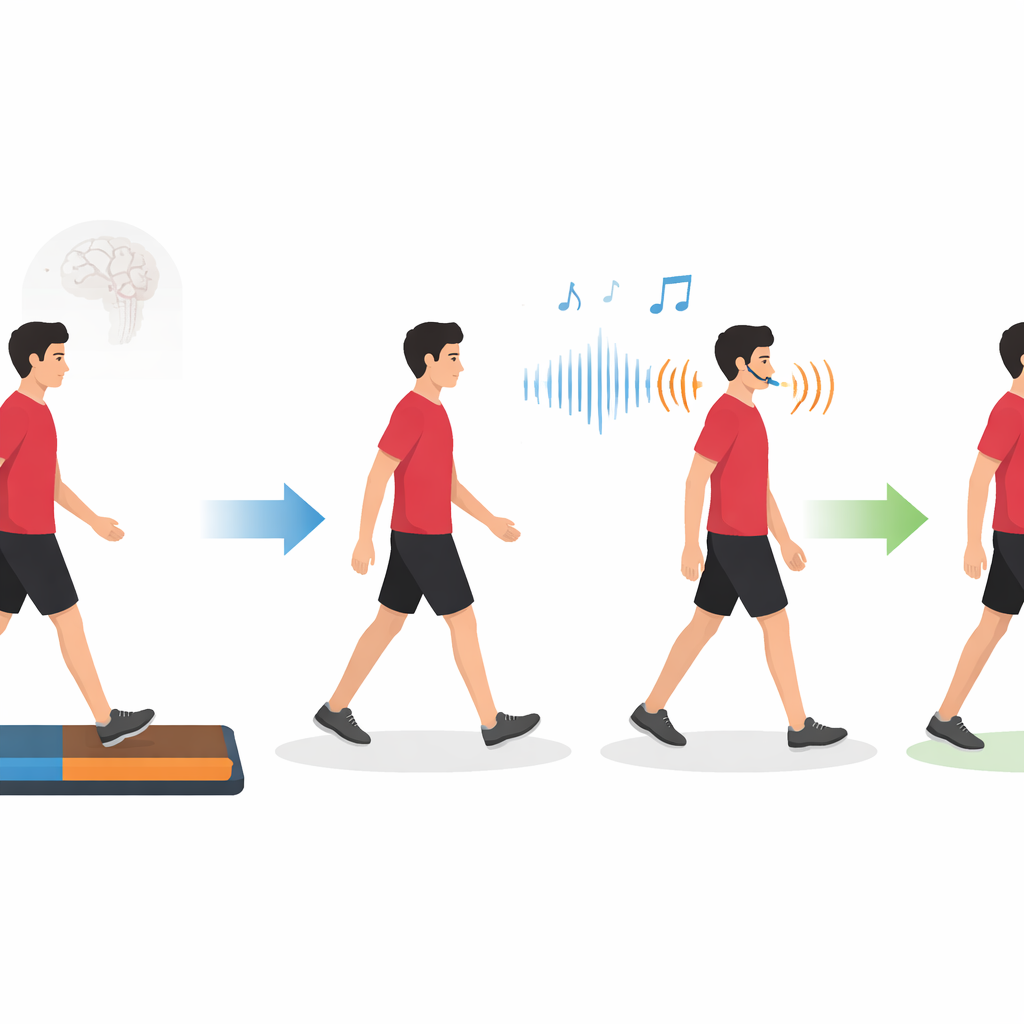
The researchers focused on two common gait-training tools that tap into different learning systems in the brain. A split-belt treadmill uses two belts moving at different speeds under each foot, nudging the body to automatically recalibrate how far and how fast each leg steps—an adjustment largely handled by “sensorimotor” processes that run in the background without much conscious thought. In contrast, asymmetric rhythmic auditory cueing uses uneven left–right beats to tell a person when to step, encouraging them to follow a deliberate timing pattern. This second approach leans on “instructional” or strategy-based learning, which depends more on attention and working memory.
Testing sequences of treadmill and sound cues
Ten healthy young adults completed six short walking sessions on a research treadmill system. In some sessions they experienced only one type of challenge: either the split-belt treadmill alone or the uneven rhythmic cues alone. In other sessions, the team combined the two methods back to back: treadmill first then cues, or cues first then treadmill. They also created “congruent” versions, where both methods pushed the walking pattern in the same direction, and “incongruent” versions, where the second method tried to undo or reverse what the first had done. Throughout, reflective markers and force plates measured differences between the left and right legs in step length, step timing, and how hard each foot pushed against the ground.
When one kind of learning helps—or hurts—another
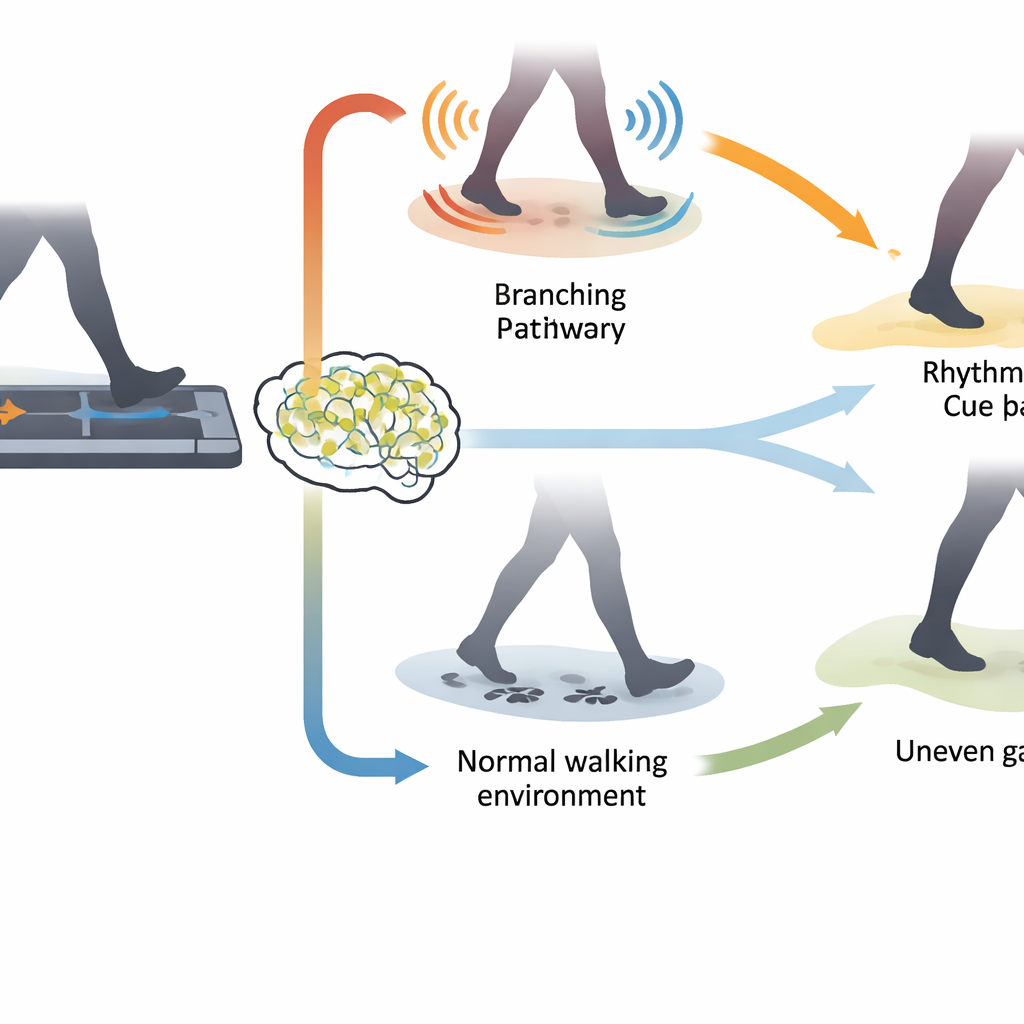
By comparing these combinations with each person’s responses to the single methods alone, the authors tested whether the total effect could be treated as a simple sum of the two—much like adding two independent pushes on a swing. They found this “additive” view worked well in some cases, especially when looking at how much asymmetry remained after the training ended. But during the second half of the combined sessions, the picture was more complicated. When the split-belt treadmill came first and the cues came second, helpful transfer to the cue-based walking appeared only when the two methods were congruent and pushed the legs in the same spatial and temporal direction. In contrast, when cues came first and the treadmill second, some transfer occurred even when they opposed each other, suggesting that cue-based learning may sometimes generalize more broadly.
Not everyone learns the same way
The study also found that people differed in which learning route they seemed to favor. Some participants mainly relied on the treadmill’s automatic sensory feedback, while others responded more strongly to the explicit rhythmic instructions. Those who depended more on rhythmic cues often showed greater short-term adaptation—meaning they could change their walking pattern more during training—but they tended to retain less of that change once the perturbations were removed. The authors suggest that this may be due to cognitive fatigue: heavily engaging attention and working memory during practice can boost performance in the moment yet make those changes harder to keep.
What this means for future rehabilitation
For everyday readers, the main message is that in gait rehabilitation, “what” you practice is only part of the story—“how” and “when” you practice different tasks can alter both progress and staying power. This study, conducted in healthy adults as a first step, indicates that using rhythmic cues before split-belt treadmill training and aligning the directions of their effects may lead to stronger lasting changes in walking symmetry. At the same time, pushing the brain too hard with instruction-heavy strategies could backfire by reducing retention. As these ideas are tested in people with stroke and other neurological conditions, they may help therapists design more personalized walking programs that respect each person’s preferred way of learning while balancing short-term gains with long-term carryover.
Citation: Hoque, A., Kim, S.H. & Reed, K.B. Sequential gait interventions reveal non-reciprocal transfer between instructional and sensorimotor adaptation mechanisms. Sci Rep 16, 8827 (2026). https://doi.org/10.1038/s41598-026-38084-8
Keywords: gait rehabilitation, split-belt treadmill, rhythmic auditory cueing, motor adaptation, stroke recovery