Clear Sky Science · en
Classification of rice plant diseases using efficient DenseNet121
Why Spotting Sick Rice Plants Matters
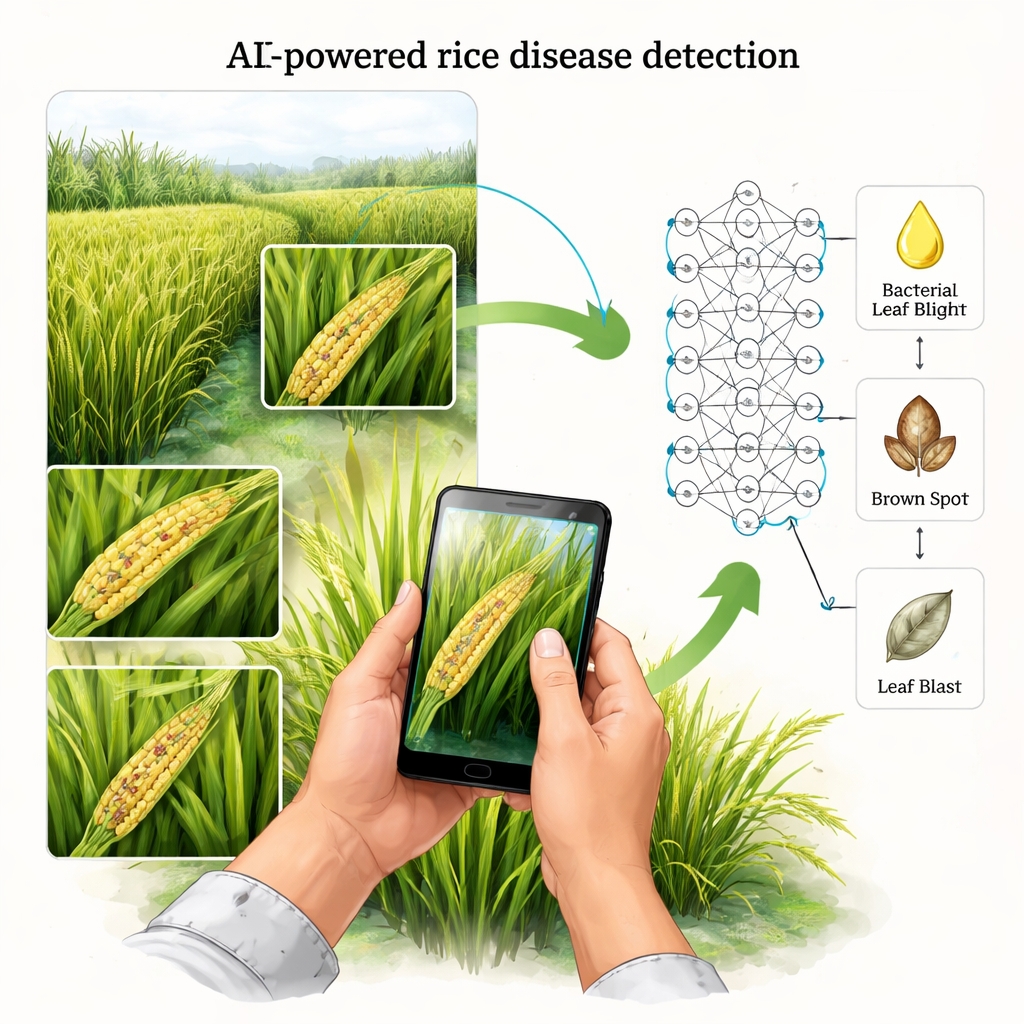
Rice is a daily staple for billions of people, so anything that harms rice crops can threaten food supplies and farmers’ livelihoods. Many rice diseases first appear as subtle spots or streaks on leaves that are easy to miss or misjudge, especially across vast fields. This paper explores how artificial intelligence (AI) can turn ordinary photos of rice plants into fast, accurate diagnoses of multiple leaf diseases, helping farmers act early and avoid major crop losses.
From Guesswork to Camera-Based Checks
Traditionally, diagnosing plant diseases has depended on experts visually inspecting fields or photos. That approach is slow, expensive, and not scalable to millions of small farms. At the same time, smartphones and cheap digital cameras are now common, even in rural areas. The authors tap into this opportunity: if farmers can snap clear leaf photos, a well-trained AI system could recognize different diseases automatically and in seconds. This work focuses on seven of the most common rice diseases, from bacterial leaf blight to fungal spots and mildew, aiming for a tool that works across a broad range of problems rather than just one or two.
How the Smart Image System Works
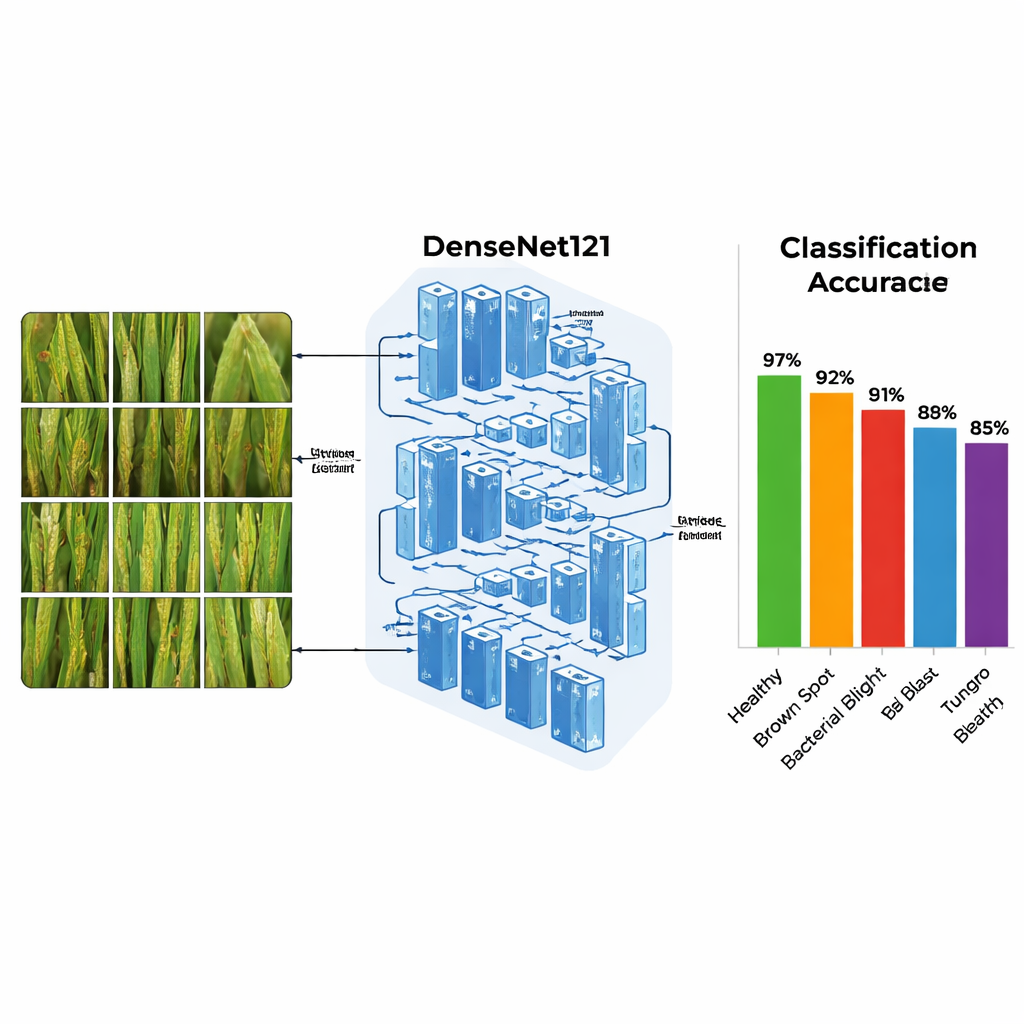
The researchers build on a powerful image-recognition approach called a convolutional neural network, which learns to detect patterns such as shapes, colors, and textures in pictures. They use a particular design named DenseNet121, known for linking many layers together so that information flows efficiently and features get reused instead of constantly relearned. Rather than starting from scratch, they apply transfer learning: beginning with a DenseNet model already trained on millions of everyday images, then fine-tuning it using rice leaf photos. They gather 8,030 original images of diseased leaves from a public “Paddy-Rice” dataset, then expand this to 11,467 images through careful data augmentation, such as rotating, flipping, and slightly changing brightness so the model becomes robust to real-world variation.
Training, Testing, and Trusting the Results
To train the system, the team divides the images into two sets: about 80% to teach the model and 20% to test it on cases it has never seen before. They tune settings such as learning rate, batch size, and number of training rounds, using an optimization method called Adam and stopping early if performance stops improving. The system then learns to assign each image to one of the disease categories. Performance is measured with several standard scores: accuracy (how often it is right overall), precision (how often its positive predictions are correct), recall (how many true diseased cases it finds), and the F1 score (which balances precision and recall). They also analyze a “confusion matrix,” which shows where the system mixes up similar-looking diseases.
How Well the AI Diagnoses Rice Diseases
The trained DenseNet121 model performs impressively. On the independent test set, it reaches an overall accuracy of 97.9%, with individual disease accuracies mostly between 96% and nearly 100%. Precision averages about 96.2%, recall about 97.9%, and the F1 score 97%, indicating that the model is not only accurate but also balanced in avoiding both missed cases and false alarms. A five-fold cross-validation—repeating the train–test split several times—shows similarly strong and stable results, with very small variations across runs. While some confusion remains between diseases with similar leaf spots, the system generally distinguishes even subtle differences in patterns and colors that human observers might overlook.
What This Means for Farmers and Food Security
For non-specialists, the takeaway is simple: this study shows that a carefully designed AI model can look at photos of rice leaves and tell, with high reliability, which disease is present among several major threats. That opens the door to smartphone or drone-based tools that give farmers rapid, on-the-spot advice about plant health, letting them treat problems early, reduce unnecessary pesticide use, and protect yields. Although more work is needed to test such systems in varied field conditions and turn them into easy-to-use apps, the results suggest that AI-powered disease diagnosis can become a practical ally in making global rice production more resilient and sustainable.
Citation: Ismail, A., Hamdy, W., Ibrahim, A.H. et al. Classification of rice plant diseases using efficient DenseNet121. Sci Rep 16, 7482 (2026). https://doi.org/10.1038/s41598-026-38078-6
Keywords: rice disease detection, plant health imaging, deep learning, crop protection, food security