Clear Sky Science · en
Study of aerodynamic characteristics of variable cross-section box girders under three-dimensional fluctuating wind field
Why mountain bridges face wild winds
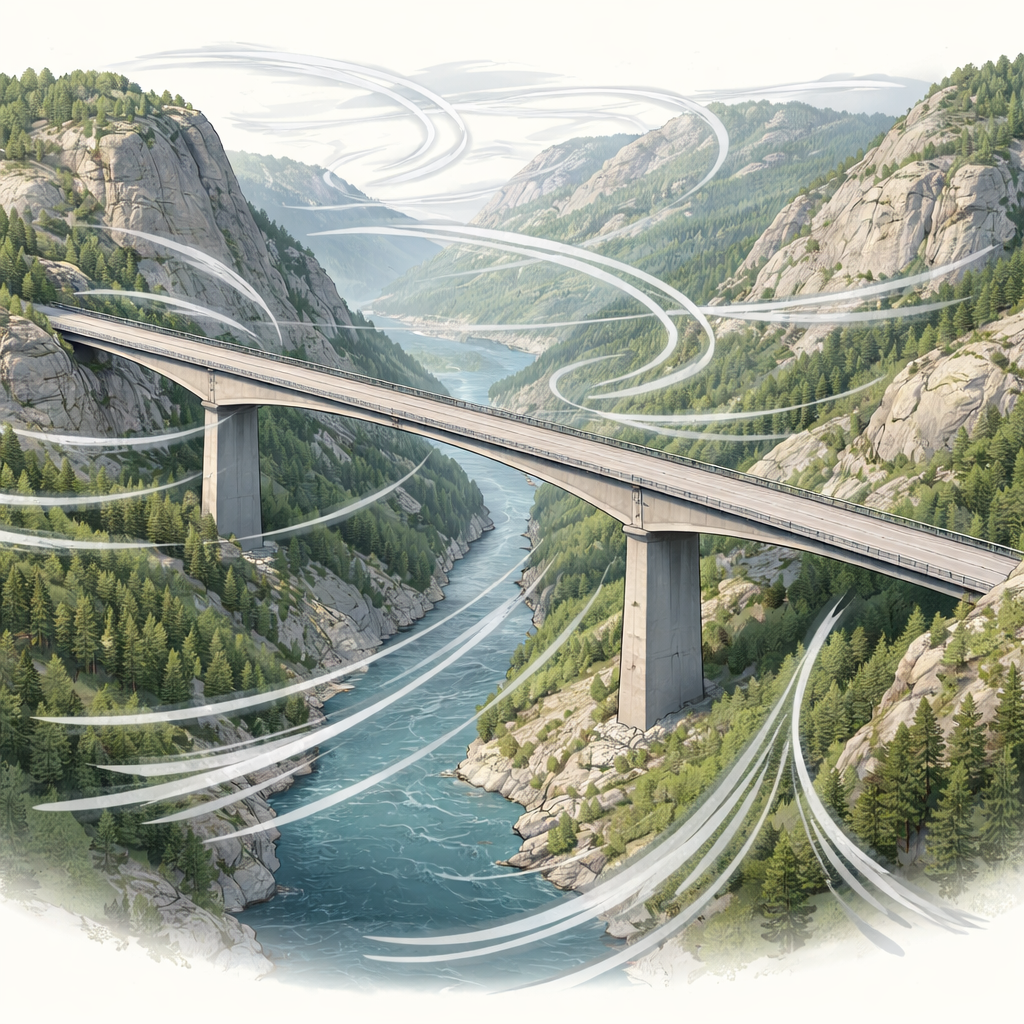
Bridges in rugged mountain valleys may look solid and calm, but the air rushing around them is anything but. As wind threads through steep gorges, it becomes gusty and chaotic, hitting long-span bridges from odd angles and with rapidly changing strength. This study asks a practical question with real safety stakes: how do these unruly, three-dimensional winds push and twist a modern box-girder bridge whose depth changes along its span, and how should engineers account for that when they design for wind?
A closer look at a complex bridge shape
The researchers focus on a real continuous rigid-frame bridge in southwestern China, where the main supporting beam, or girder, is a hollow concrete box whose height varies smoothly from thick over the piers to thin at midspan. This variable shape helps the bridge carry heavy loads efficiently, but it also makes the surrounding airflow more complicated than around a simple rectangular beam. Instead of relying only on wind-tunnel tests, the team builds a detailed three-dimensional computer model of the bridge section and the air around it. They then expose this virtual bridge to five different wind fields, each with carefully controlled levels of gustiness and the size of turbulent eddies, along with several angles at which the wind can strike the deck.
Simulating gusty wind in three dimensions
To mimic real mountain winds, the study uses a method called large-eddy simulation, which explicitly tracks the biggest swirls in the air, combined with a synthetic inflow generator that reproduces realistic gust statistics. Instead of a steady, uniform breeze, the incoming air contains fluctuating speeds and directions in all three dimensions and over a range of spatial scales. The authors first confirm that their numerical setup is trustworthy: they check that refining the computational grid or shortening the time step barely changes the results, compare key force measurements against physical wind-tunnel data, and verify that the artificial wind field matches a standard turbulence spectrum used in atmospheric science.
How gusts change pressure and forces
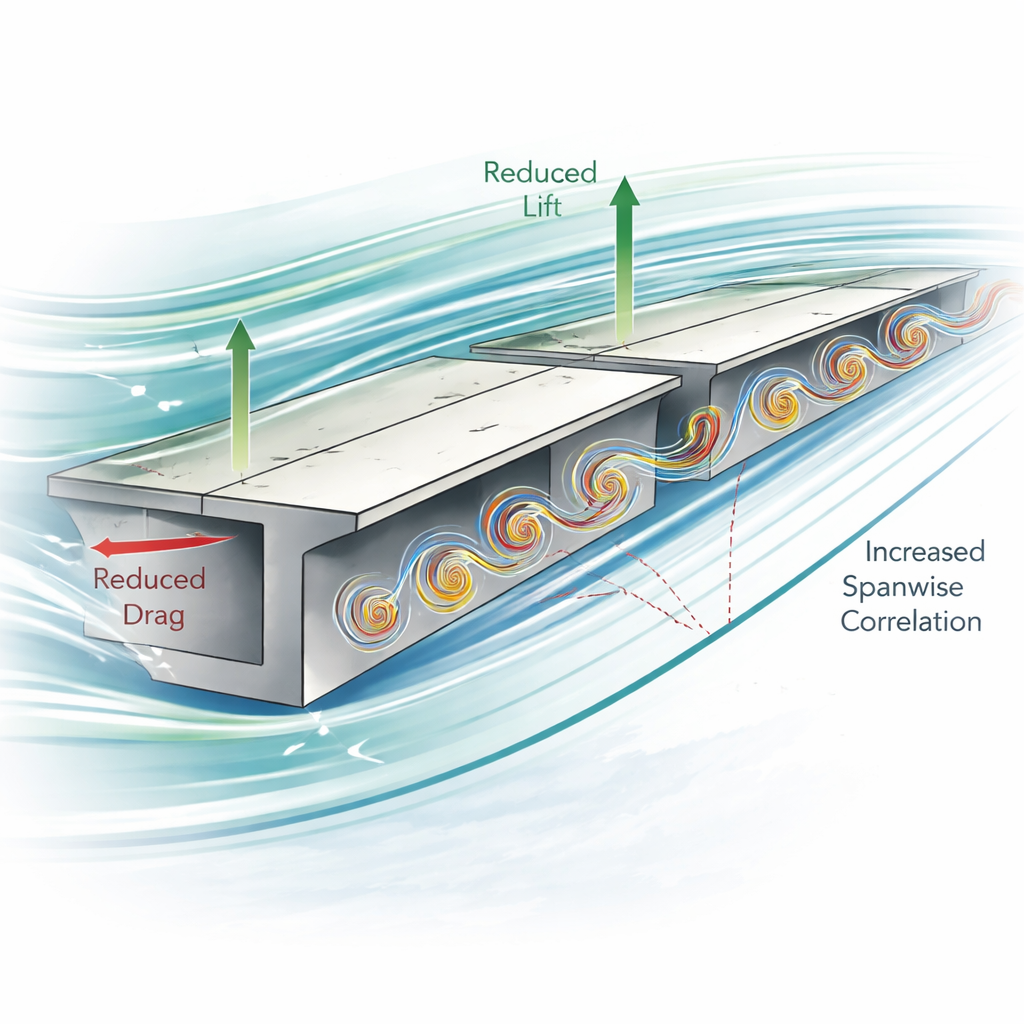
Once confident in the model, the team examines how the unsteady wind alters pressures on the bridge surfaces and the resulting overall forces. Compared with a smooth, steady “average” wind, the turbulent gusts generally reduce the suction (negative pressure) over most of the upper and lower surfaces and on the leeward side, meaning the bridge feels somewhat gentler loading on average. Only near the windward edges of the deck do the gusts slightly strengthen the suction. These local changes translate into noticeable shifts in the overall drag (downwind push), lift (up–down force), and twisting moment on the girder. In some cases, drag drops by roughly 14 percent and lift by about one-third in the gusty wind, while for certain shallower sections the twisting force can increase by more than 20 percent. The level of turbulence—the intensity of the gusts—matters more than the typical size of the turbulent eddies, and large wind attack angles are especially influential.
Vortices, shared motion, and hidden risks
Bridges do not just feel steady push and pull; they are also shaken by vortices—rotating pockets of air that peel off the deck in a repeating pattern. By analyzing the frequency content of the simulated lift forces, the authors find that gusty winds tend to weaken the strength of this vortex shedding but do not markedly change its characteristic frequency, which is mostly set by the bridge shape and wind speed. At the same time, turbulence makes the fluctuating forces along the length of the bridge more strongly linked to one another. In other words, different segments of the girder tend to move together more under gusty conditions than under a smooth flow, an effect that can amplify overall structural response even when average forces appear smaller.
What this means for real bridges
For non-specialists, the central message is that “messy” real-world winds can be kinder in some ways and harsher in others. Turbulent gusts may reduce some average forces on a mountain bridge, but they can increase twisting in certain sections and cause more coordinated buffeting along the span. The frequency at which vortices shake the structure stays almost the same, yet the intensity and spatial pattern of that shaking change. The study shows that modern numerical tools can capture these subtle effects for complex bridge shapes, providing engineers with more realistic data to design safer, more resilient crossings where the wind is wildest.
Citation: Feng, X., Jia, J. Study of aerodynamic characteristics of variable cross-section box girders under three-dimensional fluctuating wind field. Sci Rep 16, 6791 (2026). https://doi.org/10.1038/s41598-026-38074-w
Keywords: bridge aerodynamics, turbulent wind, mountain bridges, box girder, vortex shedding