Clear Sky Science · en
Gaussian process regression with physics-guided pseudo-sample augmentation for wear prediction under sparse measurements in milling
Why Smarter Tool Monitoring Matters
Everyday products—from airplanes and medical implants to smartphones—rely on metal parts machined with extreme precision. These parts are cut by tools that gradually wear out, much like the tread on a car tire. Replace a cutting tool too early and factories waste money and material; replace it too late and parts fail quality checks or machines break. This study presents a new way to predict how these tools wear over time using a blend of physics and statistics, so manufacturers can safely use tools for as long as possible without constant inspection.
Hidden Clues in Machine Sounds and Vibrations
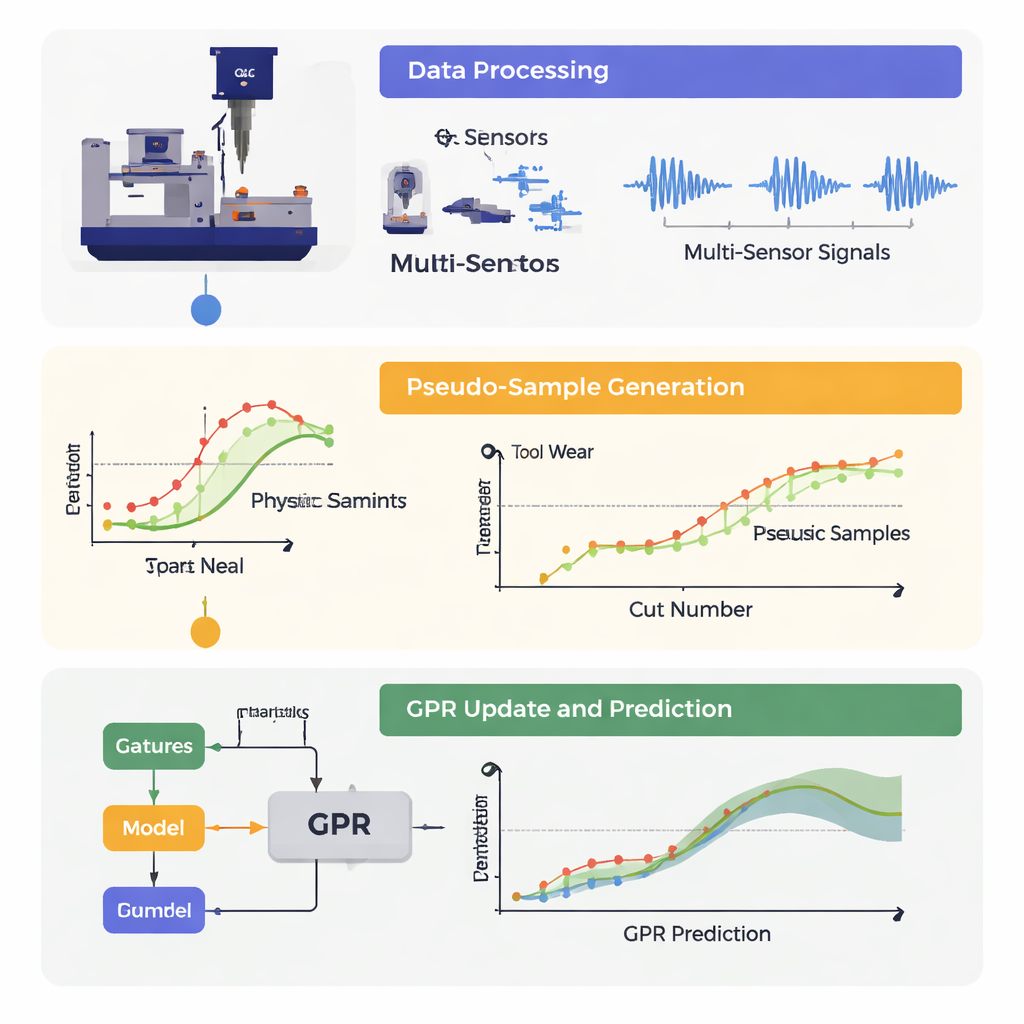
In modern computer-controlled (CNC) milling, sensors listen to the process constantly. They capture forces, tiny vibrations, and even sound waves as the cutting tool carves metal. These signals are rich with clues about the tool’s health, but they are too complex to interpret by eye. Traditionally, engineers periodically stop the machine, remove the tool, and measure wear directly under a microscope—an accurate but slow and costly checkup. The challenge is to learn a reliable mapping from the live sensor signals to the unseen wear, so that factories can minimize these interruptions while still keeping quality under tight control.
Limits of Today’s Smart Monitoring
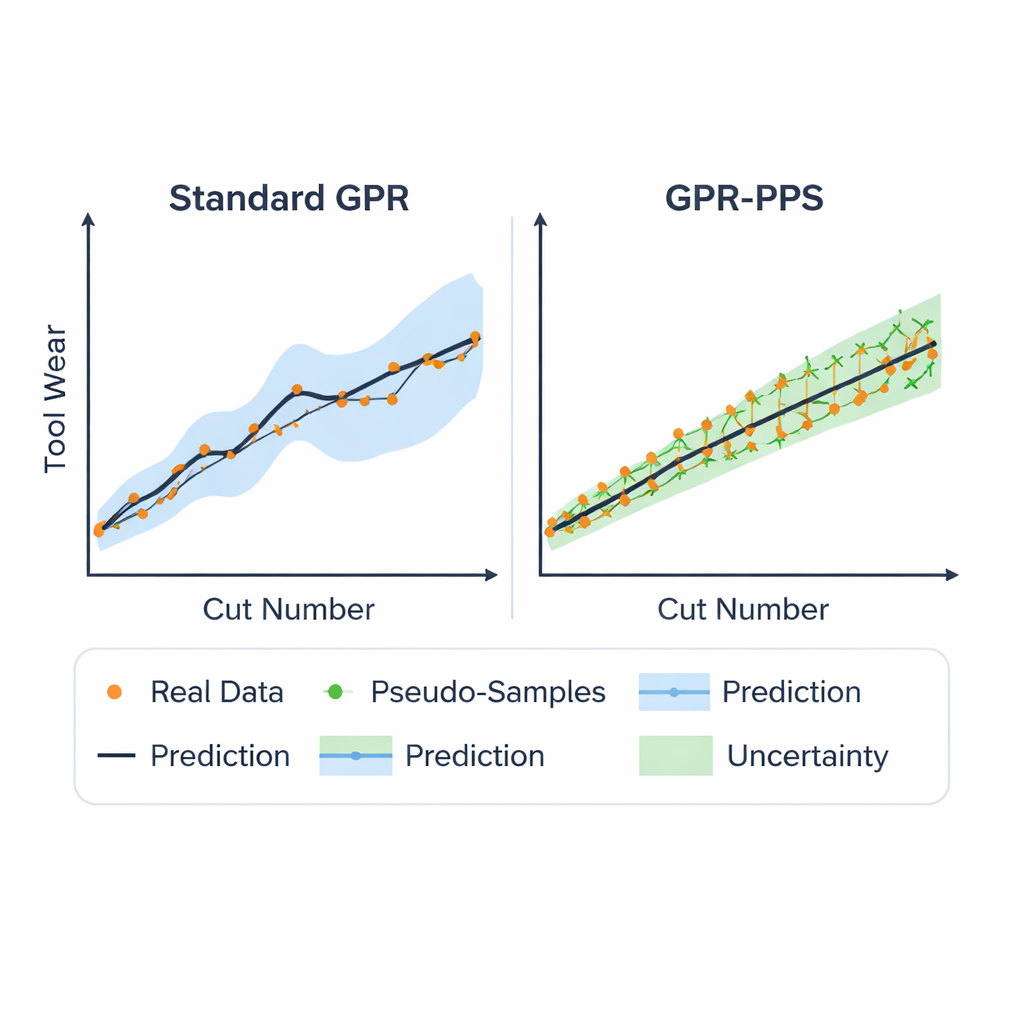
Many recent approaches use machine learning—methods such as neural networks or support vector machines—to link sensor features to wear. These systems can work well when trained on large, carefully labeled datasets. However, collecting such data is expensive because each label requires stopping production to measure tool wear. Another promising family of methods, called Gaussian process regression, shines when data are limited and has the added advantage of estimating its own uncertainty. Yet even this approach struggles when asked to forecast far beyond the measurements it has seen: its predictions gradually drift back toward a neutral guess and its uncertainty balloons, just when factories most need confident long-range forecasts.
Filling the Gaps with Physics-Guided Pseudo-Data
The authors propose a framework they call GPR-PPS, which stands for Gaussian process regression with physics-guided pseudo-samples. Instead of relying only on sparse real wear measurements, the method uses a physics-based model of how tool wear typically progresses over its life—starting with a rapid initial change, followed by a steady phase, and ending with an accelerated breakdown. After the model has been trained on early, densely measured data, it predicts wear between two inspection points. The physics-based curve is then fitted to these predictions and gently adjusted so it passes exactly through the two real measurements. Every cut in between is assigned a synthetic, or “pseudo,” wear value from this aligned curve, effectively turning a few expensive measurements into a dense, physically reasonable training set.
A Learning Loop That Adapts Over the Tool’s Life
This pseudo-data are combined with real measurements and fed back into the Gaussian process model in an ongoing loop. At each stage, the system updates its understanding of the trend in wear and the remaining uncertainties. The researchers tested this strategy on a well-known public dataset of high-speed milling, where seven different sensors recorded signals for hundreds of cuts while actual tool wear was measured only occasionally. Even when the model was given labels for less than 10% of the tool’s life, it could forecast the entire wear curve with lower errors than traditional machine learning methods and than Gaussian processes without pseudo-samples. It also produced narrower, more informative confidence bands, giving engineers a clearer sense of risk when deciding whether a tool can safely keep running.
What This Means for Real-World Manufacturing
For non-specialists, the key idea is that the method uses what we already know about how tools wear, together with limited measured data, to “fill in the blanks” in a disciplined way. By turning a handful of direct measurements into many physics-consistent pseudo-points, the model learns to track wear more accurately over the entire life of a tool, while still flagging how certain it is about each prediction. In practice, this could allow factories to check tools less often, reduce waste from early replacement, avoid sudden failures, and move closer to fully autonomous, self-monitoring machining systems.
Citation: Nguyen, HP., Nguyen, DT. & Kim, JM. Gaussian process regression with physics-guided pseudo-sample augmentation for wear prediction under sparse measurements in milling. Sci Rep 16, 7231 (2026). https://doi.org/10.1038/s41598-026-38067-9
Keywords: tool wear prediction, CNC milling, physics-guided machine learning, Gaussian process regression, predictive maintenance