Clear Sky Science · en
Study of surface texture wavelength slope spectra density distribution of micro-surfacing pavement related to vehicle interior noise
Why the sound of the road matters
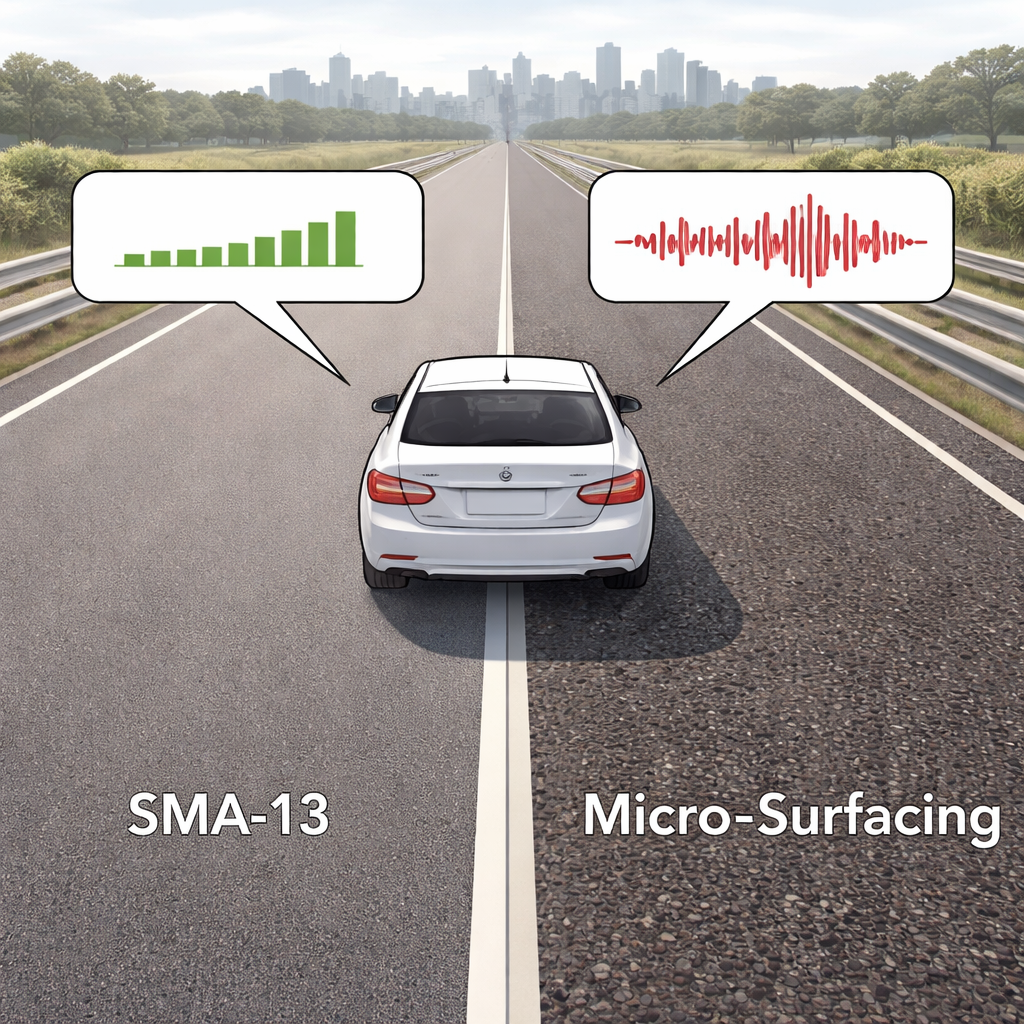
Anyone who has driven on a freshly treated road and noticed an annoying “buzz” inside the car has experienced how pavement can shape our daily comfort. This study looks at a popular road maintenance technique called micro-surfacing, which is valued for being quick, low-cost, and environmentally friendly—but often makes cars noisier inside. The researchers set out to understand exactly how the tiny bumps and grooves on these pavements create extra interior noise, and how engineers can redesign the road surface to make rides quieter without sacrificing safety.
From rough road skin to in‑car noise
Road surfaces are not smooth; they have a texture made up of peaks and valleys at different sizes, or wavelengths. These textures help tires grip the road and drain water, but they also influence how much noise is produced when a tire rolls over them. Micro-surfacing uses a thin layer of stone and asphalt spread over existing pavement. Because it is not compacted with a heavy steel roller, its surface tends to be more irregular than standard asphalt mixes such as SMA-13. Drivers often report that these roads sound louder inside the car, but until now there has been little precise information about which parts of the surface texture are responsible.
Scanning the road in 3D
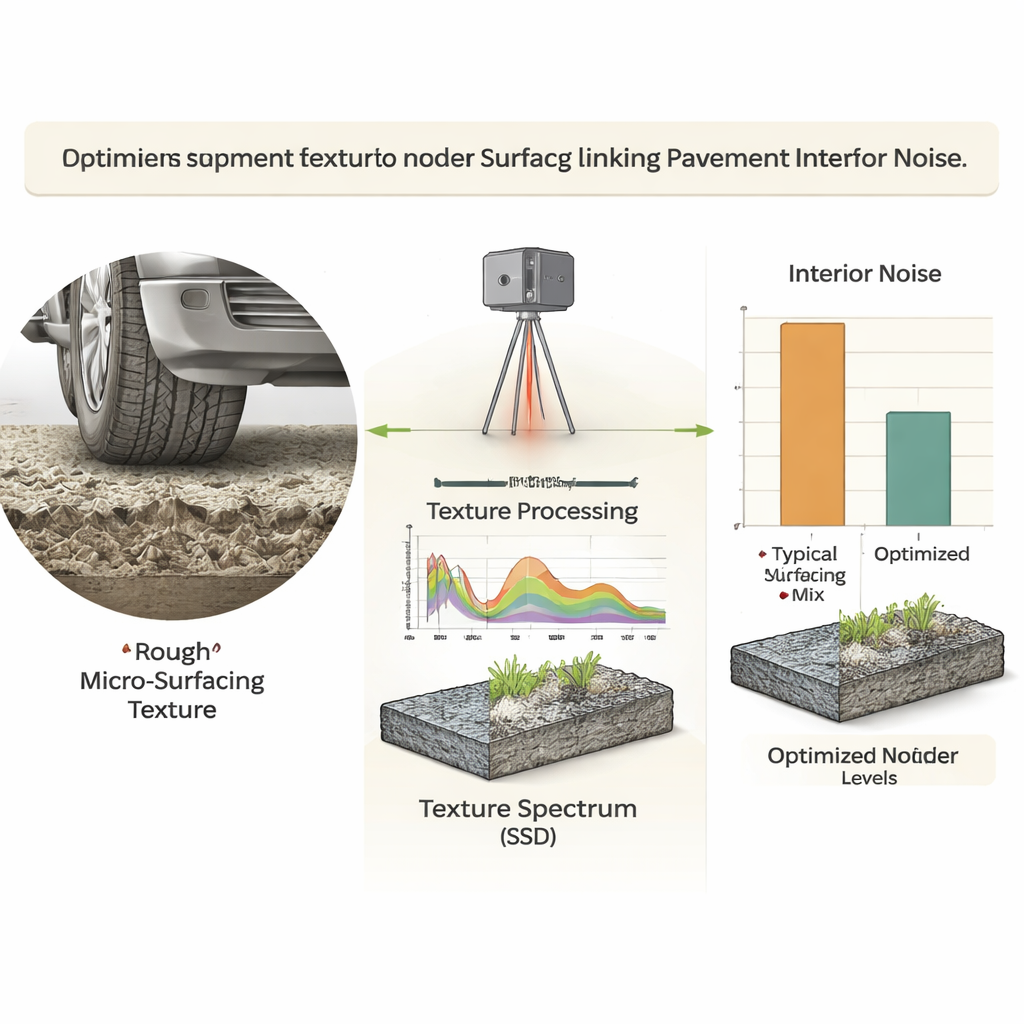
To tackle this question, the team combined two types of measurements. First, they used a high‑resolution three‑dimensional laser scanner to map the surface of micro-surfacing sections, capturing the height of the texture across very small areas. They then converted these height maps into a “slope spectrum” that shows how strongly the surface rises and falls at each texture wavelength. This measure, called slope spectral density (SSD), essentially quantifies how rough the road is at different scales. Second, they drove a test vehicle at 100 km/h over both micro-surfacing and adjacent SMA‑13 sections, using a sensitive instrument to record sound pressure levels and detailed frequency spectra inside the car. By pairing each noisy ride with the corresponding texture data, they could look for direct links between what the road looks like and what the driver hears.
Finding the noisy texture patterns
The analyses showed that micro-surfacing consistently produced higher noise inside the vehicle than SMA‑13, with average levels about 4 dB(A) higher. The difference was most pronounced in the low‑to‑mid frequency range between about 50 and 800 Hz, especially around 100 Hz. These frequencies are where vibrations of car body panels are most noticeable to passengers and are perceived as a strong, tiring “buzz.” When the researchers examined the SSD curves, they found that the overall shape of the texture spectrum fitted a specific bell‑like mathematical function extremely well, meaning the roughness followed a regular pattern. Importantly, certain parts of this spectrum, particularly texture wavelengths between 10 and 20 millimeters, were strongly and linearly related to how loud it was inside the car.
Turning measurements into a design rule
The authors then asked how this understanding could be used to build quieter roads. Rather than focusing only on simple measures of roughness, they analyzed how much of the SSD curve’s total “area” came from different wavelength bands. This area ratio tells engineers what share of the surface’s overall bumpiness is tied to a specific texture size. They discovered that when the share contributed by wavelengths around 10 millimeters was high, interior noise was also high; when that share dropped, interior noise fell. Using this relationship, they proposed a practical design target: for a common micro-surfacing mix known as MS‑III, the proportion of SSD area from wavelengths longer than 10 millimeters should not exceed 50 percent.
Designing and testing a quieter mix
To see if this rule worked in practice, the team adjusted the blend of small, medium, and larger stones in the micro-surfacing mix. By increasing some sizes and reducing others, they created several trial mixtures and scanned their textures. One optimized blend achieved a 10‑millimeter area ratio just under the 50 percent threshold. When this optimized surface was laid on a test road and allowed to settle under real traffic, the interior noise measurements showed that it was about 2.8 dB(A) quieter than the typical micro-surfacing mix at highway speed. The biggest improvement again appeared in the low‑to‑mid frequency band that dominates human perception, meaning passengers would likely feel the car as calmer and less tiring to ride in.
What this means for everyday travel
For non‑specialists, the key message is that the comfort of a car journey is not only about the vehicle itself, but also about the fine‑scale “skin” of the road. This study shows that by carefully measuring and controlling the tiny wavelengths in a micro-surfacing pavement’s texture—especially those around one centimeter long—engineers can cut down the interior buzzing sound without abandoning an otherwise efficient and sustainable maintenance technique. The work offers a clear, number‑based guideline that road agencies can use when designing future micro-surfacing projects, helping cities build streets that are not only durable and safe, but also noticeably quieter inside the car.
Citation: Lin, J., Liang, H., Wang, H. et al. Study of surface texture wavelength slope spectra density distribution of micro-surfacing pavement related to vehicle interior noise. Sci Rep 16, 6915 (2026). https://doi.org/10.1038/s41598-026-38065-x
Keywords: road traffic noise, micro-surfacing pavement, pavement texture, interior vehicle noise, quiet road design