Clear Sky Science · en
Volitional modulation of beta-band EMG coherence through frequency-specific neurofeedback
Training the Body by Training the Signals
Most people think of strength and coordination as properties of muscles, but every movement we make is choreographed by the nervous system. This study explores whether we can "coach" the hidden communication signals between nerves and muscles using real-time feedback, with an eye toward future rehabilitation tools for people recovering from injury or illness.
Looking Inside Muscle Talk
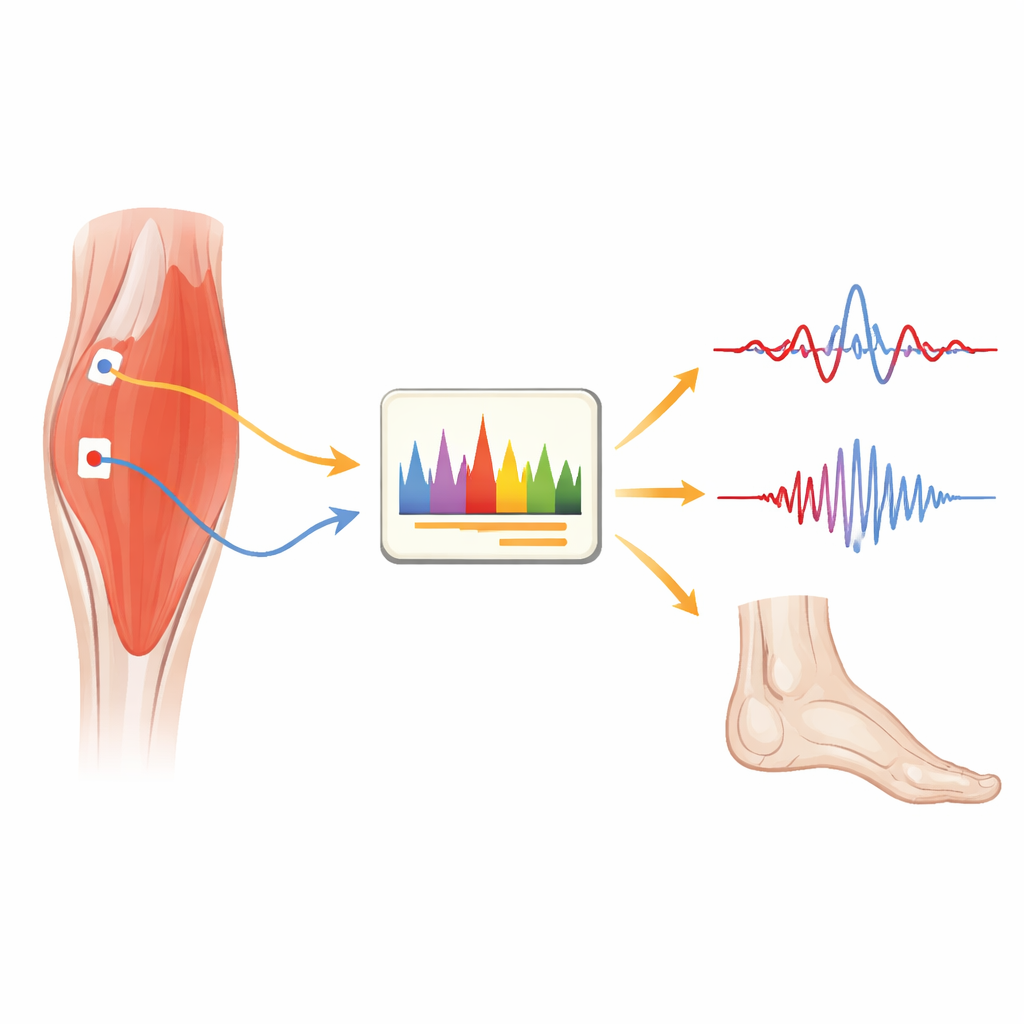
When we move, countless nerve cells send rhythmic electrical pulses to muscle fibers. These rhythms can be recorded with sensors on the skin, producing electromyography, or EMG. Instead of just measuring how strong a muscle’s activity is, scientists can also ask how well different parts of a muscle are working together. They do this by looking at “coherence,” a statistical measure of how similar the rhythms are between two EMG signals. In a particular frequency range called the beta band, this shared rhythm is thought to reflect how strongly the brain’s movement centers are driving the muscle in a coordinated way.
Turning Coherence into a Training Signal
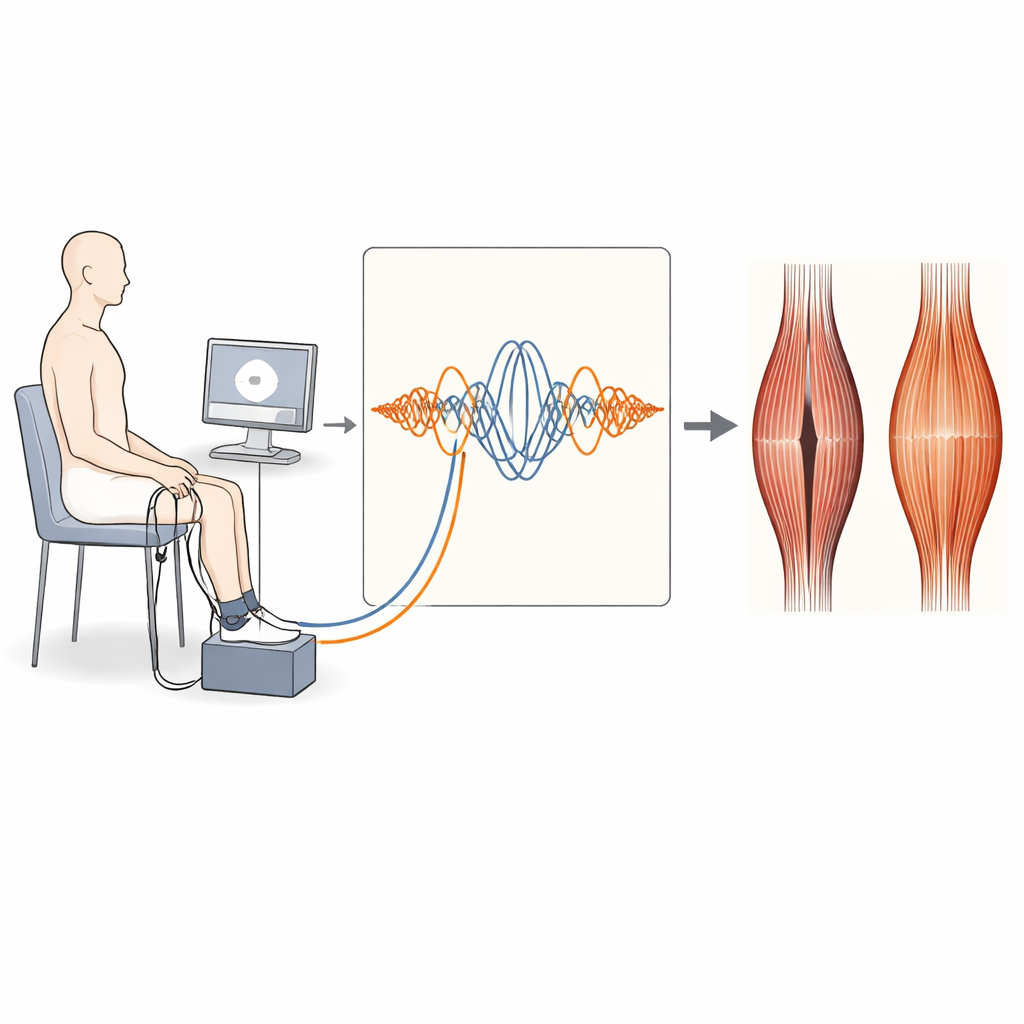
The researchers asked whether people could learn to voluntarily increase this beta-band coherence if they could see it in real time. Twenty-two healthy young adults performed a simple task: gently pulling their foot upward (ankle dorsiflexion) at a low, steady effort over five days. All wore EMG sensors on two spots along the same shin muscle. One group saw a visual display whose size directly reflected how synchronized their muscle signals were in the beta range. Their goal was to “grow” this display by adjusting how they activated the muscle, even though they were not given explicit strategies. A second, sham group saw a similar display, but it was based on noisy, pre-recorded signals rather than their true coherence.
Neural Synchrony Changes Without Changing Performance
After training, the real-feedback group showed a clear increase in beta-band coherence between the two recording sites on the muscle, while the sham group did not. Importantly, this change was selective: other frequency bands linked to different aspects of motor control (very slow, alpha, and higher gamma rhythms) did not change, and standard measures of muscle signal size and variability also stayed the same. In other words, the training appeared to tune a specific pattern of neural coordination rather than just making the muscle work harder. Yet, when the researchers tested how accurately participants could match the target ankle force, there was no detectable improvement in either average error or its variability. For healthy people doing a relatively easy, low-intensity task, performance may already be so good that there is little room to get better, even if the underlying neural pattern changes.
Mind Feelings Versus Hidden Changes
The team also asked participants in the real-feedback group how much control they felt they had over the feedback display, using a simple numerical rating. Surprisingly, the people who felt more "in control" were not necessarily the ones who showed the largest physiological change in coherence. This suggests that our subjective sense of influencing a neurofeedback signal may not always match what is actually happening in the nervous system. At the same time, mental fatigue ratings stayed modest and similar in both the real and sham groups over the five training days, indicating that this kind of frequency-specific feedback can be delivered without imposing a large cognitive burden.
Why This Matters for Future Rehabilitation
The study shows that people can, with practice, reshape the fine-grained timing of signals within a muscle when given carefully designed feedback, even if they do not consciously know how they are doing it. This ability to selectively boost beta-band coherence provides a proof of concept for a new kind of training target: instead of focusing only on how strong or smooth a movement is, therapists might eventually train the quality of neural communication that underlies movement. Although this initial work in healthy volunteers did not translate into immediate performance gains, the approach could become powerful when applied to more challenging tasks or to patients whose coordination has been disrupted by stroke, spinal cord injury, or other conditions.
Citation: Nojima, I., Horiuchi, Y., Yaguchi-Horiuchi, A. et al. Volitional modulation of beta-band EMG coherence through frequency-specific neurofeedback. Sci Rep 16, 8454 (2026). https://doi.org/10.1038/s41598-026-38064-y
Keywords: EMG neurofeedback, beta-band coherence, neuromuscular coordination, motor rehabilitation, electromyography