Clear Sky Science · en
Identification of multiple ocular diseases using a hybrid quantum convolutional neural network with fundus images
Sharper Eye Checks with Smarter Machines
Many of the world’s vision problems could be avoided if eye diseases were caught early, but specialists and high‑quality imaging are not always available. This study explores a new way to read photographs of the back of the eye, called fundus images, using a blend of cutting‑edge quantum computing ideas and modern artificial intelligence. The goal is simple but powerful: to spot several common eye diseases at once, quickly and reliably, so that sight‑saving treatment can start sooner.
Why the Back of the Eye Matters
The retina is a thin layer of tissue at the back of the eye that turns light into signals for the brain. Many serious eye conditions leave telltale marks here, including age‑related macular degeneration, glaucoma, diabetic retinopathy, hypertension‑related damage, myopia, and cataracts. Doctors can photograph the retina with a standard fundus camera, which is cheaper and more widely available than advanced scanners. But reading these images by eye is slow, depends on highly trained experts, and becomes especially difficult when early disease changes are faint or when several problems exist at once.
Cleaning Up the Picture Before the Diagnosis
Before any computer can make sense of fundus photos, the images must be cleaned and standardized. In this work, the authors first crop the circular eye region, resize it, and then improve the visibility of important structures using two techniques: anisotropic diffusion filtering to reduce noise without blurring key edges, and wavelet transforms to enhance contrast. They also expand the training set by rotating, zooming, shifting, and flipping images, and by adding controlled noise. This careful "image grooming" helps the model learn how real‑world pictures vary, reducing the risk that it will fail on slightly different cameras or lighting conditions. 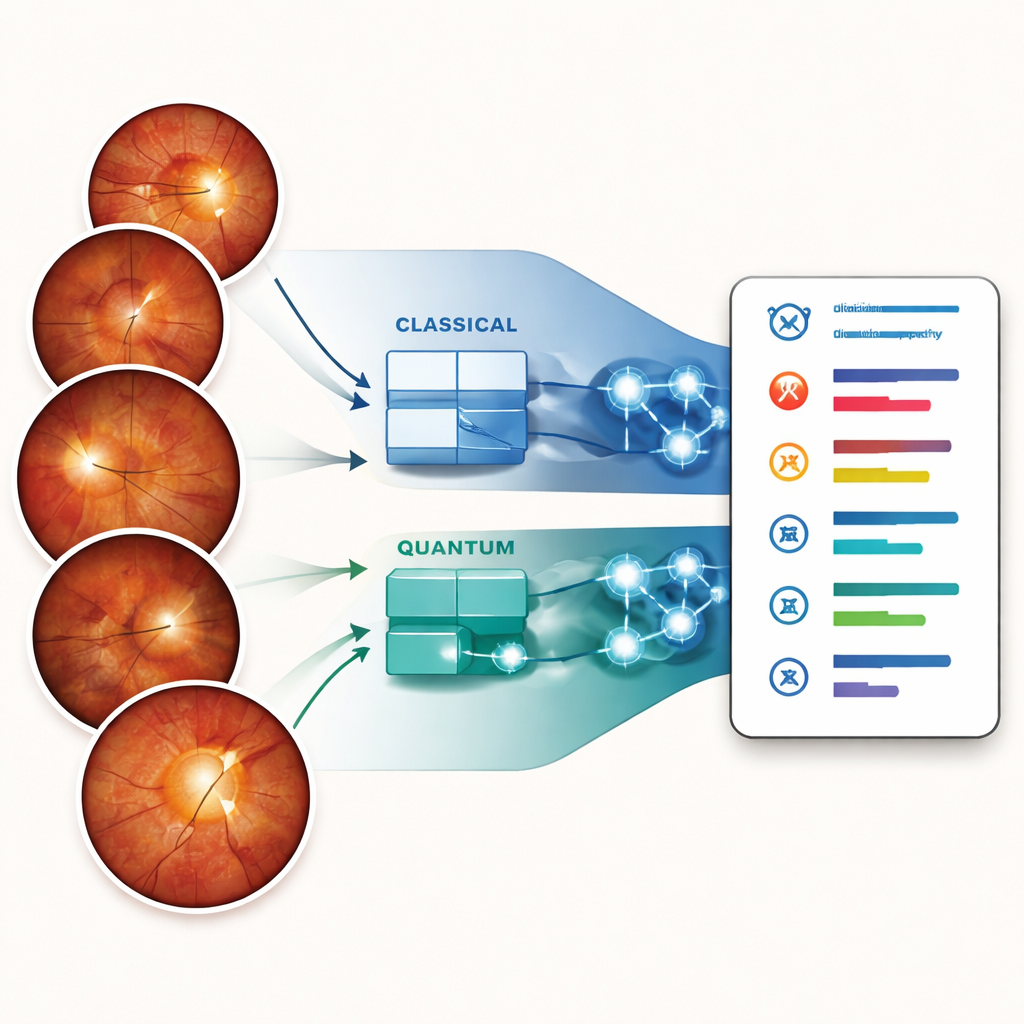
Mixing Classical AI with Quantum Ideas
At the heart of the study is a hybrid quantum convolutional neural network, or QCNN. A traditional convolutional neural network is very good at spotting patterns such as lines, textures, and shapes in images. The QCNN keeps this familiar structure but adds quantum‑inspired layers that act on data encoded as quantum states. In practical terms, a lightweight classical network first compresses each pair of images from a patient’s left and right eyes. These features are then mapped into an eight‑"qubit" representation, where special quantum gates perform rotations and build connections between qubits. This allows the system to explore a very rich space of possible patterns using relatively few adjustable parameters.
How the Quantum Layers Learn
The quantum side of the model mimics well‑known steps in image analysis. Quantum "convolution" layers act like filters, scanning for useful structures in the data, while quantum "pooling" layers reduce complexity by merging information from multiple qubits without losing the most important clues. The system repeatedly measures the resulting quantum states and feeds these measurements into a final decision layer that outputs the likelihood of each eye disease label. During training, a classical optimizer nudges both the usual neural‑network weights and the quantum gate settings to improve performance, guided by standard measures such as accuracy, precision, recall, and F1‑score. 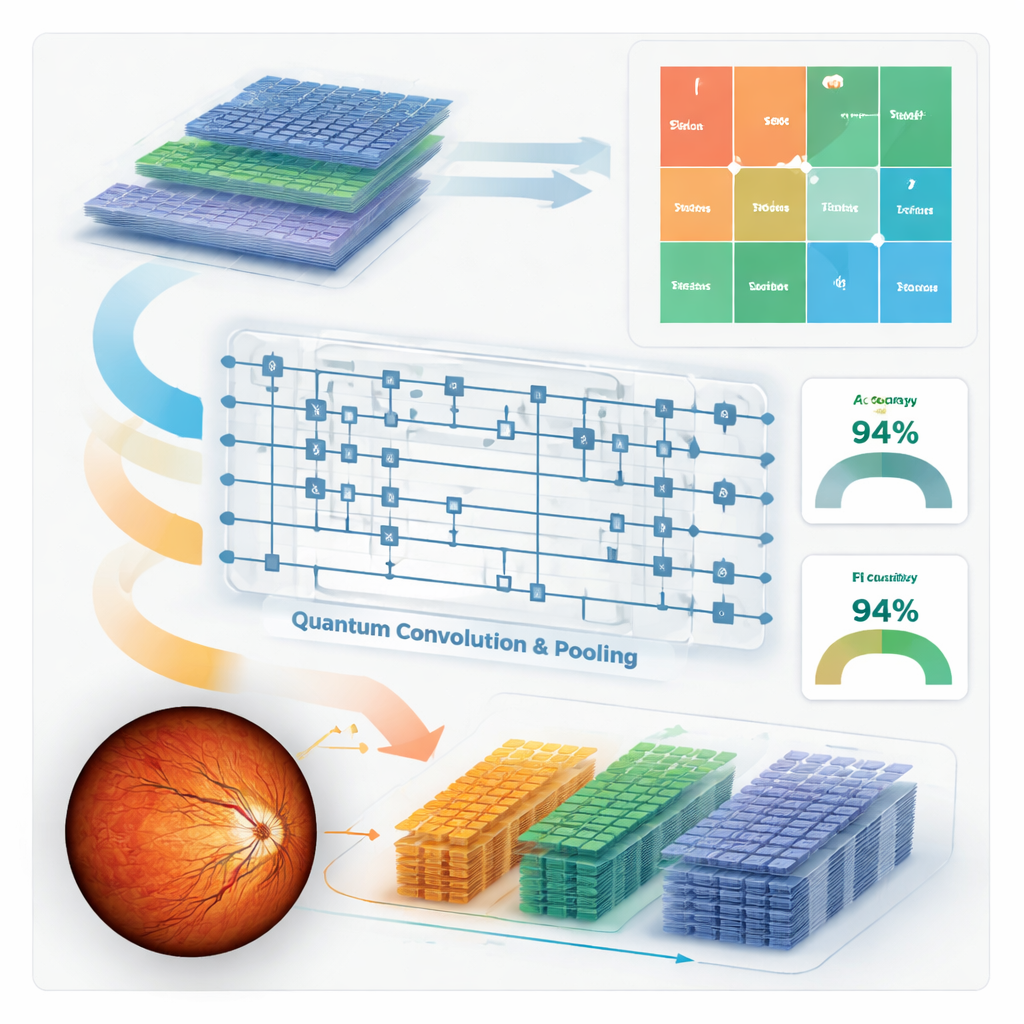
Putting the Model to the Test
To see whether this approach is more than just an elegant idea, the researchers trained and tested it on OIA‑ODIR, a large public collection of 10,000 fundus images from 5,000 patients labeled for seven eye diseases plus normal eyes. The data were split so that some images were used to train the model, some to tune it, and others—both from the same site and from external sites—to test how well it generalizes. When compared with several strong deep‑learning systems, including Fundus‑DeepNet, Inception‑v4, VGG16, and ResNet‑101, the QCNN came out on top. It reached about 94 percent accuracy and similarly high precision, recall, and F1‑scores, for both the on‑site and off‑site test sets, meaning it not only made correct calls often but also missed few diseased cases.
What This Means for Patients
From a lay perspective, the message is that smarter software could help protect eyesight by making mass retinal screening faster, more consistent, and capable of flagging several diseases at once. The quantum‑enhanced network described here is still run on simulators and relies on powerful computers, so it is not yet ready for routine clinic use. It also inherits the usual limitations of medical AI, such as uneven data for rare diseases and differences between hospitals. Even so, its strong performance suggests that combining classical and quantum‑inspired methods can squeeze more information out of the same eye photographs. As quantum hardware matures and datasets grow, such systems may become practical tools to support eye doctors worldwide, particularly in places where specialists are scarce.
Citation: Alqassab, A.I.M., Luque-Nieto, MÁ. & Mohammed, M.A. Identification of multiple ocular diseases using a hybrid quantum convolutional neural network with fundus images. Sci Rep 16, 6798 (2026). https://doi.org/10.1038/s41598-026-38063-z
Keywords: retinal fundus imaging, ocular disease detection, quantum neural networks, medical image analysis, artificial intelligence in ophthalmology