Clear Sky Science · en
Cryovial versus straw for sheep semen cryopreservation: a comparative study of surface area-to-volume ratio on post-thaw viability and in vitro embryo production
Keeping Valuable Genes on Ice
Selective breeding has transformed farm animals over centuries, and freezing semen is a key tool for spreading desirable traits without moving animals around the globe. But freezing is harsh on delicate cells. This study asks a surprisingly practical question with big implications for livestock breeding: when storing frozen sheep semen, does the type and position of the container—a thin plastic straw or a small cryovial tube—make a real difference in how many sperm survive and how many embryos can be created in the lab?
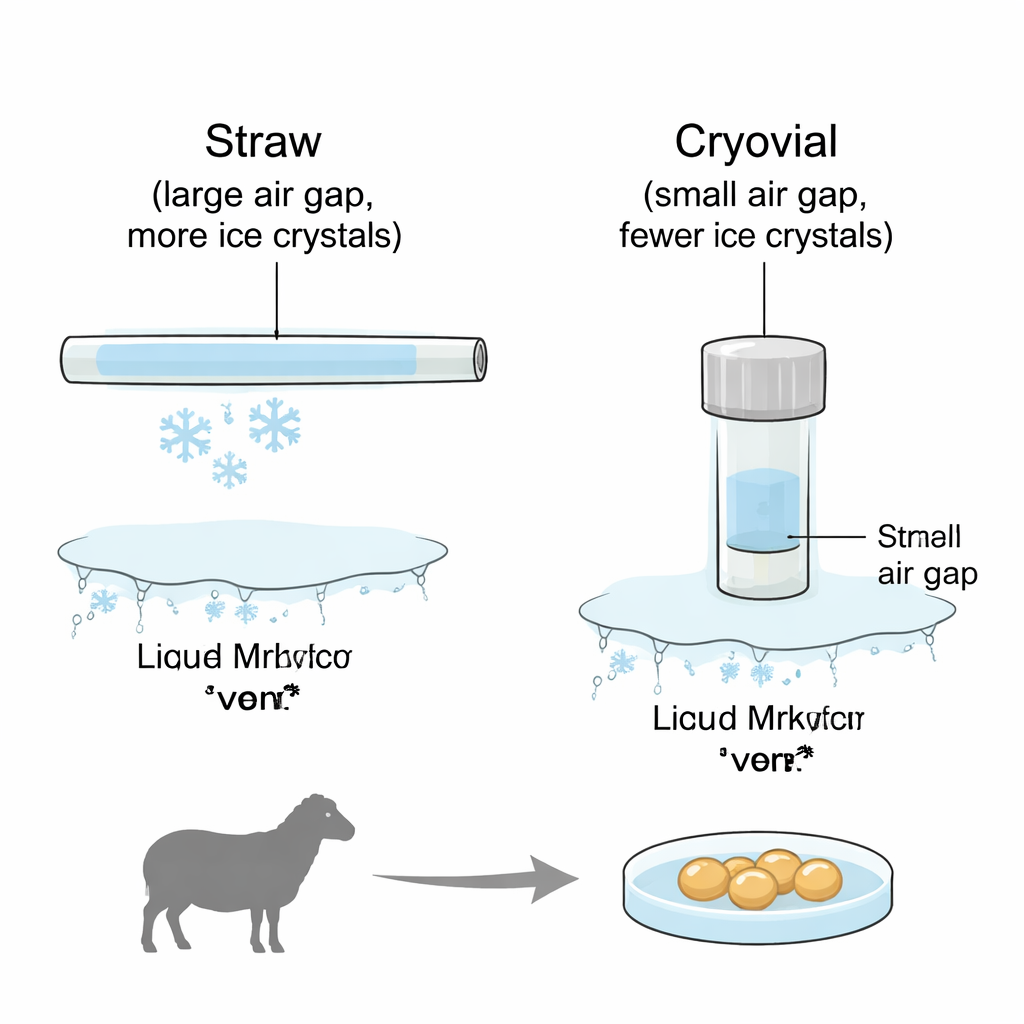
Why the Shape of the Container Matters
When semen is frozen, water inside and around sperm cells can form ice crystals, which act like tiny knives, tearing membranes and damaging DNA. The rate at which the sample cools, and how evenly it does so, depend strongly on the container’s shape and how much of its surface is exposed to the frigid nitrogen vapor. Thin straws present a large surface area compared with their volume, encouraging rapid and sometimes uneven cooling. Wider cryovials, especially when held upright, expose less of the semen directly to the cold, and gravity helps the sperm settle to the bottom, creating only a small air gap above the liquid. The authors hypothesized that this smaller air gap and lower surface area-to-volume ratio would slow ice crystal formation enough to protect more sperm.
Testing Straws Versus Vials in the Freezer
To put this idea to the test, researchers collected semen from healthy rams and diluted it in a standard protective solution. They then packaged the samples into three container types: narrow 0.25 mL straws, and two sizes of cryovials (0.5 mL and 1.5 mL). The straws were frozen either in a programmable bio-freezer in a vertical position, or above liquid nitrogen (LN₂) vapor in a horizontal position. The cryovials were frozen only in LN₂ vapor and always kept vertical. After at least three days of storage in liquid nitrogen, the samples were gently thawed and examined for how well the sperm were moving, how intact their membranes and acrosomes (the cap-like structure needed to penetrate the egg) remained, how many were still alive, and how much damaging “reactive oxygen species” had built up inside them.
How the Sperm Fared After Thawing
The differences were striking. Sperm stored in cryovials and frozen upright in nitrogen vapor consistently outperformed those frozen in straws, no matter how the straws were cooled. In the cryovials, a much higher proportion of sperm remained motile, swam faster and more directly, and retained healthy membranes and acrosomes. Many more cells were alive after thawing, and they showed lower levels of harmful reactive oxygen species, which are chemically reactive molecules that can damage cell components. Among the straw-based methods, horizontally placed straws above LN₂ did better than straws frozen vertically in the programmable freezer, but both were clearly inferior to cryovials. Interestingly, the two cryovial sizes gave very similar results, suggesting that once the air gap and overall geometry are favorable, fine-tuning the volume matters less.
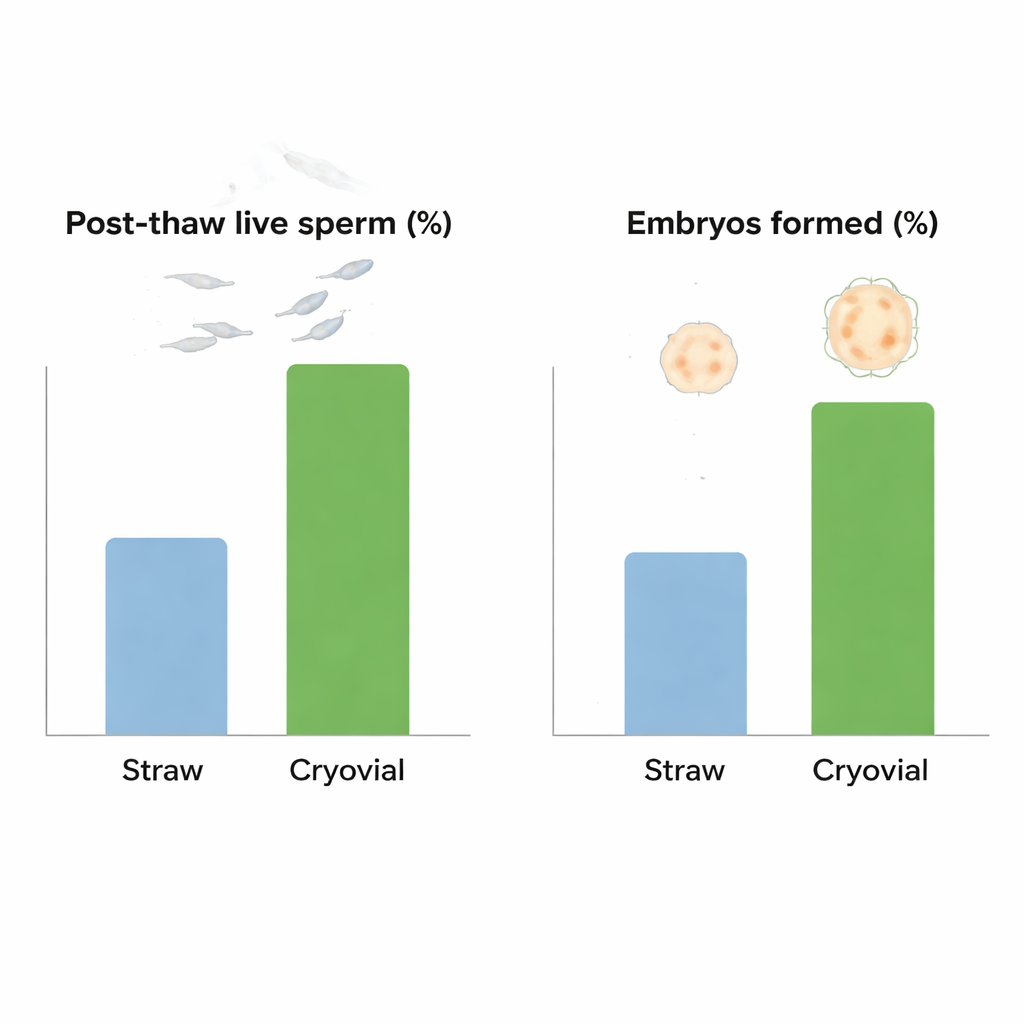
From Frozen Sperm to Living Embryos
Beyond cell-level measurements, the key question is whether these frozen-thawed sperm can actually create embryos. To find out, the team used eggs collected from slaughterhouse sheep ovaries and performed in vitro fertilization in the lab. Sperm from cryovials produced more developing embryos at each stage—first cleavage, then compacted balls of cells (morulae), and finally early blastocysts—than sperm from any straw-based method. While fresh semen remained the gold standard, cryovial-frozen samples came closer to this ideal, whereas straw-frozen semen, especially from the programmable freezer, yielded far fewer embryos.
What This Means for Breeding Programs
For a non-specialist, the takeaway is that something as simple as the container and its position in the freezer can greatly influence whether frozen sheep semen remains useful for making embryos. Upright cryovials create a smaller air gap and reduce ice crystal damage, leading to more vigorous sperm and more embryos in lab conditions. Standard straws, although convenient for large-scale artificial insemination, appear to subject sperm to harsher freezing conditions, with more cell damage and lower embryo yields. The study suggests that when the goal is to maximize the number of healthy embryos in vitro—for example, to preserve rare breeds or rapidly multiply valuable genetics—freezing semen in vertical cryovials may be a simple but powerful improvement over traditional straw-based methods.
Citation: Karimpat, A., Atreya, S., Mishra, A. et al. Cryovial versus straw for sheep semen cryopreservation: a comparative study of surface area-to-volume ratio on post-thaw viability and in vitro embryo production. Sci Rep 16, 7199 (2026). https://doi.org/10.1038/s41598-026-38062-0
Keywords: sheep reproduction, semen freezing, cryopreservation methods, embryo production, livestock genetics