Clear Sky Science · en
Primordial germ cell-like cells residing in the pituitary may serve as the origin of intracranial germ cell tumors
Hidden Seeds of Brain Tumors
Most people think of brain tumors as starting from brain cells themselves. This study explores a more surprising possibility: that some rare childhood brain tumors may actually arise from cells in the pituitary gland that behave a bit like reproductive germ cells—the cells that normally give rise to sperm or eggs. Understanding where these tumors come from could eventually lead to faster diagnosis and more targeted treatments for affected children and teenagers.
A Rare but Puzzling Group of Tumors
Intracranial germ cell tumors are uncommon brain tumors that mostly strike children and adolescents. They tend to appear along the midline of the brain, especially near the pineal gland and the region that includes the hypothalamus and pituitary. Doctors have long noticed some odd patterns: these tumors are much more common in boys when they arise in the pineal region, and their frequency varies several-fold between different parts of the world. Despite decades of study, scientists still debate where these tumors originate—do they come from reproductive germ cells that strayed into the brain during early development, or from very early embryonic cells that went off course?
A New Suspect Inside the Pituitary
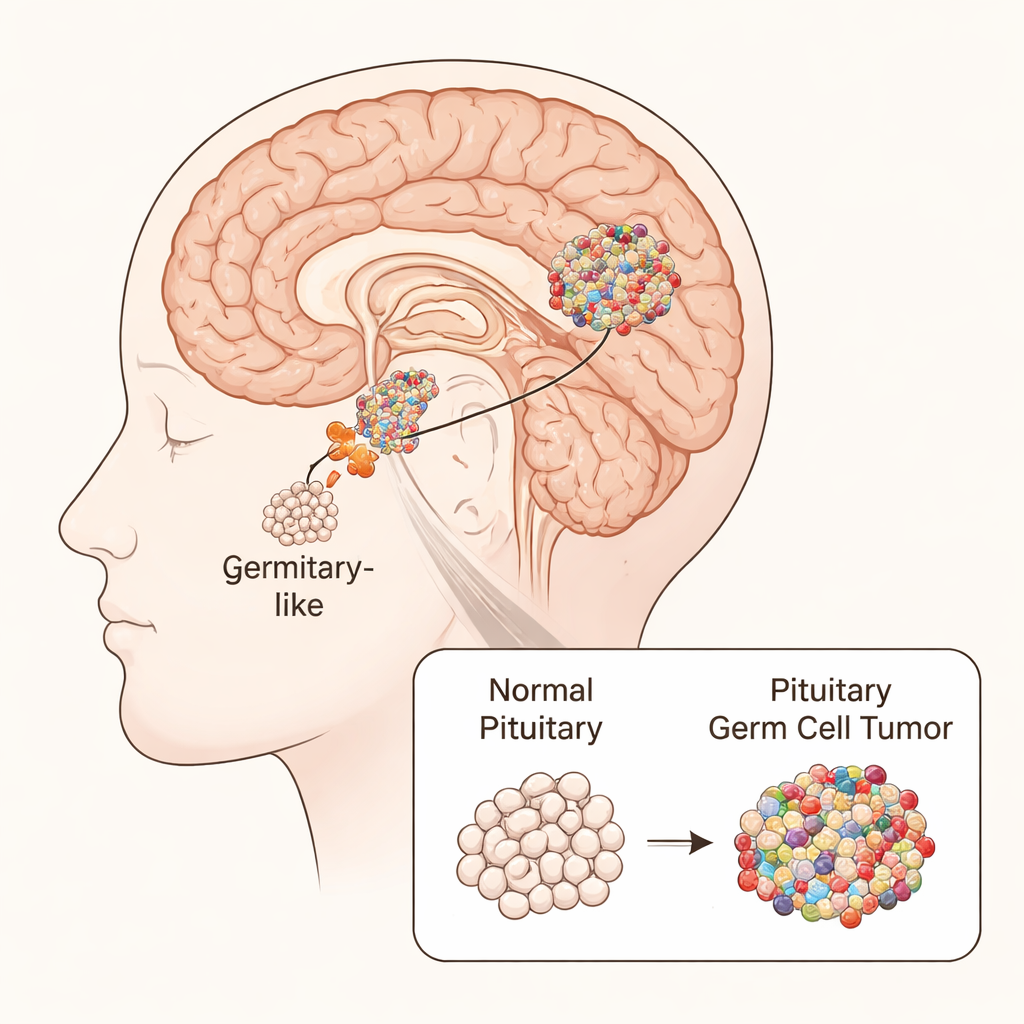
The authors propose a third, complementary idea: that the pituitary gland itself may harbor a tiny population of cells that resemble early germ cells in some of their molecular traits. The pituitary sits at the base of the brain and acts as a hormonal command center, constantly adjusting its cell makeup throughout life to match the body’s changing needs. Building on recent work showing stem-like cells in the pituitary, the researchers wondered whether a few of these cells might also carry “germ cell–like” features and, under certain conditions, become the starting point for germ cell tumors arising near the pituitary.
Looking for Germ Cell Signatures
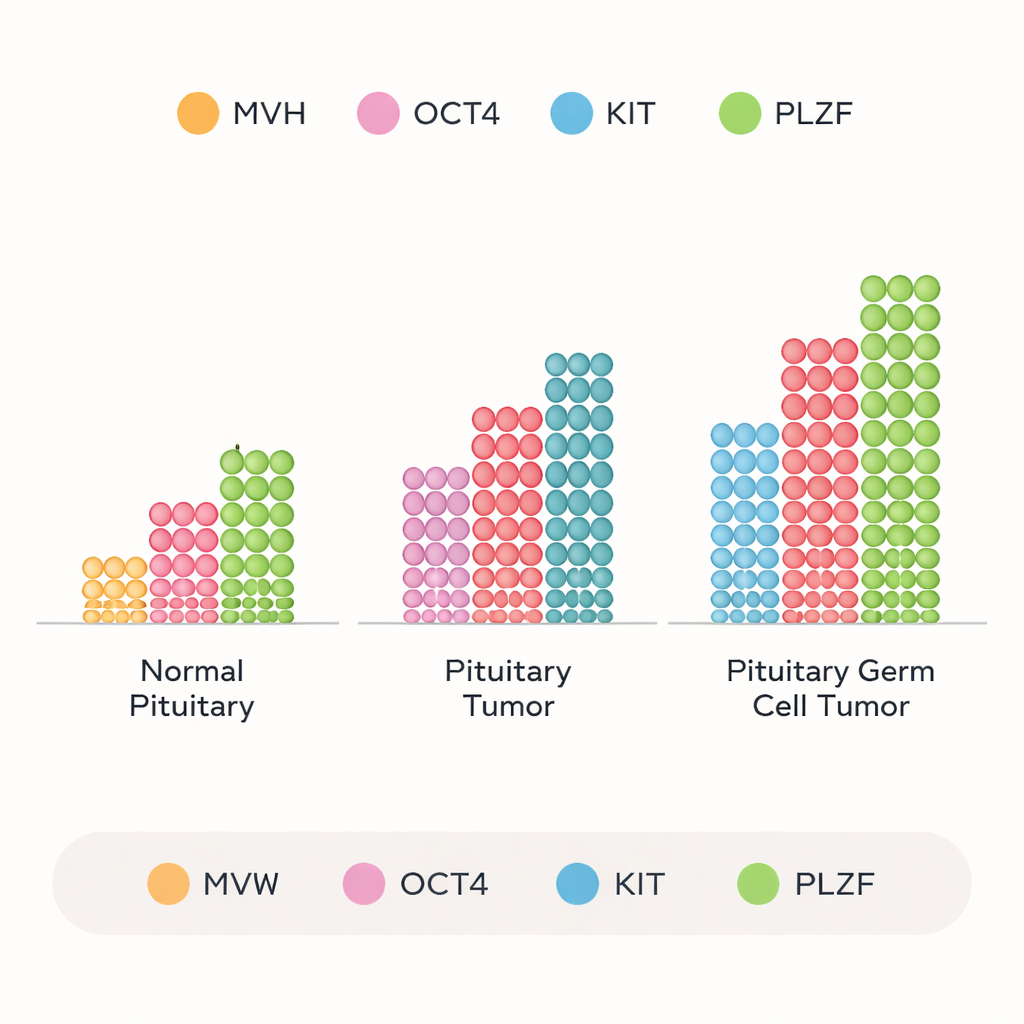
To test this idea, the team examined human pituitary tissue from surgery patients, along with pituitary tumors and pituitary-region germ cell tumors. They focused on four proteins that are well known markers of germ cells: MVH (also called DDX4), OCT4, KIT, and PLZF. Using three complementary techniques—microscopic staining, protein gel analysis, and gene expression measurements—they asked a simple question: are these germ cell markers present in the pituitary, and if so, how strongly are they expressed?
Stronger Signals in Tumors
The answer was yes. All four germ cell markers were detectable in normal human pituitary tissue, suggesting the presence of cells with at least some germ cell–like properties. The signals grew stronger in pituitary tumors and were highest in pituitary-region germ cell tumors. Although the levels of RNA and protein did not line up perfectly for every marker—a reminder that cells regulate gene activity in complex ways—the overall pattern was consistent: from normal pituitary to pituitary tumor to germ cell tumor, germ cell markers generally increased. These trends held across the different laboratory methods, reinforcing the idea that germ cell–associated programs are active in the pituitary.
From Hormone Control to Cancer Risk
Finding germ cell markers in normal pituitary tissue does not mean that these cells are already cancerous. Intracranial germ cell tumors remain rare, which suggests that additional genetic changes, epigenetic shifts, and environmental or hormonal cues are needed before a tumor forms. The authors point to the hypothalamic–pituitary–gonadal axis—the hormone circuit that links the brain, pituitary, and reproductive organs—as a likely influence. Because this system is especially active and changing during puberty, it could help explain why these tumors appear most often in young people and show distinct patterns by sex.
What This Could Mean for Patients
For nonspecialists, the key takeaway is that the pituitary gland may house a small population of cells that look and act a bit like early germ cells, and that these cells might, under the wrong conditions, give rise to certain brain tumors. This idea complements, rather than replaces, older theories about stray germ cells or early embryonic cells. If confirmed by future single-cell and functional studies, it could sharpen how doctors distinguish pituitary tumors from germ cell tumors near the same region, and could eventually guide therapies that target the specific molecular pathways—such as KIT and OCT4 networks—that help these unusual cells tip from normal hormonal helpers into dangerous tumor precursors.
Citation: Zhang, Y., Zhang, L., Shen, Z. et al. Primordial germ cell-like cells residing in the pituitary may serve as the origin of intracranial germ cell tumors. Sci Rep 16, 7086 (2026). https://doi.org/10.1038/s41598-026-38060-2
Keywords: intracranial germ cell tumors, pituitary gland, primordial germ cell-like cells, brain tumors in children, germ cell markers