Clear Sky Science · en
Exploring gene expression as a sublethal endpoint in gammarids exposed to pesticides: insights from next-generation sequencing
Why tiny stream creatures matter
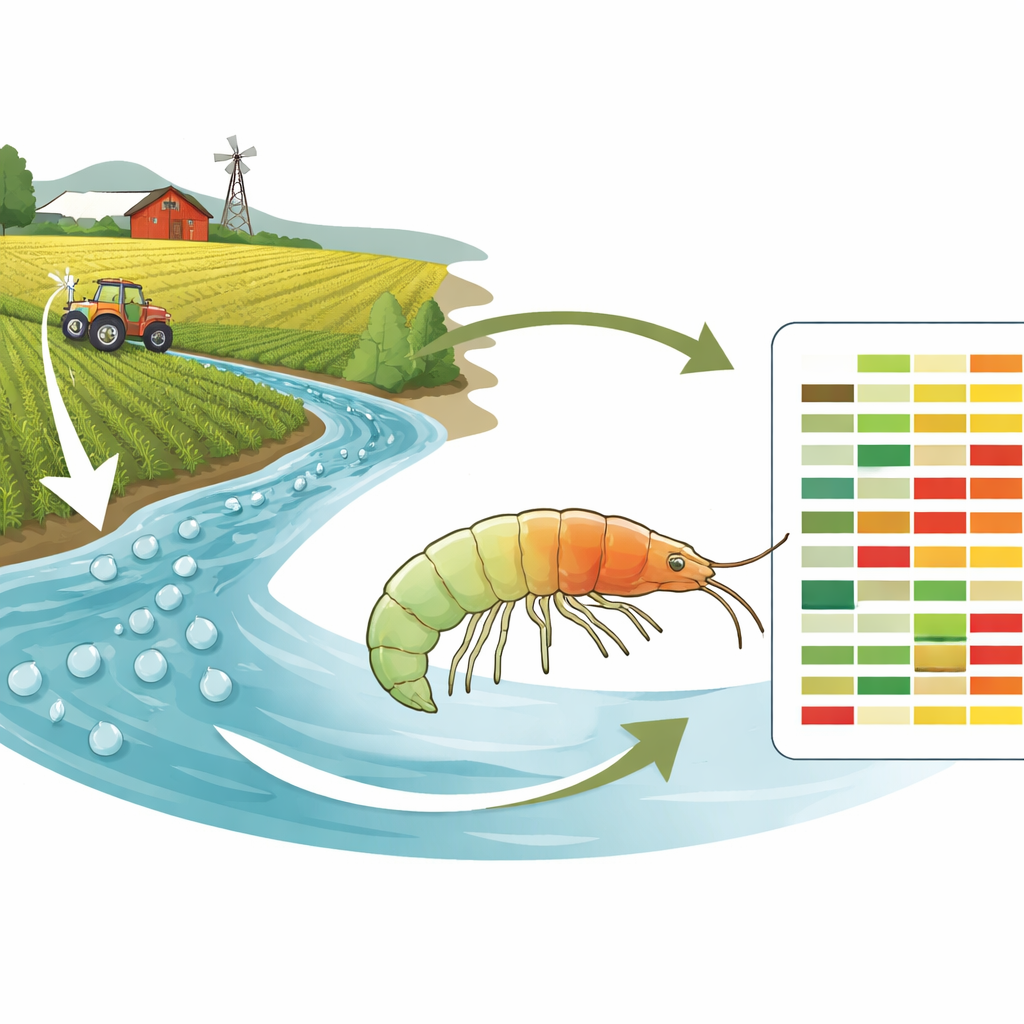
Pesticides sprayed on fields do not always stay where they are meant to. Rain and runoff can wash small amounts into nearby streams, where they may not kill animals outright but can still disturb their inner workings. This study focuses on gammarids—small shrimp-like crustaceans that are key recyclers of dead leaves in European streams—and asks a simple question: can we detect subtle, early warning signs of pesticide stress by looking at changes in their gene activity, long before we see dead animals or collapsed ecosystems?
From farm fields to freshwater life
Across Europe, low levels of many pesticides are regularly found in rivers and streams, sometimes at concentrations that pose a risk of chronic harm to aquatic life. Gammarids sit at the center of these ecosystems: they break down fallen leaves, help keep streams clean, and serve as food for fish and other animals. Because they are both ecologically important and sensitive to pollution, they are widely used as “canaries in the coal mine” for freshwater health. Until now, most studies have tracked visible signs of stress in gammarids such as reduced feeding or altered movement. These are useful but hard to measure directly in wild populations, which is where early warning tools are most needed.
Reading the hidden signals inside cells
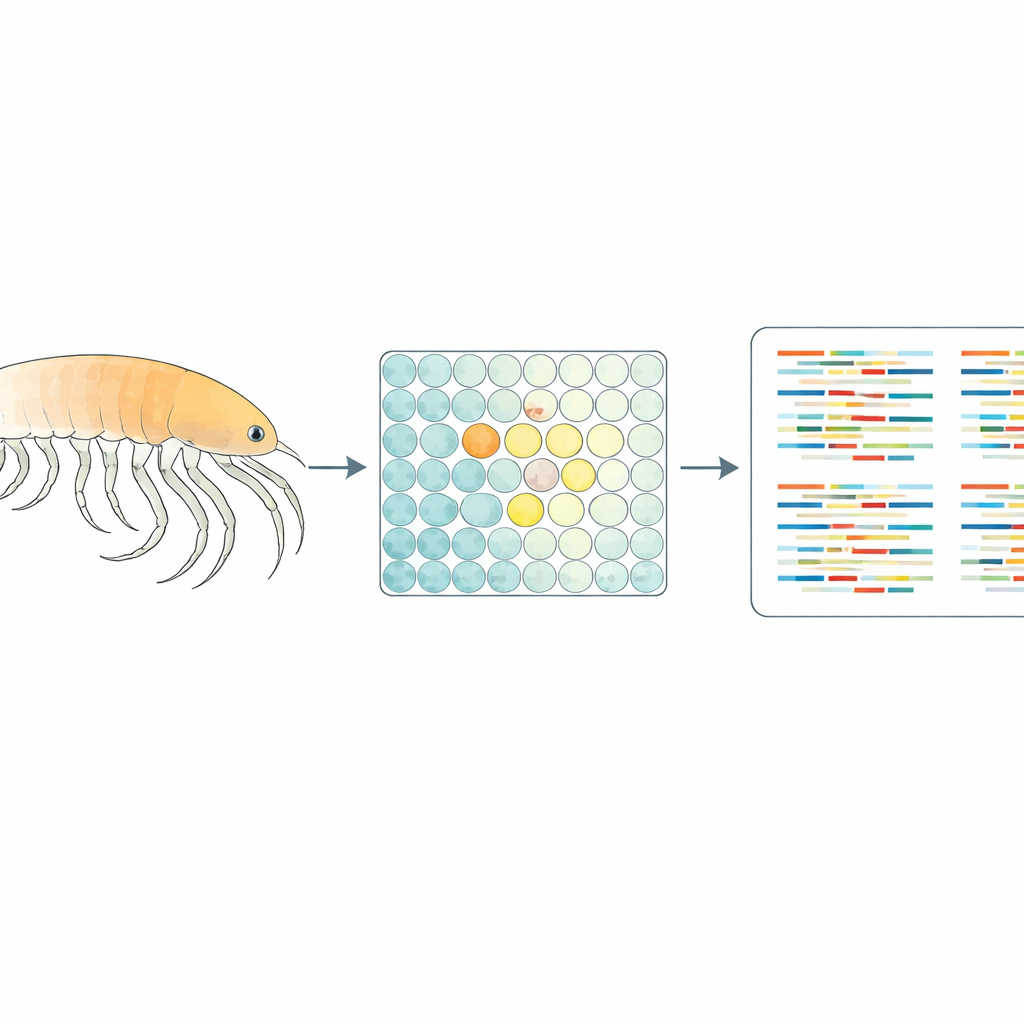
The researchers explored a more microscopic approach by examining gene expression—the on–off activity pattern of thousands of genes inside cells. They caught male gammarids from a relatively clean stream in Germany and brought them into the lab. There, the animals were exposed for 24 hours to low, non-lethal doses of two common pesticides: acetamiprid, a widely used insecticide, and azoxystrobin, a fungicide. Instead of looking for deaths or obvious behavioral changes, the team extracted RNA, the molecule that reflects which genes are active, and used next-generation sequencing to capture a snapshot of gene activity across the entire genome.
What changed when pesticides were present
The sequencing experiments revealed that pesticide exposure did indeed trigger shifts in gene activity. Depending on the pesticide and the experimental run, roughly 150 to 300 gene transcripts showed altered expression compared with unexposed controls. When the researchers grouped these genes by broad biological roles, many pointed to changes in metabolism, cell growth, and cell differentiation. In some cases, there were hints that energy production and developmental processes were being dialed down, suggesting that the animals may be diverting resources away from growth and maintenance toward coping with stress. For azoxystrobin, genes linked to energy-producing structures in cells and sugar processing pathways appeared to be affected, in line with earlier work showing that this fungicide can interfere with how gammarids obtain and use energy.
Surprising variability behind the scenes
However, the story turned out to be less straightforward than a simple “pesticide equals clear molecular fingerprint.” The researchers repeated the entire exposure and sequencing experiment a second time, using new gammarids taken from the same stream just 12 days later. Although the same pesticides and concentrations were used, the detailed gene expression patterns changed markedly between the two runs. Only a handful of gene transcripts responded in a similar way both times, and broader pattern analyses showed that differences between the two gammarid batches were as large as, or larger than, the differences between treated and untreated animals. This suggests that natural genetic diversity, prior environmental history, and other subtle factors in wild populations can strongly shape molecular responses, even under carefully controlled lab conditions.
Challenges and promise for better water tests
These findings highlight both the power and the current limitations of using gene expression as a sublethal warning signal in non-model species like gammarids. On the one hand, the study demonstrates that next-generation sequencing can be applied successfully to these small crustaceans and that short-term pesticide exposures can leave a detectable imprint on their gene activity. On the other hand, incomplete knowledge of their genomes and high natural variability made it difficult to pinpoint a consistent set of “stress marker” genes that could be reliably used across time or locations. The authors conclude that, with better genetic reference data, more standardized ways of keeping and breeding gammarids, and perhaps slightly stronger or longer exposures, gene-based tools could eventually complement traditional toxicity tests. For now, gene expression patterns provide a promising but still experimental lens on how everyday levels of pesticides may be nudging freshwater life away from healthy functioning, long before obvious damage appears.
Citation: Züger, D., Kolvenbach, B., Hettich, T. et al. Exploring gene expression as a sublethal endpoint in gammarids exposed to pesticides: insights from next-generation sequencing. Sci Rep 16, 7890 (2026). https://doi.org/10.1038/s41598-026-38052-2
Keywords: pesticide pollution, freshwater invertebrates, gene expression, RNA sequencing, ecological risk assessment