Clear Sky Science · en
Mechanical characterization of PETG – carbon fiber composite parts using 3D printing for drone frame application
Why stronger, cheaper drones matter
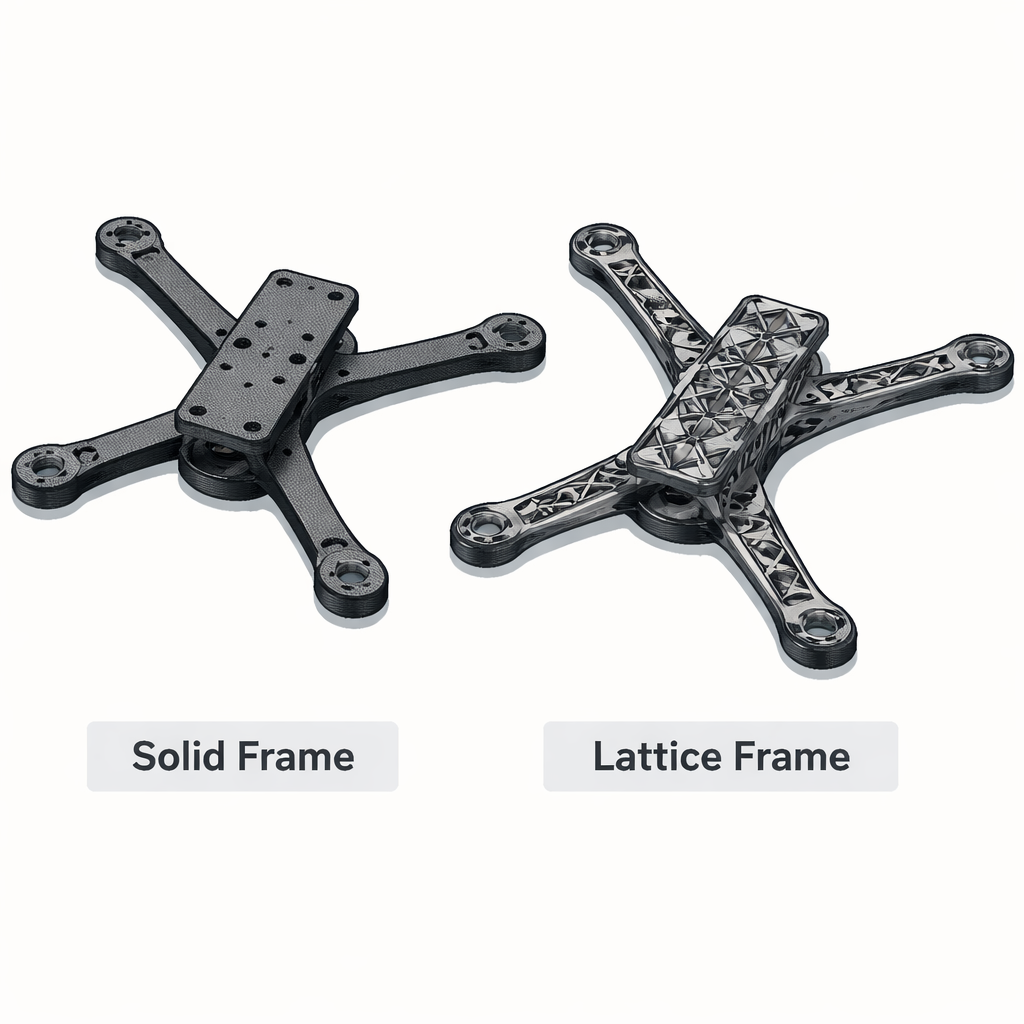
Small drones are now used for everything from filming and farming to search‑and‑rescue. But their frames are often made from costly, fragile materials that can crack in hard landings. This study explores whether we can 3D‑print tough, lightweight drone frames from an inexpensive plastic reinforced with carbon fibers—and how the hidden internal “skeleton” of the print can be tuned to survive crashes better than today’s designs.
Building a better plastic for flying machines
The researchers focused on PETG, a common 3D‑printing plastic known for being tougher and more heat‑resistant than the popular PLA used in hobby printers. By mixing PETG with short carbon fibers, they created a stiffer, stronger material that still prints reliably. The goal was to turn this low‑cost filament into a realistic alternative to traditional carbon‑fiber plates, which are light but expensive and can fail suddenly under impact—an issue for drones that may hit the ground more often than we like to admit.
The hidden geometry inside a print
When an object is 3D‑printed, it is usually not solid; instead, software fills its interior with a repeating pattern called infill. This pattern acts like the trusses inside a bridge, carrying loads while saving material. From an initial list of 21 possibilities, the team chose five promising patterns that are widely available in desktop printers: Tri‑Hexagon, Triangle, Support Cubic, Rectilinear (straight lines), and Quarter Cubic. They printed standard test pieces from PETG–carbon fiber using each pattern at the same density, then measured how well they stretched, wore down, absorbed impact, and resisted surface indentation.
Strength versus crash survival
The tests revealed that no single pattern is “best” for everything. Rectilinear infill, with its straight, continuous strands, delivered the highest tensile strength and the lowest wear: it was hardest to pull apart and held up best when rubbed under increasing loads. Quarter Cubic and Triangle were close behind. In contrast, the Support Cubic lattice was weaker in pure pull tests and wore faster, but it excelled when struck suddenly. Its three‑dimensional web of struts could bend and crush in stages, soaking up over three times more impact energy than some other patterns. Hardness tests showed Tri‑Hexagon and Rectilinear were the stiffest at the surface, again highlighting how internal geometry changes the way the same material behaves.
Letting software redesign the frame
Armed with these results, the authors chose the Support Cubic pattern for a full drone frame because crash resistance matters more than raw pulling strength in flight mishaps. They then turned to generative design software: instead of drawing the frame by hand, they told the program where motors and electronics must attach, where propellers and wiring must stay clear, what loads the frame should survive, and that it would be printed from PETG–carbon fiber. The software searched thousands of options and produced a skeletal, organically shaped frame that used less material than a simple “plus‑shaped” design while keeping stresses and bending within safe limits.
Putting new frames to the drop test
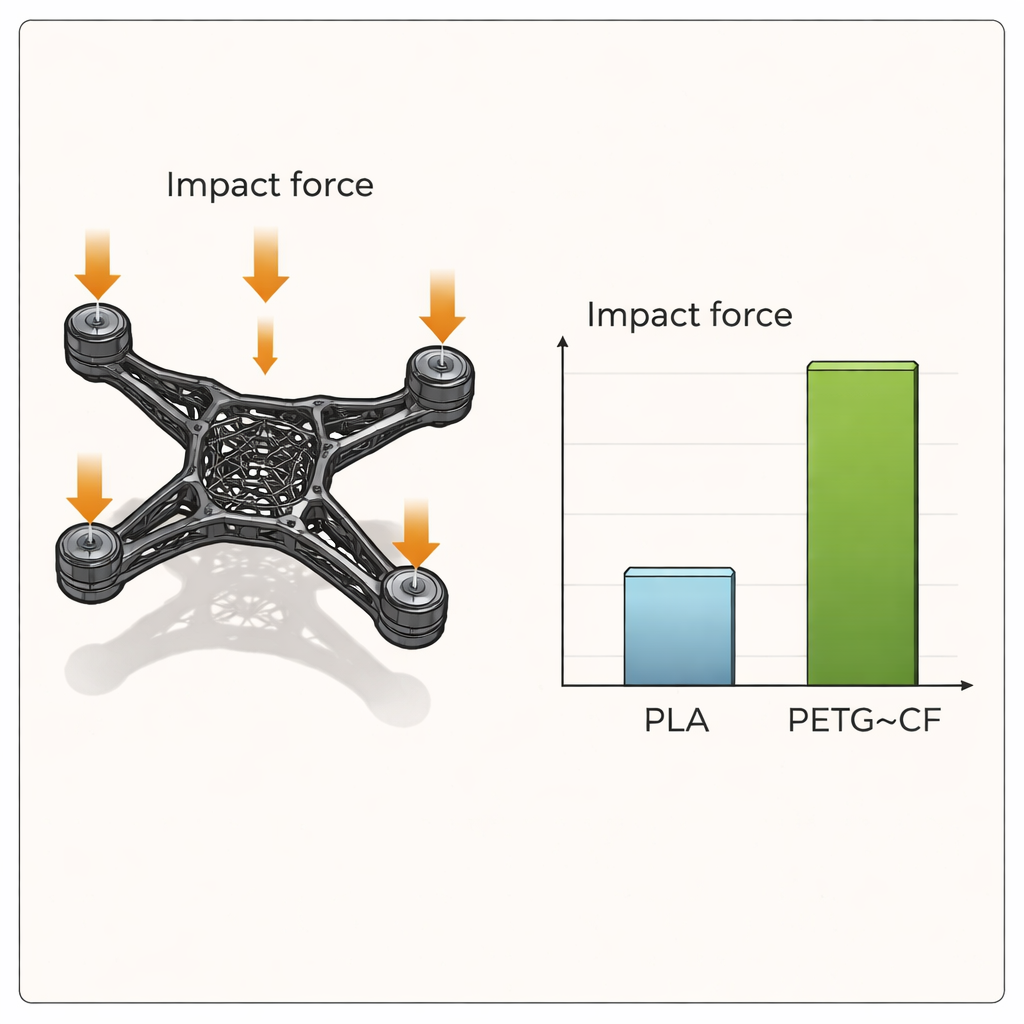
To see if the virtual gains held up in reality, the researchers 3D‑printed the optimized PETG–carbon fiber frame and compared it with a more conventional PLA frame of similar size. Both were dropped from increasing heights onto a flat surface. The PLA frame showed internal damage at 9 meters, while the PETG–carbon fiber frame survived that height with only light scratches and did not suffer a structural break until 12 meters. Computer simulations of stress, strain, and deflection supported these observations, indicating that the new frame spreads loads efficiently and bends only slightly under heavy forces.
What this means for everyday drones
For non‑specialists, the takeaway is clear: by carefully choosing the internal pattern and letting design software carve away unneeded material, a common 3D‑printing plastic reinforced with carbon fiber can rival, and in some crash scenarios outperform, traditional carbon‑fiber drone frames. That could make future drones cheaper to build, more forgiving of rough landings, and easier to customize for specific tasks—all using equipment that fits on a desktop.
Citation: Palaniappan, M., Kumar, P.M., Arunkumar, P. et al. Mechanical characterization of PETG – carbon fiber composite parts using 3D printing for drone frame application. Sci Rep 16, 6938 (2026). https://doi.org/10.1038/s41598-026-38051-3
Keywords: 3D printed drones, carbon fiber composites, PETG filament, infill pattern design, generative design